Massoud Rana I, Bouaziz Mohamed, Abdallah Hiba, Zeiz Ali, Flamini Guido, El-Dakdouki Mohammad H
Department of Chemistry, Faculty of Science, Beirut Arab University, P.O. Box 11-5020, Riad El Solh, Beirut 11072809, Lebanon.
Laboratory of Electrochemistry and Environment, National School of Engineers of Sfax, University of Sfax, Sfax BP117 33038, Tunisia.
ACS Omega. 2024 Jul 4;9(28):30244-30255. doi: 10.1021/acsomega.4c00313. eCollection 2024 Jul 16.
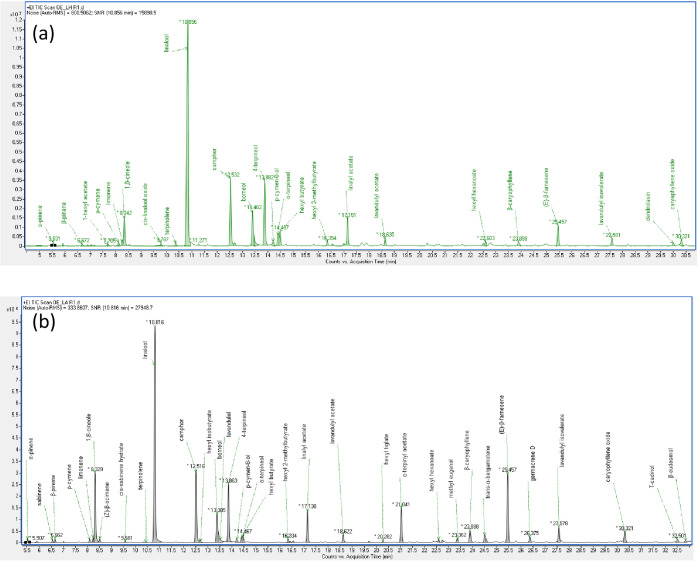
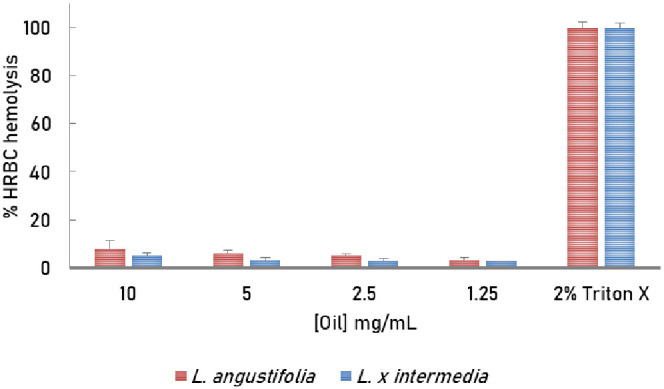
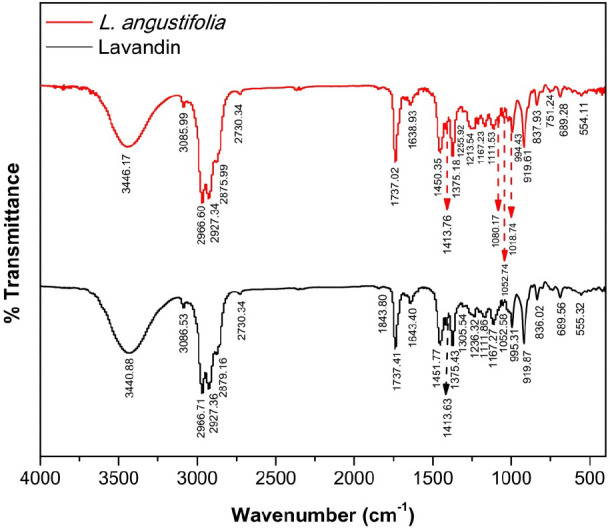
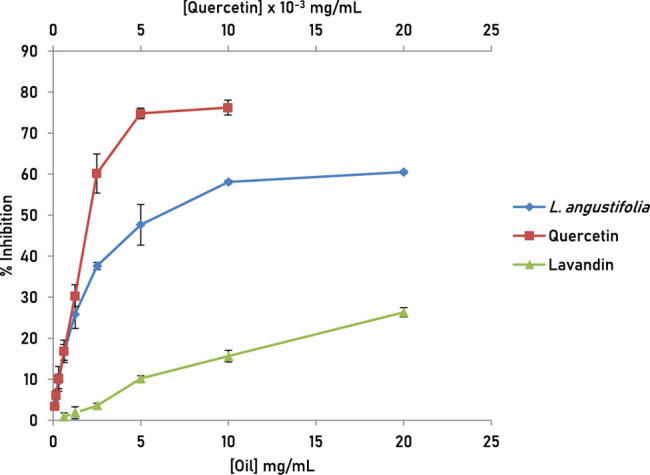
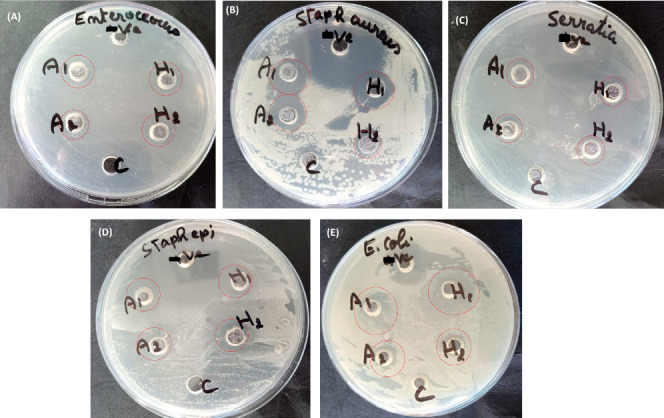
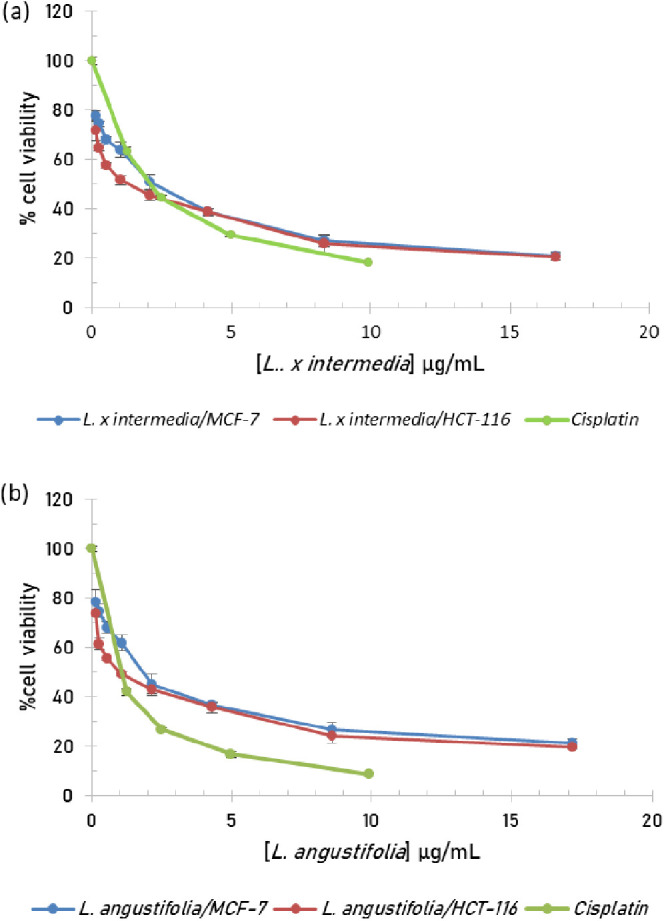
The phytochemical profile of essential oils is influenced by genetic and paragenetic factors. In this research, we studied the essential oils of and cultivated in Lebanon. The latter is a cross hybrid between and and is also known as lavandin and . Specifically, the chemical composition and biological activities (antibacterial, antioxidant, anticancer, and hemolytic) of the essential oils were assessed. GC-MS results showed marked differences in the chemical compositions of the oils. For example, linalool was more abundant in (44.15%) than in (32%), while an opposite trend was observed for the percentages of 1,8-cineole (8.6% in and 4.0% in ). FTIR analysis confirmed the richness of both oils in monoterpenes and sesquiterpenes. In terms of antioxidant activity, essential oil demonstrated significantly better activity (IC= 5.24 ± 1.20 mg/mL) compared to oil in the DPPH radical scavenging assay. MTT cell viability assays revealed that essential oil was a slightly more potent antiproliferative agent than oil on human colorectal (HCT-116) and human breast (MCF-7) cancer cells. The antibacterial activity of the essential oils was tested against , , , , and . Both oils showed good antibacterial activities with MIC values of 0.174 and 0.169 mg/mL for and oils, respectively. MBC determinations revealed that the antibacterial activity was bactericidal against all bacteria, except . Furthermore, both essential oils did not exhibit notable hemolytic activity on red blood cells. Overall, Lebanese and essential oils have promising industrial and medicinal values.
精油的植物化学特征受遗传和共生因素影响。在本研究中,我们对黎巴嫩种植的[具体品种1]和[具体品种2]的精油进行了研究。后者是[品种1]和[品种2]的杂交品种,也被称为杂薰衣草和[具体名称]。具体而言,对精油的化学成分和生物活性(抗菌、抗氧化、抗癌和溶血)进行了评估。气相色谱 - 质谱联用(GC - MS)结果显示,两种精油的化学成分存在显著差异。例如,芳樟醇在[品种1]中含量更高(44.15%),而在[品种2]中为32%,而1,8 - 桉叶素的百分比则呈现相反趋势(在[品种1]中为8.6%,在[品种2]中为4.0%)。傅里叶变换红外光谱(FTIR)分析证实两种精油中均富含单萜和倍半萜。在抗氧化活性方面,在二苯基苦味酰基自由基(DPPH)清除试验中,[品种1]精油表现出明显更好的活性(IC₅₀ = 5.24 ± 1.20 mg/mL),相比[品种2]精油。噻唑蓝(MTT)细胞活力测定显示,[品种1]精油对人结肠(HCT - 116)和人乳腺(MCF - 7)癌细胞的抗增殖作用略强于[品种2]精油。对精油的抗菌活性针对[具体细菌1]、[具体细菌2]、[具体细菌3]、[具体细菌4]和[具体细菌5]进行了测试。两种精油均表现出良好的抗菌活性,[品种1]精油和[品种2]精油的最低抑菌浓度(MIC)值分别为0.174和0.169 mg/mL。最低杀菌浓度(MBC)测定表明,除了[具体细菌]外,两种精油对所有测试细菌均具有杀菌活性。此外,两种精油对红细胞均未表现出明显的溶血活性。总体而言,黎巴嫩的[品种1]和[品种2]精油具有良好的工业和药用价值。