Poblete Roy A, Pena Jesus, Kuo Grace, Tarzi Fawaz, Nguyen Peggy L, Cen Steven Y, Yaceczko Shelby, Louie Stan G, Lewis Meghan R, Martin Matthew, Amar Arun P, Sanossian Nerses, Sung Gene, Lyden Patrick D
Department of Neurology, University of Southern California Keck School of Medicine, Los Angeles, California, USA.
Department of Radiology, University of Southern California Keck School of Medicine, Los Angeles, California, USA.
Neurotrauma Rep. 2024 Jun 19;5(1):574-583. doi: 10.1089/neur.2024.0005. eCollection 2024.
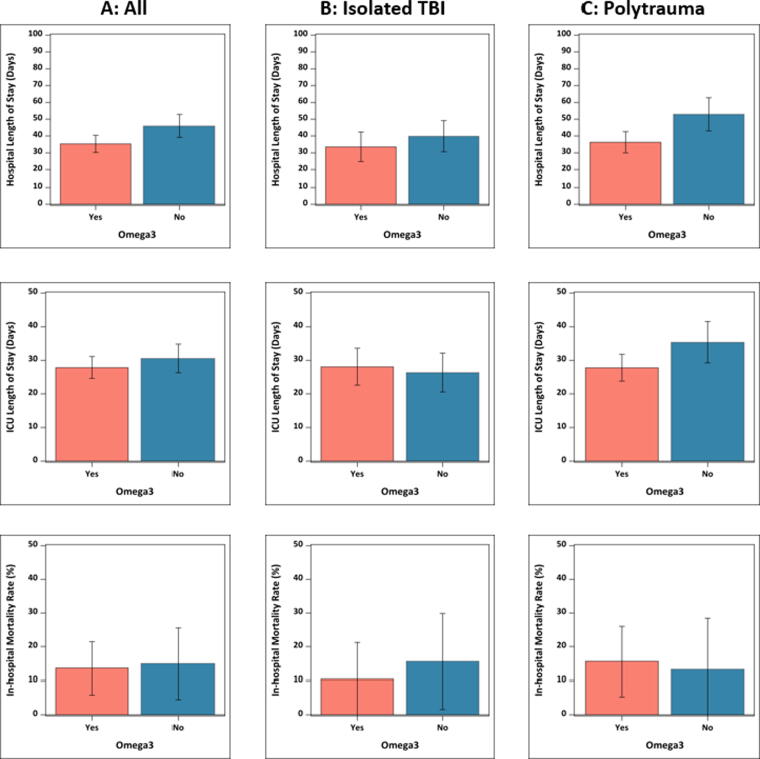
Early evidence-based medical interventions to improve patient outcomes after traumatic brain injury (TBI) are lacking. In patients admitted to the ICU after TBI, optimization of nutrition is an emerging field of interest. Specialized enteral nutrition (EN) formulas that include immunonutrition containing omega-3 polyunsaturated fatty acids (n-3 PUFAs) have been developed and are used for their proposed anti-inflammatory and proimmune properties; however, their use has not been rigorously studied in human TBI populations. A single-center, retrospective, descriptive observational study was conducted at the LAC + USC Medical Center. Patients with severe TBI (sTBI, Glasgow Coma Scale score ≤ 8) who remained in the ICU for ≥2 weeks and received EN were identified between 2017 and 2022 using the institutional trauma registry. Those who received immunonutrition formulas containing n-3 PUFAs were compared with those who received standard, polymeric EN with regard to baseline characteristics, clinical markers of inflammation and immune function, and short-term clinical outcomes. A total of 151 patients with sTBI were analyzed. Those who received immunonutrition with n-3 PUFA supplementation were more likely to be male, younger, Hispanic/Latinx, and have polytrauma needing non-central nervous system surgery. No differences in clinical markers of inflammation or infection rate were found. In multivariate regression analysis, immunonutrition was associated with reduced hospital length of stay (LOS). ICU LOS was also reduced in the subgroup of patients with polytrauma and TBI. This study identifies important differences in patient characteristics and outcomes associated with the EN formula prescribed. Study results can directly inform a prospective pragmatic study of immunonutrition with n-3 PUFA supplementation aimed to confirm the biomechanistic and clinical benefits of the intervention.
目前缺乏早期基于循证医学的干预措施来改善创伤性脑损伤(TBI)后的患者预后。在TBI后入住重症监护病房(ICU)的患者中,营养优化是一个新兴的研究领域。已开发出包含含ω-3多不饱和脂肪酸(n-3 PUFAs)的免疫营养的特殊肠内营养(EN)配方,并因其具有抗炎和免疫促进特性而被使用;然而,尚未在人类TBI人群中对其使用进行严格研究。在洛杉矶县+南加州大学医学中心进行了一项单中心、回顾性、描述性观察研究。使用机构创伤登记系统,在2017年至2022年期间确定了在ICU住院≥2周并接受EN的重度TBI(sTBI,格拉斯哥昏迷量表评分≤8)患者。将接受含n-3 PUFAs免疫营养配方的患者与接受标准聚合型EN的患者在基线特征、炎症和免疫功能的临床指标以及短期临床结局方面进行比较。共分析了151例sTBI患者。接受补充n-3 PUFA免疫营养的患者更可能为男性、更年轻、为西班牙裔/拉丁裔,并且有需要非中枢神经系统手术的多发伤。未发现炎症临床指标或感染率存在差异。在多因素回归分析中,免疫营养与住院时间(LOS)缩短相关。多发伤和TBI患者亚组的ICU住院时间也缩短。本研究确定了与所开具的EN配方相关的患者特征和结局的重要差异。研究结果可直接为一项旨在证实补充n-3 PUFA免疫营养的生物力学和临床益处的前瞻性实用性研究提供参考。