Kulig Kamila, Rapala-Kozik Maria, Karkowska-Kuleta Justyna
Department of Comparative Biochemistry and Bioanalytics, Faculty of Biochemistry, Biophysics and Biotechnology, Jagiellonian University, Gronostajowa 7, 30-387 Kraków, Poland.
Curr Res Microb Sci. 2024 Jun 22;7:100255. doi: 10.1016/j.crmicr.2024.100255. eCollection 2024.
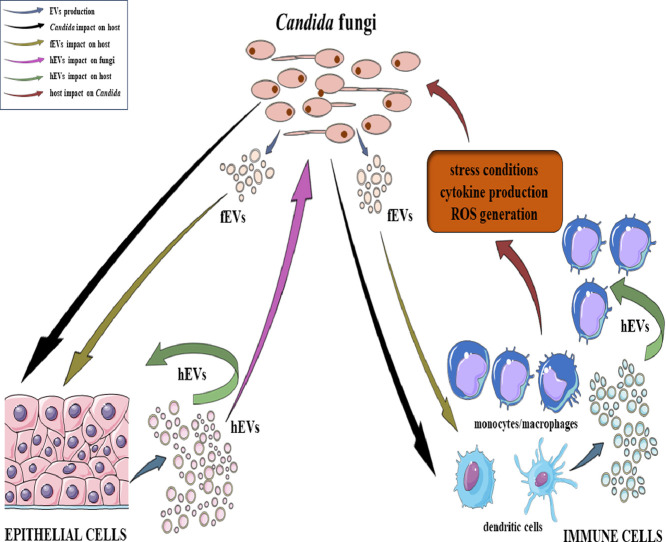
fungi exploit various virulence strategies to invade the human host, while host cells employ diverse mechanisms to maintain homeostasis and respond to infection. Extracellular vesicles (EVs) are integral components of the multifaceted landscape of host-pathogen interactions, with their abundant production by all contributors involved in these complex and dynamic relations. Herein, we present the current state of knowledge regarding the host response by releasing EVs in reaction to , as well as the influence of fungal EVs on the functionality of the confronted host cells. Fungal vesicles contribute to enhanced adhesion of pathogens to human cells as evidenced for , and may modulate the production of several cytokines, including IL-6, IL-8, IL-10, IL-12p40, TGF-β and TNF-α, thereby exerting pro-infective and pro-inflammatory effects, as described for and other species. Whereas the biosynthesis of EVs by host cells can dynamically modulate the proliferation and viability of fungal cells and affect the candidacidal functionality of other effector cells. The reciprocal influence of EVs from host cells and pathogens is a key focus, explaining their significant role in cell signaling and interkingdom communication.
真菌利用多种毒力策略侵入人体宿主,而宿主细胞则采用多种机制来维持体内平衡并应对感染。细胞外囊泡(EVs)是宿主 - 病原体相互作用多方面格局的重要组成部分,参与这些复杂动态关系的所有参与者都会大量产生细胞外囊泡。在此,我们阐述了关于宿主通过释放细胞外囊泡对 做出反应的当前知识状态,以及真菌细胞外囊泡对所接触的宿主细胞功能的影响。真菌囊泡有助于病原体增强对人类细胞的粘附,如 所示,并且可能调节多种细胞因子的产生,包括白细胞介素 - 6、白细胞介素 - 8、白细胞介素 - 10、白细胞介素 - 12p40、转化生长因子 - β和肿瘤坏死因子 - α,从而发挥促感染和促炎作用,如 及其他 物种所描述的那样。而宿主细胞产生细胞外囊泡的生物合成过程可动态调节真菌细胞的增殖和活力。宿主细胞和 病原体的细胞外囊泡之间的相互影响是一个关键焦点,这解释了它们在细胞信号传导和跨界通讯中的重要作用。