Flatiron Health, Inc, New York, NY, USA.
School of Public Health, Division of Health Policy and Management, University of California, Berkeley, Berkeley, CA, USA.
JNCI Cancer Spectr. 2024 Jul 1;8(4). doi: 10.1093/jncics/pkae060.
Expanding access to clinical trials in community settings is a potential approach to addressing disparities in accrual of historically underrepresented populations. However, little is known about the characteristics of practices that do not participate in research. We investigated differences in patient and practice characteristics of US community oncology practices with high vs low engagement in clinical research.
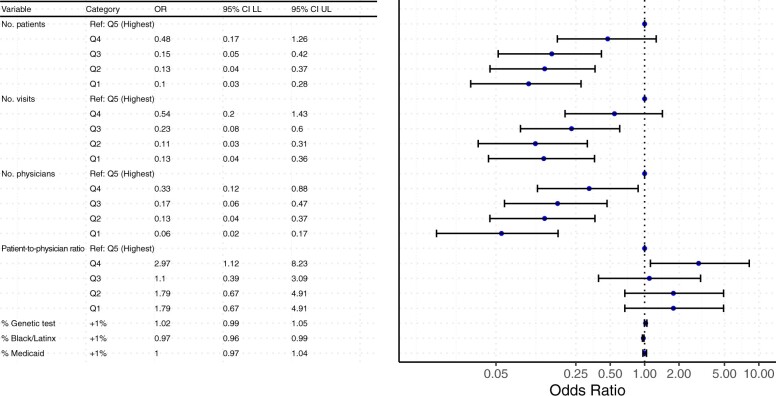
We included patients from a real-world, nationwide electronic health record-derived, de-identified database who received active treatment for cancer at community oncology practices between November 1, 2017, and October 31, 2022. We assessed patient and practice characteristics and their associations with high vs low research engagement using descriptive analyses and logistic regression models.
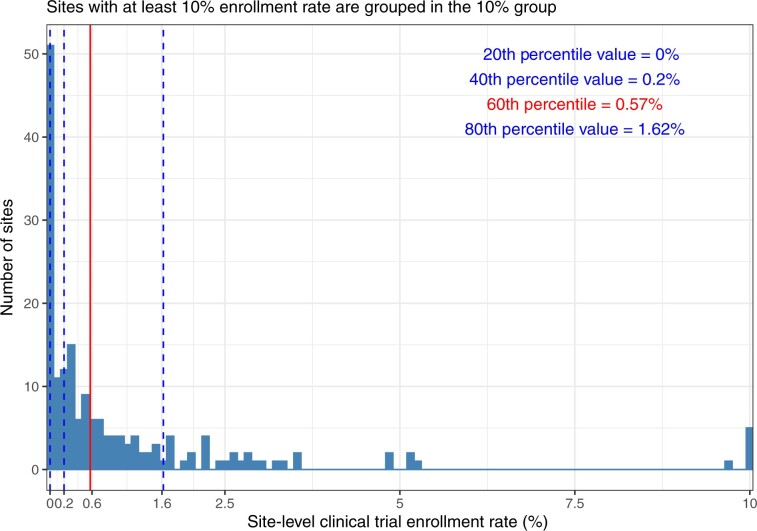
Of the 178 practices, 70 (39.3%) events had high research engagement, treated 57.8% of the overall 568 540 patient cohort, and enrolled 3.25% of their patients on cancer treatment trials during the 5-year observation period (vs 0.27% enrollment among low engagement practices). Practices with low vs high research engagement treated higher proportions of the following patient groups: ages 75 years and older (24.2% vs 21.8%), non-Latinx Black (12.6% vs 10.3%) or Latinx (11.6% vs 6.1%), were within the lowest socioeconomic status quintile (21.9% vs16.5%), and were uninsured or had no documented insurance (22.2% vs 13.6%).
Patient groups historically underrepresented in oncology clinical trials are more likely to be treated at community practices with limited or no access to trials. These results suggest that investments to expand the clinical research footprint among practices with low research engagement could help address persistent inequities in trial representation.
扩大社区环境中临床试验的可及性是解决历史上代表性不足人群入组率差异的一种潜在方法。然而,对于那些不参与研究的实践的特征,我们知之甚少。我们调查了美国社区肿瘤实践中,高参与度和低参与度临床研究的患者和实践特征差异。
我们纳入了 2017 年 11 月 1 日至 2022 年 10 月 31 日期间在社区肿瘤实践中接受癌症积极治疗的来自真实世界、全国性的电子健康记录衍生的、去标识化的数据库中的患者。我们使用描述性分析和逻辑回归模型评估患者和实践特征及其与高参与度和低参与度研究的关联。
在 178 个实践中,70 个(39.3%)事件具有高研究参与度,治疗了整个 568540 名患者队列的 57.8%,并在 5 年观察期内招募了其 3.25%的癌症治疗试验患者(而低参与度实践的招募率为 0.27%)。与高研究参与度实践相比,低研究参与度实践治疗了更高比例的以下患者群体:75 岁及以上(24.2% vs 21.8%)、非拉丁裔黑人(12.6% vs 10.3%)或拉丁裔(11.6% vs 6.1%)、处于最低社会经济地位五分位数(21.9% vs 16.5%)、没有保险或没有记录保险的(22.2% vs 13.6%)。
在肿瘤临床试验中代表性不足的患者群体更有可能在参与试验机会有限或没有的社区实践中接受治疗。这些结果表明,投资扩大低参与度实践的临床研究足迹可能有助于解决试验代表性方面的持续不平等问题。