Department of Occupational Medicine, Kaohsiung Chang Gung Memorial Hospital and Chang Gung University College of Medicine, Kaohsiung, Taiwan.
Department of Family Medicine, Kaohsiung Chang Gung Memorial Hospital and Chang Gung University College of Medicine, Kaohsiung, Taiwan.
Thorac Cancer. 2024 Aug;15(24):1805-1814. doi: 10.1111/1759-7714.15411. Epub 2024 Jul 24.
Organophosphate flame retardants (OPFRs) are extensively distributed in our environment, prompting concerns about potential health hazards, including lung injuries resulting from OPFR exposure.
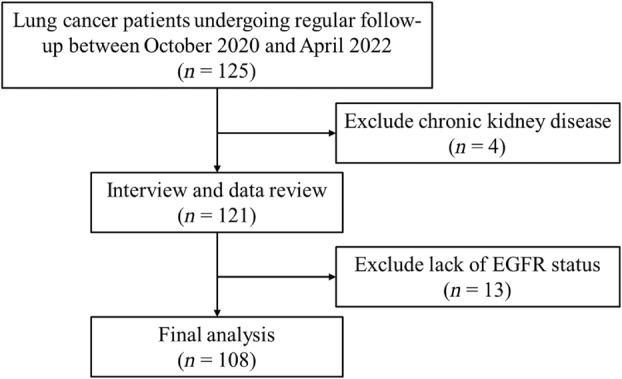
The present study recruited 125 lung cancer patients, assessing their exposure to 10 OPFR compounds through urine samples. The final analysis comprised 108 participants after excluding those lacking epidermal growth factor receptor (EGFR) status and those with chronic kidney disease. Demographic and clinical characteristics, as well as urinary OPFR concentrations, were compared based on OPFR detection. Spearman correlation was conducted to explore the relationship between OPFR compounds, while logistic regression was used to identify OPFR compounds associated with EGFR mutation.
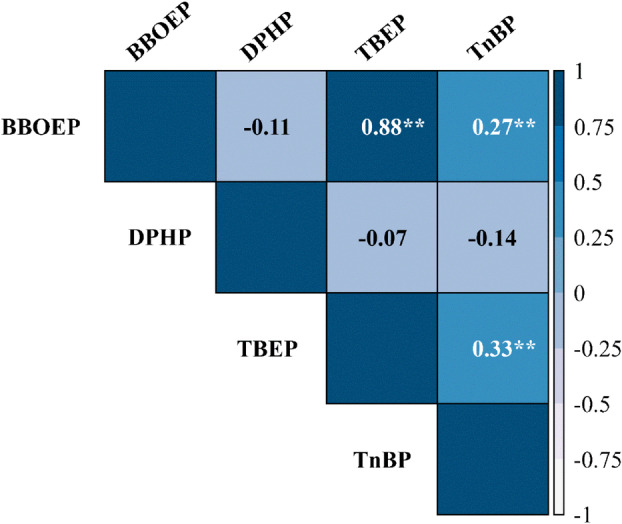
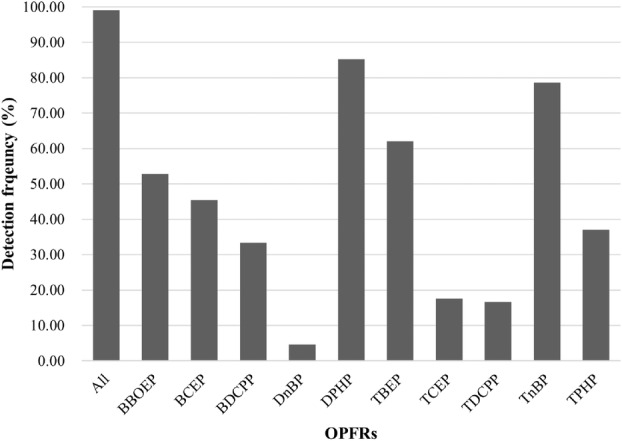
The study revealed widespread OPFR exposure among lung cancer patients, with an overall detection frequency of 99.07%. Tris(2-butoxyethyl) phosphate (TBEP) exhibited a strong correlation to its metabolite bis(2-butoxyethyl) phosphate (r = 0.88, p < 0.01). Patients with TBEP in their urine had higher percentage of wild-type EGFR and the detection of TBEP was associated with a reduced likelihood of mutant EGFR expression.
OPFR exposure was prevalent in lung cancer patients, with TBEP detection identified as a factor with lower EGFR mutation expression. This study contributes to the understanding of OPFR exposure in lung cancer patients and underscores the significance of TBEP in evaluating EGFR mutation in this population.
有机磷系阻燃剂(OPFRs)在环境中广泛分布,引起了对潜在健康危害的关注,包括 OPFR 暴露引起的肺部损伤。
本研究招募了 125 名肺癌患者,通过尿液样本评估他们接触的 10 种 OPFR 化合物。在排除缺乏表皮生长因子受体(EGFR)状态和慢性肾脏病的患者后,最终分析包括 108 名参与者。根据 OPFR 的检测结果比较了人口统计学和临床特征以及尿 OPFR 浓度。采用 Spearman 相关分析探讨了 OPFR 化合物之间的关系,采用逻辑回归分析鉴定与 EGFR 突变相关的 OPFR 化合物。
研究表明肺癌患者普遍存在 OPFR 暴露,总检出率为 99.07%。磷酸三(2-丁氧基乙基)酯(TBEP)与其代谢物双(2-丁氧基乙基)磷酸酯(bis(2-butoxyethyl) phosphate,BBOEP)之间存在很强的相关性(r=0.88,p<0.01)。尿液中含有 TBEP 的患者具有更高比例的野生型 EGFR,且 TBEP 的检测与突变型 EGFR 表达的可能性降低相关。
OPFR 暴露在肺癌患者中很普遍,TBEP 的检出被认为是 EGFR 突变表达较低的一个因素。本研究有助于了解肺癌患者中 OPFR 暴露的情况,并强调了 TBEP 在评估该人群 EGFR 突变中的重要性。