Plichta Veronika, Steinwider Johann, Vogel Nina, Weber Till, Kolossa-Gehring Marike, Murínová Lubica Palkovičová, Wimmerová Soňa, Tratnik Janja Snoj, Horvat Milena, Koppen Gudrun, Govarts Eva, Gilles Liese, Rodriguez Martin Laura, Schoeters Greet, Covaci Adrian, Fillol Clémence, Rambaud Loïc, Jensen Tina Kold, Rauscher-Gabernig Elke
Austrian Agency for Health and Food Safety(AGES), Division of Integrative Risk Assessment, Data & Statistics, Department of Risk Assessment, 1220 Vienna, Austria.
German Environment Agency (UBA), 06844 Dessau-Roßlau, Germany.
Toxics. 2022 May 3;10(5):234. doi: 10.3390/toxics10050234.
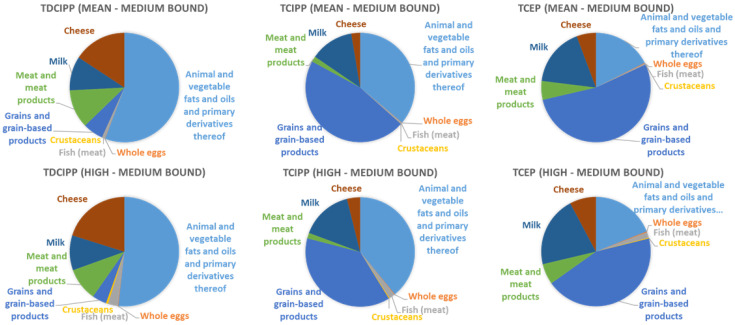
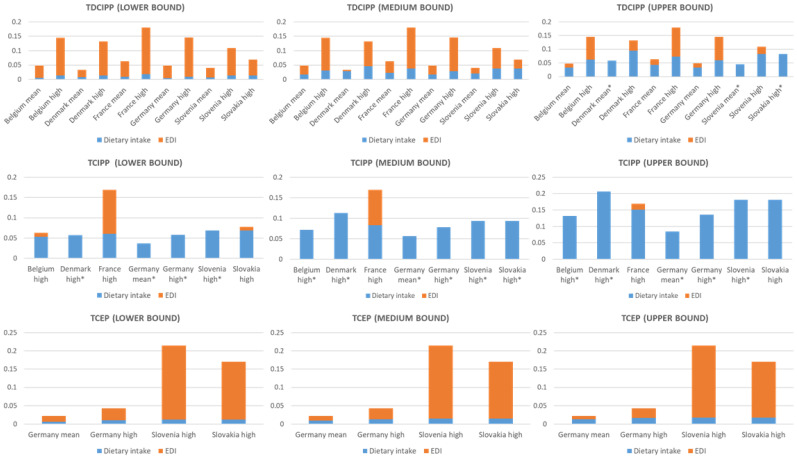
Due to their extensive usage, organophosphorus flame retardants (OPFRs) have been detected in humans and in the environment. Human are exposed to OPFRs via inhalation of indoor air, dust uptake or dietary uptake through contaminated food and drinking water. Only recently, few studies addressing dietary exposure to OPFRs were published. In this study, we used human biomonitoring (HBM) data of OPFRs to estimate how much the dietary intake may contribute to the total exposure. We estimated by reverse dosimetry, the daily intake of tris (2-chloroethyl) phosphate (TCEP), tris (1-chloro-2-propyl) phosphate (TCIPP), tris (1,3-dichloro-2-propyl) phosphate (TDCIPP) for children using HBM data from studies with sampling sites in Belgium, Denmark, France, Germany, Slovenia and Slovakia. For estimating the dietary exposure, a deterministic approach was chosen. The occurrence data of selected food categories were used from a published Belgium food basket study. Since the occurrence data were left-censored, the Lower bound (LB)-Upper bound (UB) approach was used. The estimated daily intake (EDI) calculated on the basis of urine metabolite concentrations ranged from 0.03 to 0.18 µg/kg bw/d for TDCIPP, from 0.05 to 0.17 µg/kg bw/d for TCIPP and from 0.02 to 0.2 µg/kg bw/d for TCEP. Based on national food consumption data and occurrence data, the estimated dietary intake for TDCIPP ranged from 0.005 to 0.09 µg/kg bw/d, for TCIPP ranged from 0.037 to 0.2 µg/kg bw/d and for TCEP ranged from 0.007 to 0.018 µg/kg bw/d (summarized for all countries). The estimated dietary intake of TDCIPP contributes 11-173% to the EDI, depending on country and LB-UB scenario. The estimated dietary uptake of TCIPP was in all calculations, except in Belgium and France, above 100%. In the case of TCEP, it is assumed that the dietary intake ranges from 6 to 57%. The EDI and the estimated dietary intake contribute less than 3% to the reference dose (RfD). Therefore, the estimated exposure to OPFRs indicates a minimal health risk based on the current knowledge of available exposure, kinetic and toxicity data. We were able to show that the dietary exposure can have an impact on the general exposure based on our underlying exposure scenarios.
由于其广泛使用,有机磷阻燃剂(OPFRs)已在人类和环境中被检测到。人类通过吸入室内空气、摄取灰尘或通过受污染的食物和饮用水进行饮食摄取而接触到OPFRs。直到最近,才发表了一些关于饮食中OPFRs暴露的研究。在本研究中,我们使用了OPFRs的人体生物监测(HBM)数据来估计饮食摄入量对总暴露量的贡献程度。我们通过反向剂量测定法,利用来自比利时、丹麦、法国、德国、斯洛文尼亚和斯洛伐克采样地点的研究中的HBM数据,估算了儿童每日三(2-氯乙基)磷酸酯(TCEP)、三(1-氯-2-丙基)磷酸酯(TCIPP)、三(1,3-二氯-2-丙基)磷酸酯(TDCIPP)的摄入量。为了估算饮食暴露量,我们选择了一种确定性方法。所选食物类别的出现数据来自已发表的比利时食物篮子研究。由于出现数据是左删失的,因此使用了下限(LB)-上限(UB)方法。根据尿液代谢物浓度计算的估计每日摄入量(EDI),TDCIPP为0.03至0.18μg/kg体重/天,TCIPP为0.05至0.17μg/kg体重/天,TCEP为0.02至0.2μg/kg体重/天。根据国家食物消费数据和出现数据,TDCIPP的估计饮食摄入量为0.005至0.09μg/kg体重/天,TCIPP为0.037至0.2μg/kg体重/天,TCEP为0.007至0.018μg/kg体重/天(所有国家汇总)。根据国家和LB-UB情况,TDCIPP的估计饮食摄入量对EDI的贡献为11%-173%。除比利时和法国外,在所有计算中,TCIPP的估计饮食摄入量均超过100%。对于TCEP,假定饮食摄入量为6%至57%。EDI和估计的饮食摄入量对参考剂量(RfD)的贡献小于3%。因此,根据现有暴露、动力学和毒性数据的当前知识,估计的OPFRs暴露表明健康风险极小。基于我们潜在的暴露情况,我们能够证明饮食暴露会对总体暴露产生影响。