Kirby Institute, UNSW Sydney, Sydney, Australia.
Institute of HIV Research and Innovation, Bangkok, Thailand.
AIDS Behav. 2024 Nov;28(11):3587-3595. doi: 10.1007/s10461-024-04431-x. Epub 2024 Jul 24.
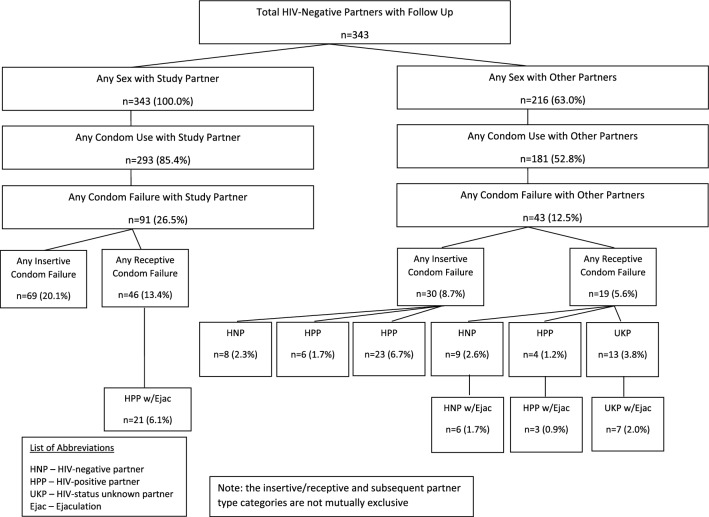
Condoms continue to be used by many gay, bisexual, and other men who have sex with men (GBM) to reduce the risk of HIV transmission. However this is impacted by condom failure events, defined here as condom breakage and slippage. In a prospective, observational cohort study of 343 HIV serodiscordant male couples recruited through high HIV caseload clinics and hospitals between 2012 and 2016 in Australia, Brazil, and Thailand, condom failure rates and associated factors were analysed, including with the study partner versus other sexual partners. There were 717 reported instances of condom failure from an estimated total of 25,831 sex acts with condoms, from over 588.4 participant years of follow up. Of the HIV-negative partners (n = 343) in the study, more than a third (n = 117, 36.7%) reported at least one instance of condom failure with any partner type during study follow-up. Condom failure with their study partner was reported by 91/343 (26.5%) HIV-negative partners, compared with 43/343 (12.5%) who reported condom failure with other partners. In total, there were 86 events where the HIV-negative partner experienced ano-receptive condom failure with ejaculation, representing 12.0% of all failure events. In multivariable analysis, compared to Australia, HIV-negative men in Brazil reported a higher incidence risk rate of condom failure (IRR = 1.64, 95%CI 1.01-2.68, p = 0.046) and HIV-negative men who reported anal sex with other partners reported an increased risk of condom failure compared with men who only had sex with their study partner (IRR = 1.89, 95%CI 1.08-3.33, p = 0.025). Although at least one event of condom failure was reported by a significant proportion of participants, overall condom failure events represented a small proportion of the total condom protected sex acts.
安全套继续被许多男同性恋、双性恋和其他与男性发生性行为的男性(GBM)用于降低 HIV 传播的风险。然而,这受到避孕套失效事件的影响,这里定义为避孕套破裂和滑脱。在 2012 年至 2016 年间,澳大利亚、巴西和泰国通过高 HIV 病例诊所和医院招募了 343 对 HIV 血清不一致的男同性恋伴侣,进行了一项前瞻性、观察性队列研究,分析了避孕套失效的发生率和相关因素,包括与研究伴侣和其他性伴侣的避孕套失效情况。在超过 588.4 名参与者随访的 25831 次避孕套保护的性行为中,报告了 717 例避孕套失效事件。在研究中,343 名 HIV 阴性伴侣(n=343)中,超过三分之一(n=117,36.7%)在研究随访期间报告与任何类型的伴侣至少有一次避孕套失效。91/343(26.5%)HIV 阴性伴侣报告与研究伴侣发生避孕套失效,而 43/343(12.5%)HIV 阴性伴侣报告与其他伴侣发生避孕套失效。总共,有 86 次 HIV 阴性伴侣经历了避孕套在接受肛交时失效且伴有射精,占所有失效事件的 12.0%。在多变量分析中,与澳大利亚相比,巴西的 HIV 阴性男性报告的避孕套失效发生率风险更高(IRR=1.64,95%CI 1.01-2.68,p=0.046),报告与其他伴侣发生肛交的 HIV 阴性男性与仅与研究伴侣发生性行为的男性相比,避孕套失效的风险增加(IRR=1.89,95%CI 1.08-3.33,p=0.025)。尽管有相当一部分参与者报告了至少一次避孕套失效事件,但总体而言,避孕套失效事件仅占避孕套保护的总性行为的一小部分。