The Kirby Institute, UNSW Sydney, Sydney, Australia.
PREVENTION, Thai Red Cross AIDS Research Centre, Bangkok, Thailand.
J Int AIDS Soc. 2019 Apr;22(4):e25277. doi: 10.1002/jia2.25277.
There are few data about the range of strategies used to prevent sexual HIV transmission within gay male serodiscordant couples. We examined HIV prevention strategies used by such couples and compared differences between countries.
Opposites Attract was a cohort study of male serodiscordant couples in Australia, Brazil and Thailand, from May 2014 (Australia) or May 2016 (Brazil/Thailand) to December 2016. At visits, HIV-positive partners had viral load (VL) tested; HIV-negative partners reported sexual behaviour and perceptions of their HIV-positive partner's VL results. Within-couple acts of condomless anal intercourse (CLAI) were categorized by strategy: condom-protected, biomedically protected (undetectable VL and/or pre-exposure prophylaxis [PrEP]), or not protected by either (HIV-negative partners engaging in insertive CLAI, receptive CLAI with withdrawal, or receptive CLAI with ejaculation).
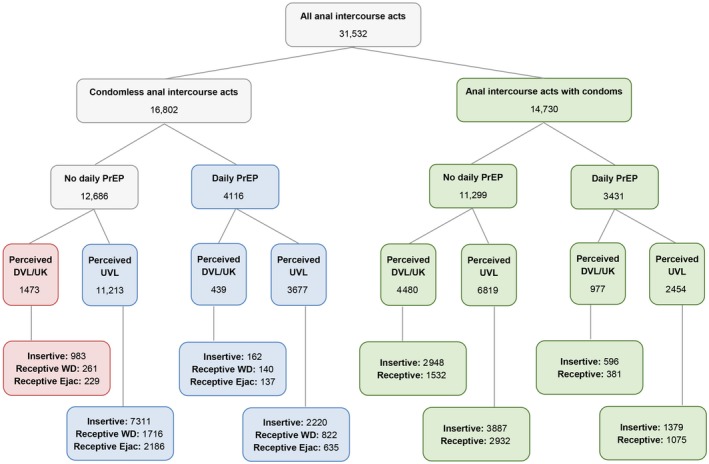
A total of 343 couples were included in this analysis (153 in Australia, 93 in Brazil and 97 in Thailand). Three-quarters of HIV-positive partners were consistently virally suppressed (<200 copies/mL) during follow-up, and HIV-negative partners had correct perceptions of their partner's VL result for 76.5% of tests. One-third of HIV-negative partners used daily PrEP during follow-up. Over follow-up, 73.8% of couples had CLAI. HIV-negative partners reported 31,532 acts of anal intercourse with their HIV-positive partner. Of these, 46.7% were protected by condoms, 48.6% by a biomedical strategy and 4.7% of acts were not protected by these strategies. Australian couples had fewer condom-protected acts and a higher proportion of biomedically protected acts than Brazilian and Thai couples. Of the 1473 CLAI acts where the perceived VL was detectable/unknown and were not protected by PrEP (4.7% of all acts), two-thirds (n = 983) were when the HIV-negative partner was insertive (strategic positioning). Of the 490 acts when the HIV-negative partner was receptive, 261 involved withdrawal and 280 involved ejaculation. Thus, <1% of acts were in the highest risk category of receptive CLAI with ejaculation.
Couples used condoms, PrEP or perceived undetectable VL for prevention in the majority of anal intercourse acts. Only a very small proportion of events were not protected by these strategies. Variation between countries may reflect differences in access to HIV treatment, education, knowledge and attitudes.
关于男同性恋血清不一致伴侣中预防性传播艾滋病毒的策略范围,数据有限。我们研究了此类伴侣使用的艾滋病毒预防策略,并比较了各国之间的差异。
2014 年 5 月(澳大利亚)或 2016 年 5 月(巴西/泰国)至 2016 年 12 月,Opposites Attract 是一项在澳大利亚、巴西和泰国的男同性恋血清不一致伴侣队列研究。每次就诊时,艾滋病毒阳性伴侣都要检测病毒载量(VL);艾滋病毒阴性伴侣报告性行为以及对艾滋病毒阳性伴侣 VL 结果的看法。根据策略对无保护肛交(CLAI)行为进行分类:避孕套保护、生物医学保护(无法检测到的 VL 和/或暴露前预防 [PrEP])或两者均不保护(艾滋病毒阴性伴侣进行插入性 CLAI、带撤回的接受性 CLAI 或带射精的接受性 CLAI)。
共纳入 343 对伴侣进行分析(澳大利亚 153 对、巴西 93 对、泰国 97 对)。在随访期间,四分之三的艾滋病毒阳性伴侣的病毒持续得到抑制(<200 拷贝/毫升),艾滋病毒阴性伴侣对伴侣 VL 结果的认知正确率为 76.5%。在随访期间,三分之一的艾滋病毒阴性伴侣每天使用 PrEP。在随访期间,73.8%的伴侣有 CLAI。艾滋病毒阴性伴侣报告与艾滋病毒阳性伴侣发生 31532 次肛交。其中,46.7%受到避孕套保护,48.6%受到生物医学策略保护,4.7%的行为不受这些策略保护。澳大利亚夫妇的避孕套保护行为较少,生物医学保护行为比例较高,高于巴西和泰国夫妇。在 1473 次 CLAI 行为中,感知 VL 可检测/未知且未使用 PrEP 保护(占所有行为的 4.7%),其中三分之二(n=983)发生在艾滋病毒阴性伴侣为插入性(策略性定位)时。在 490 次艾滋病毒阴性伴侣接受性行为中,261 次涉及撤回,280 次涉及射精。因此,只有不到 1%的行为属于接受性 CLAI 伴射精的最高风险类别。
伴侣在大多数肛交行为中使用避孕套、PrEP 或感知不到的 VL 进行预防。只有极少数行为不受这些策略的保护。国家之间的差异可能反映了艾滋病毒治疗、教育、知识和态度的获取方面的差异。