Peking University People's Hospital, Peking University Institute of Hematology, National Clinical Research Center for Hematologic Disease, Beijing Key Laboratory of Hematopoietic Stem Cell Transplantation, Beijing, China.
National Clinical Research Center for Blood Diseases, Institute of Hematology & Blood Diseases Hospital, Chinese Academy of Medical Sciences & Peking Union Medical College, Tianjing, China.
Blood. 2024 Oct 31;144(18):1951-1961. doi: 10.1182/blood.2024024761.
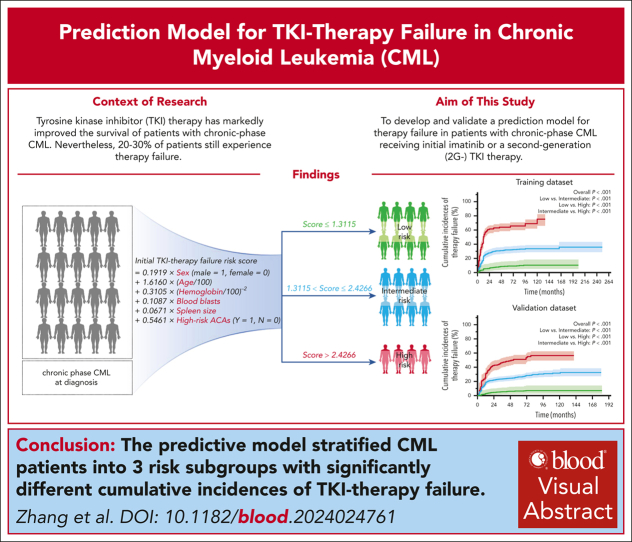
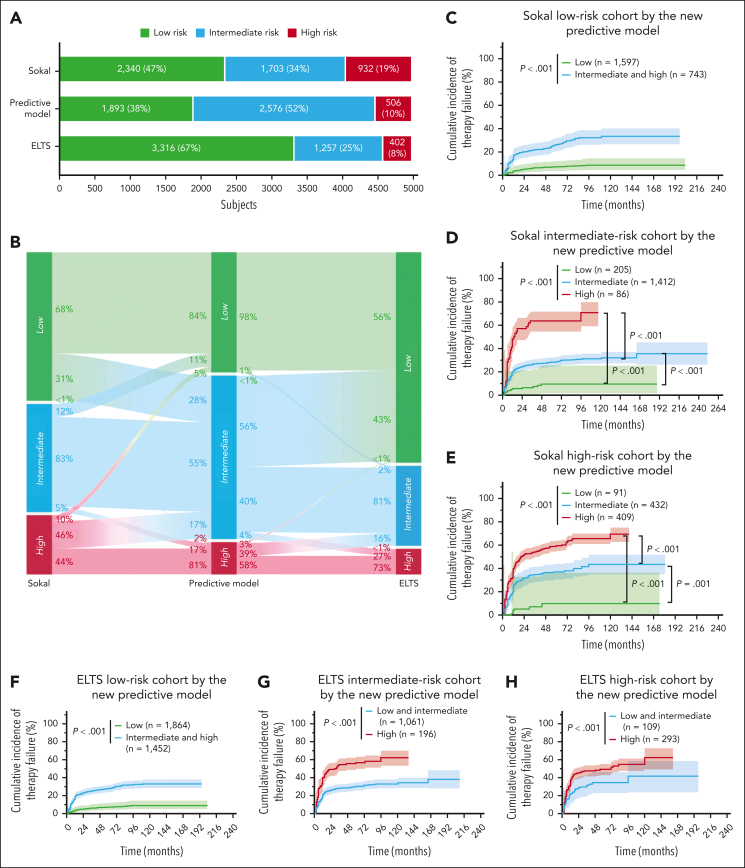
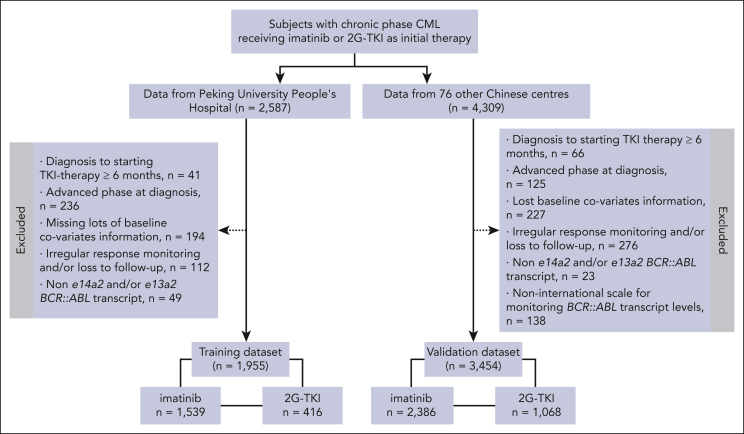
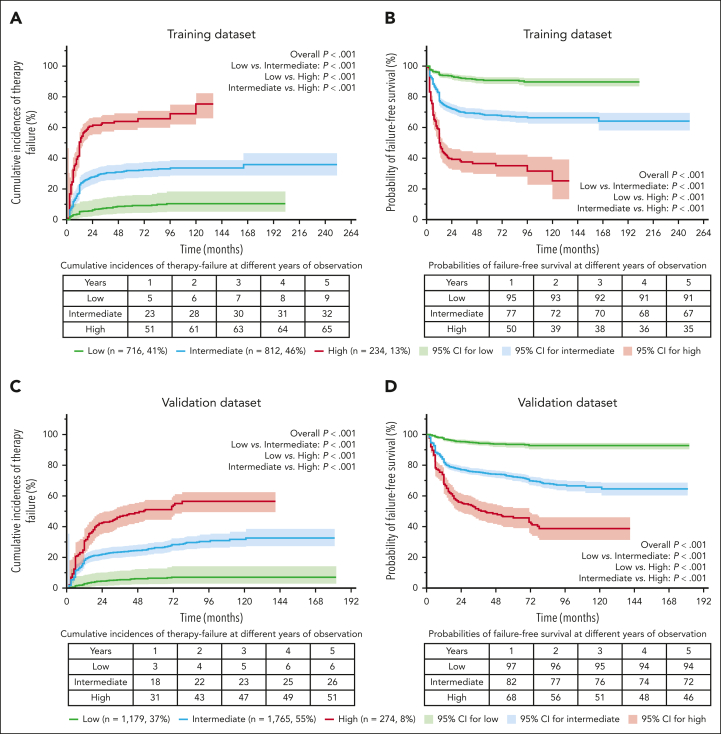
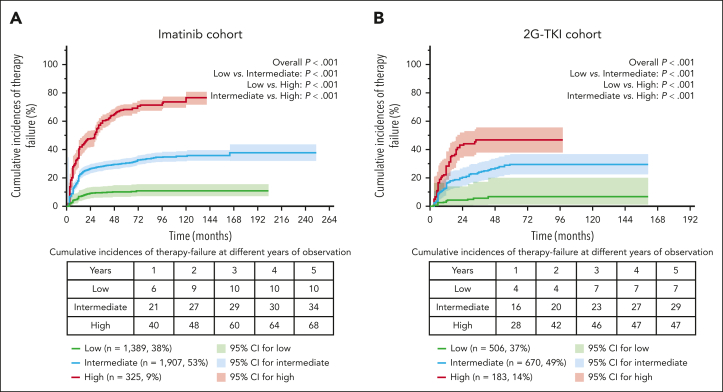
Although tyrosine kinase inhibitor (TKI) therapy has markedly improved the survival of people with chronic-phase chronic myeloid leukemia (CML), 20% to 30% of people still experienced therapy failure. Data from 1955 consecutive patients with chronic-phase CML diagnosed by the European LeukemiaNet recommendations from 1 center receiving initial imatinib or a second-generation (2G) TKI therapy were interrogated to develop a clinical prediction model for TKI-therapy failure. This model was subsequently validated in 3454 patients from 76 other centers. Using the predictive clinical covariates associated with TKI-therapy failure, we developed a model that stratified patients into low-, intermediate- and high-risk subgroups with significantly different cumulative incidences of therapy failure (P < .001). There was good discrimination and calibration in the external validation data set, and the performance was consistent with that of the training data set. Our model had the better prediction discrimination than the Sokal and European Treatment and Outcome Study long-term survival scores, with the greater time-dependent area under the receiver-operator characteristic curve values and a better ability to redefine the risk of therapy failure. Our model could help physicians estimate the likelihood of initial imatinib or 2G TKI-therapy failure in people with chronic-phase CML.
虽然酪氨酸激酶抑制剂(TKI)治疗显著改善了慢性期慢性髓性白血病(CML)患者的生存,但仍有 20%至 30%的患者治疗失败。对 1 个中心按照欧洲白血病网建议诊断的 1955 例慢性期 CML 患者的初始接受伊马替尼或第二代(2G)TKI 治疗的数据进行了分析,以建立 TKI 治疗失败的临床预测模型。该模型随后在来自 76 个其他中心的 3454 例患者中进行了验证。使用与 TKI 治疗失败相关的预测临床协变量,我们开发了一种模型,将患者分为低、中、高危亚组,其治疗失败的累积发生率有显著差异(P<0.001)。外部验证数据集的判别和校准效果良好,且性能与训练数据集一致。与 Sokal 和欧洲治疗和预后研究长期生存评分相比,我们的模型具有更好的预测判别能力,其接受者操作特征曲线下面积值的时间依赖性更高,重新定义治疗失败风险的能力更强。我们的模型可以帮助医生估计慢性期 CML 患者初始接受伊马替尼或 2G TKI 治疗失败的可能性。