Lin Zhencan, Sun Hao, Chen Meiyi, Li Deng, Cai Zhiqing, Wang Yimin, Xu Jie, Ma Ruofan
Department of Orthopedics, Sun Yat-sen Memorial Hospital, Sun Yat-sen University, Guangzhou, 510120, Guangdong, China.
Department of Orthopedics, The Eighth Affiliated Hospital, Sun Yat-Sen University, Shenzhen, 518000, Guangdong, China.
Thromb J. 2024 Jul 24;22(1):68. doi: 10.1186/s12959-024-00633-4.
This study aims to investigate the potential role of Caprini risk assessment model (RAM) in predicting the risk of venous thromboembolism (VTE) in patients undergoing total hip or knee arthroplasty (THA/TKA). No national study has investigated the role of Caprini RAM after primary THA/TKA.
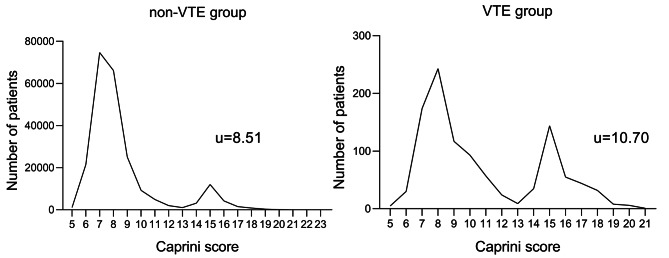
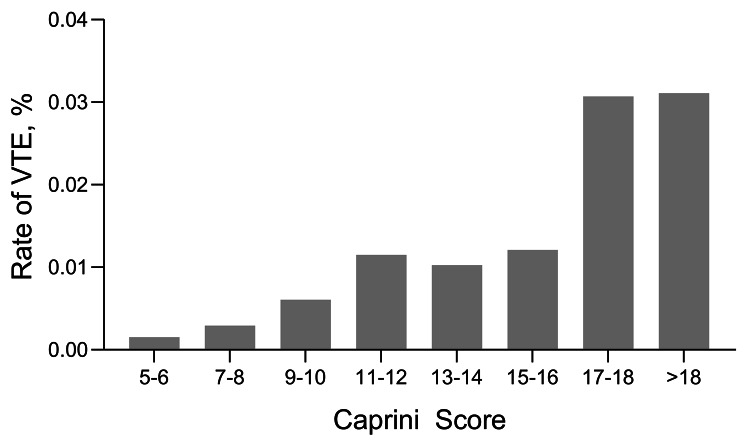
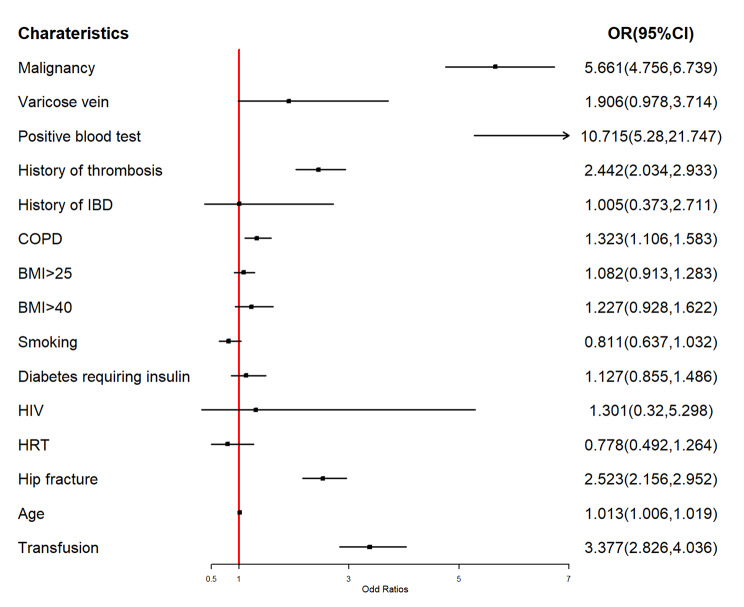
Data from The National Sample of Healthcare Cost and Utilization Project (HCUP) in 2019 were utilized for this study. The dataset consisted of 229,134 patients who underwent primary THA/TKA. Deep vein thrombosis (DVT) and pulmonary embolism (PE) were considered as VTE. The incidence of thrombosis was calculated based on different Caprini scores, and the risk of the Caprini indicator for VTE events was evaluated using a forest plot.
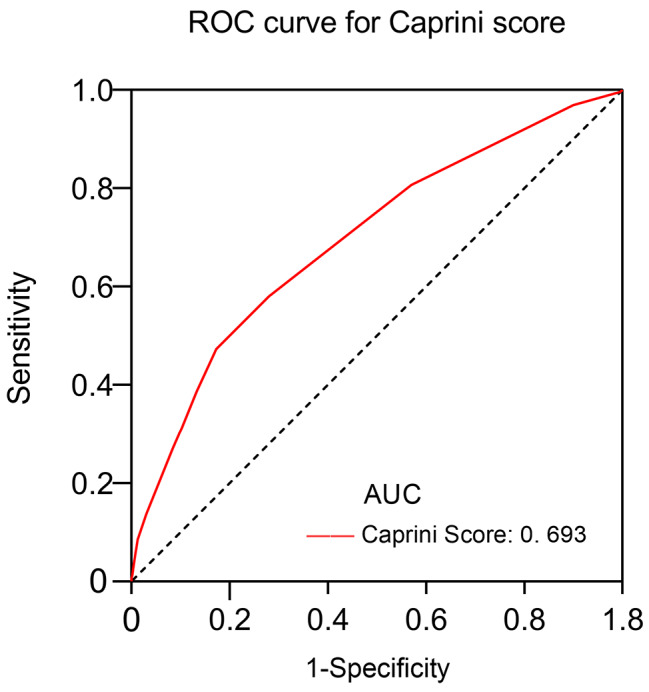
The prevalence of VTE after primary THA/TKA in the U.S. population in 2019 was found to be 4.7 cases per 1000 patients. Age, body mass index (BMI), and Caprini score showed a positive association with the risk of VTE (P < 0.05). The receiver operating characteristic (ROC) curve analysis indicated that a Caprini score of 9.5 had a sensitivity of 47.2% and a specificity of 82.7%, with an area under the curve (AUC) of 0.693 (95% CI, 0.677-0.710). The highest Youden index was 0.299. Multivariate logistic regression analysis revealed that malignancy, varicose vein, positive blood test for thrombophilia, history of thrombosis, COPD, hip fracture, blood transfusion, and age were significant risk factors for VTE. Based on these findings, a new risk stratification system incorporating the Caprini score was proposed.
Although the Caprini score does not seem to be a good predictive model for VTE after primary THA/TKA, new risk stratification for the Caprini score is proposed to increase its usefulness.
本研究旨在探讨Caprini风险评估模型(RAM)在预测全髋关节或膝关节置换术(THA/TKA)患者静脉血栓栓塞症(VTE)风险中的潜在作用。尚无全国性研究调查过初次THA/TKA后Caprini RAM的作用。
本研究使用了2019年国家医疗保健成本和利用项目(HCUP)的全国样本数据。该数据集包含229134例接受初次THA/TKA的患者。深静脉血栓形成(DVT)和肺栓塞(PE)被视为VTE。根据不同的Caprini评分计算血栓形成的发生率,并使用森林图评估Caprini指标对VTE事件的风险。
2019年美国人群初次THA/TKA后VTE的患病率为每1000例患者中有4.7例。年龄、体重指数(BMI)和Caprini评分与VTE风险呈正相关(P < 0.05)。受试者工作特征(ROC)曲线分析表明,Caprini评分为9.5时,灵敏度为47.2%,特异度为82.7%,曲线下面积(AUC)为0.693(95% CI,0.677 - 0.710)。最高约登指数为0.299。多因素逻辑回归分析显示,恶性肿瘤、静脉曲张、血栓形成倾向血液检测阳性、血栓形成病史、慢性阻塞性肺疾病(COPD)、髋部骨折、输血和年龄是VTE的重要危险因素。基于这些发现,提出了一种纳入Caprini评分的新风险分层系统。
尽管Caprini评分似乎不是初次THA/TKA后VTE的良好预测模型,但仍提出了Caprini评分的新风险分层以提高其有用性。