Das Nipan, Dey Biswajit, Lakadong Rennie Orson, Raphael Vandana, Verma Shikha
Department of Pathology, North Eastern Indira Gandhi Regional Institute of Health and Medical Sciences, Shillong, Meghalaya, India.
Allied Health Sciences, Martin Luther Christian University, Shillong, Meghalaya, India.
Indian Dermatol Online J. 2024 Jun 10;15(4):620-623. doi: 10.4103/idoj.idoj_586_23. eCollection 2024 Jul-Aug.
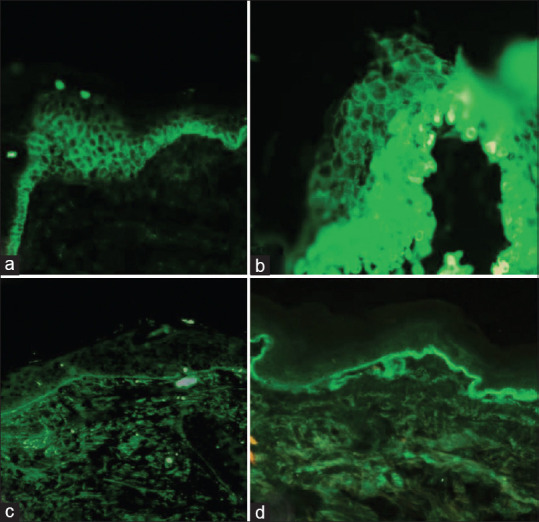
When immunofluorescence on the frozen section is insufficient or unavailable, salvage immunofluorescence techniques can be used on formalin-fixed, paraffin-embedded tissue. The goal of the current investigation was to evaluate the diagnostic value of paraffin immunofluorescence following proteinase K digestion on skin biopsy samples in comparison to fresh frozen immunofluorescence.
It was standardized and compared to the immunofluorescence on fresh frozen tissue (IF-Frozen) for paraffin immunofluorescence by proteinase K digestion of formalin-fixed paraffin-embedded skin biopsies (IF-FFPE). The study included 50 native skin biopsy cases, and fluorescein isothiocyanate-labeled IgA, IgG, IgM, and C3 intensity levels were evaluated in each case.
A total of 50 cases of native skin biopsy were included in the study, and their intensities for IgA, IgG, IgM, and C3 antibodies were compared. The average staining intensities in each disease group for the antibodies had equal intensity or had a minor difference (1+)/significant difference (2+). Paraffin immunofluorescence, proteinase K digestion had the best correlation, that is, had either equal or minor difference (1+) with fresh frozen immunofluorescence. The difference of 2+ intensity of antibodies between IF-FFPE and IF-Frozen was noted mainly in C3 antibody on paraneoplastic pemphigus. IF-FFPE showed a sensitivity of 100%, 97.6%, 100%, and 81.6% for IgA, IgG, IgM, and C3, respectively, whereas the specificity was 100% for IgA, IgG, IgM, and C3.
Small sample size and and the employment of one method of antigen retrieval in IF-FFPE.
Immunofluorescence techniques done on formalin-fixed paraffin-embedded tissue can serve as salvage techniques in cases where immunofluorescence on the frozen section may not be adequate or may not be available.
当冷冻切片上的免疫荧光不足或无法进行时,可以在福尔马林固定、石蜡包埋的组织上使用挽救性免疫荧光技术。本研究的目的是评估蛋白酶K消化后的石蜡免疫荧光在皮肤活检样本中的诊断价值,并与新鲜冷冻免疫荧光进行比较。
对福尔马林固定石蜡包埋的皮肤活检组织进行蛋白酶K消化,对石蜡免疫荧光进行标准化,并与新鲜冷冻组织上的免疫荧光(IF-冷冻)进行比较。该研究纳入了50例天然皮肤活检病例,并对每例病例中异硫氰酸荧光素标记的IgA、IgG、IgM和C3强度水平进行评估。
该研究共纳入50例天然皮肤活检病例,并比较了它们的IgA、IgG、IgM和C3抗体强度。每个疾病组中抗体的平均染色强度具有相同强度或有微小差异(1+)/显著差异(2+)。石蜡免疫荧光、蛋白酶K消化具有最佳相关性,即与新鲜冷冻免疫荧光具有相同或微小差异(1+)。IF-FFPE和IF-冷冻之间抗体2+强度的差异主要见于副肿瘤性天疱疮的C3抗体。IF-FFPE对IgA、IgG、IgM和C3的敏感性分别为100%、97.6%、100%和81.6%,而IgA、IgG、IgM和C3的特异性均为100%。
样本量小以及在IF-FFPE中采用了一种抗原修复方法。
在冷冻切片上的免疫荧光可能不充分或无法进行的情况下,对福尔马林固定石蜡包埋组织进行的免疫荧光技术可作为挽救性技术。