Cho Min Jeong, Hwang Donghwi, Yie Si Young, Lee Jae Sung
Interdisciplinary Program in Bioengineering, Seoul National University College of Engineering, Seoul, 03080, South Korea.
Department of Nuclear Medicine, Seoul National University College of Medicine, 103 Daehak-ro, Jongno-gu, Seoul, 03080, South Korea.
EJNMMI Phys. 2024 Jul 25;11(1):67. doi: 10.1186/s40658-024-00670-y.
Effective radiation therapy requires accurate segmentation of head and neck cancer, one of the most common types of cancer. With the advancement of deep learning, people have come up with various methods that use positron emission tomography-computed tomography to get complementary information. However, these approaches are computationally expensive because of the separation of feature extraction and fusion functions and do not make use of the high sensitivity of PET. We propose a new deep learning-based approach to alleviate these challenges.
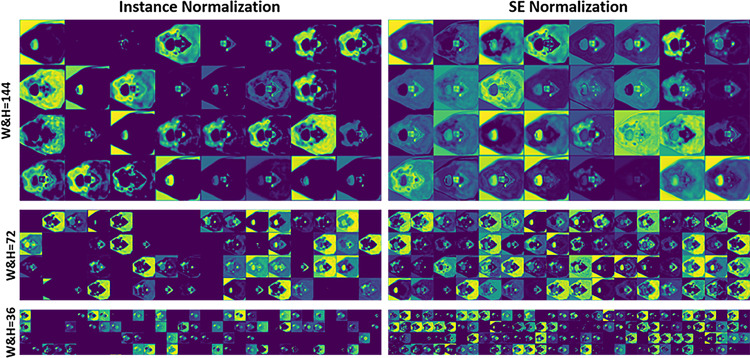
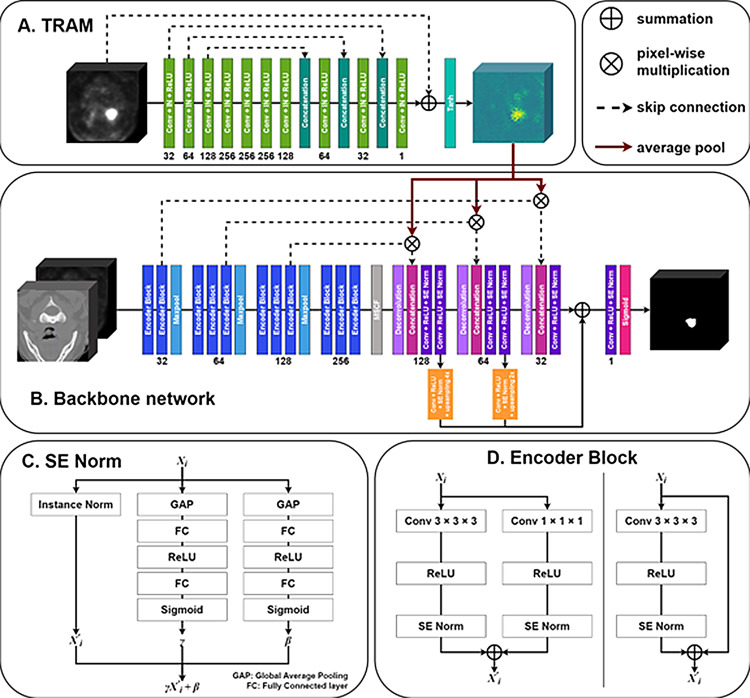
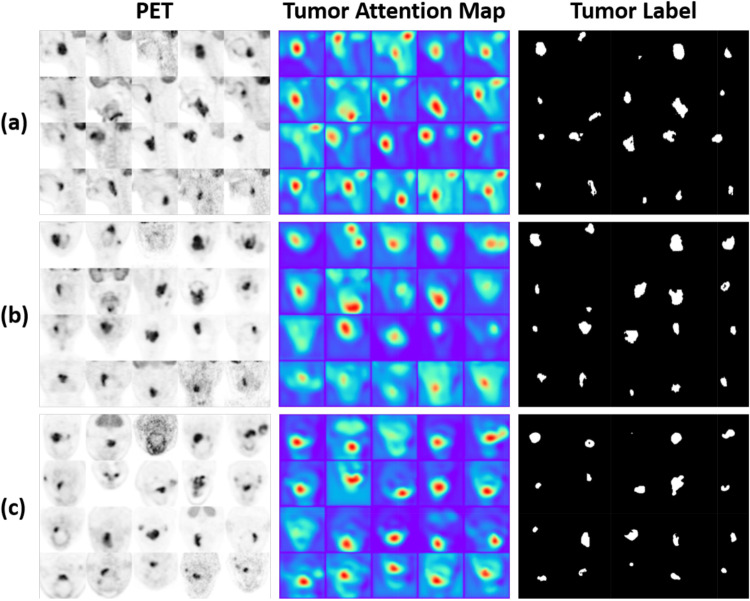
We proposed a tumor region attention module that fully exploits the high sensitivity of PET and designed a network that learns the correlation between the PET and CT features using squeeze-and-excitation normalization (SE Norm) without separating the feature extraction and fusion functions. In addition, we introduce multi-scale context fusion, which exploits contextual information from different scales.
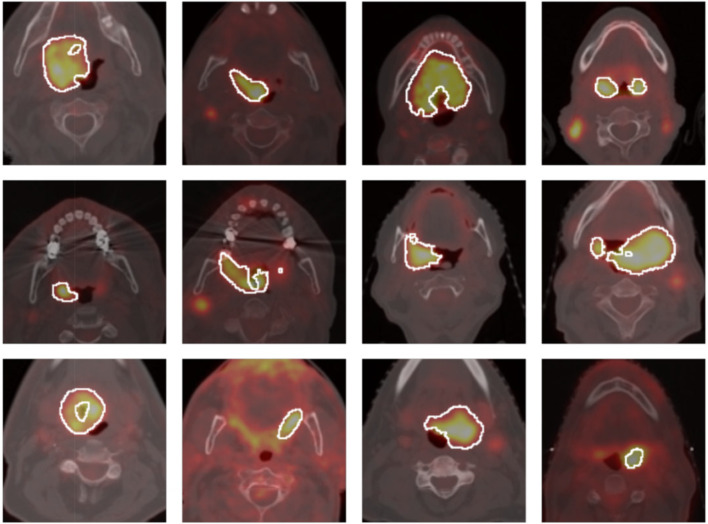
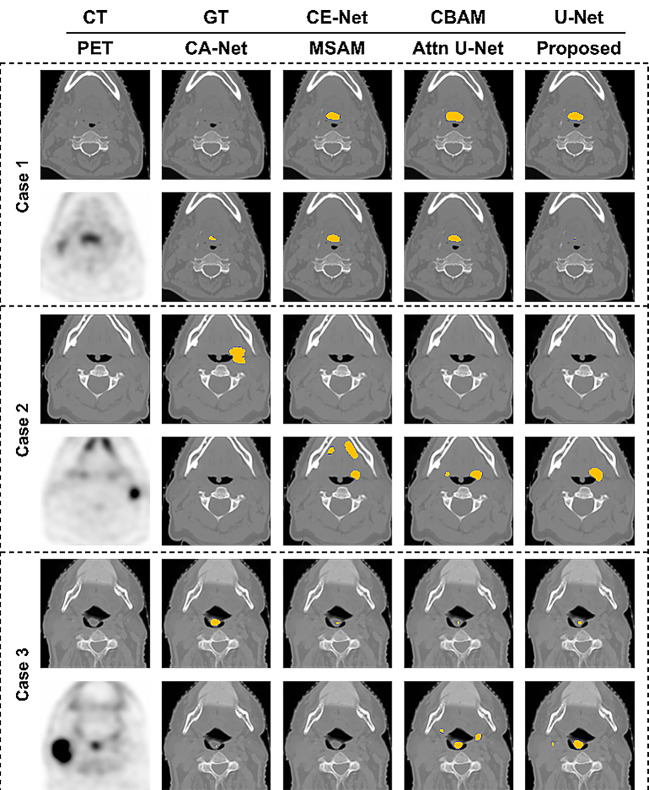
The HECKTOR challenge 2021 dataset was used for training and testing. The proposed model outperformed the state-of-the-art models for medical image segmentation; in particular, the dice similarity coefficient increased by 8.78% compared to U-net.
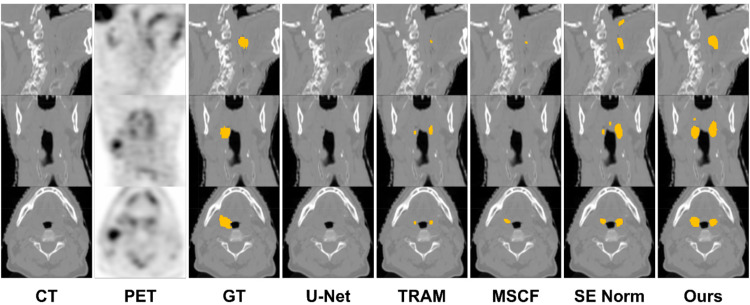
The proposed network segmented the complex shape of the tumor better than the state-of-the-art medical image segmentation methods, accurately distinguishing between tumor and non-tumor regions.
有效的放射治疗需要对头颈部癌(最常见的癌症类型之一)进行精确分割。随着深度学习的发展,人们提出了各种利用正电子发射断层扫描-计算机断层扫描来获取补充信息的方法。然而,由于特征提取和融合功能的分离,这些方法计算成本高昂,且未利用PET的高灵敏度。我们提出一种基于深度学习的新方法来应对这些挑战。
我们提出了一种肿瘤区域注意力模块,该模块充分利用PET的高灵敏度,并设计了一个网络,使用挤压激励归一化(SE Norm)来学习PET和CT特征之间的相关性,而不分离特征提取和融合功能。此外,我们引入了多尺度上下文融合,利用来自不同尺度的上下文信息。
使用HECKTOR挑战2021数据集进行训练和测试。所提出的模型在医学图像分割方面优于现有模型;特别是,与U-net相比,骰子相似系数提高了8.78%。
所提出的网络在分割肿瘤的复杂形状方面优于现有医学图像分割方法,能够准确区分肿瘤和非肿瘤区域。