Division of Allergy, Asthma, and Clinical Immunology, Mayo Clinic, Phoenix, AZ, USA.
Division of Hematology and Medical Oncology, Mayo Clinic, Phoenix, AZ, USA.
Blood Cancer J. 2024 Jul 25;14(1):124. doi: 10.1038/s41408-024-01107-6.
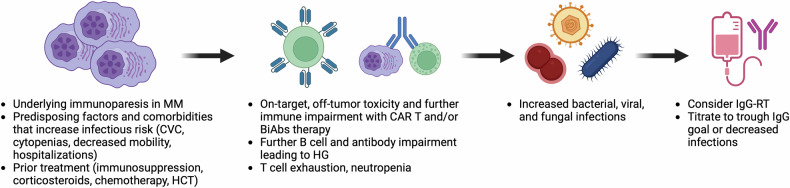
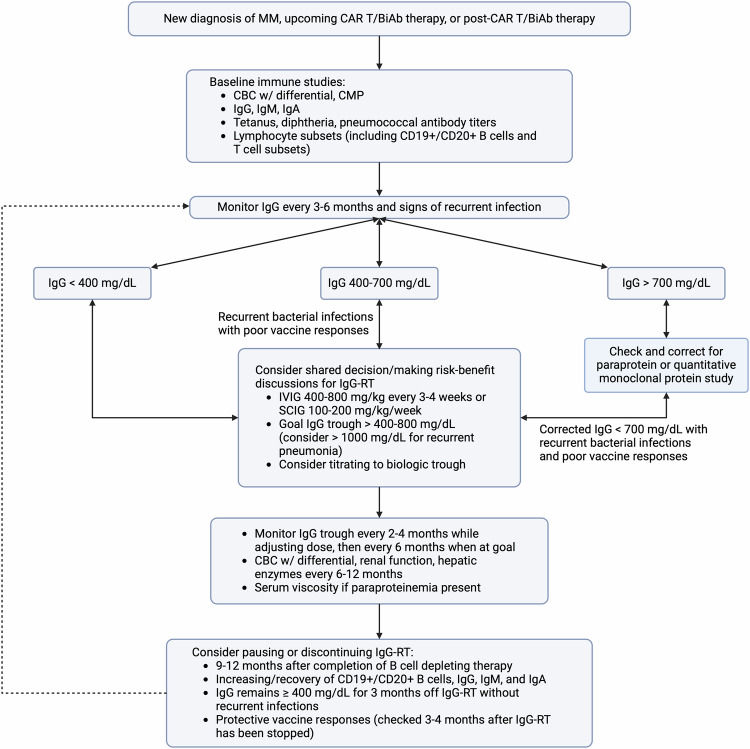
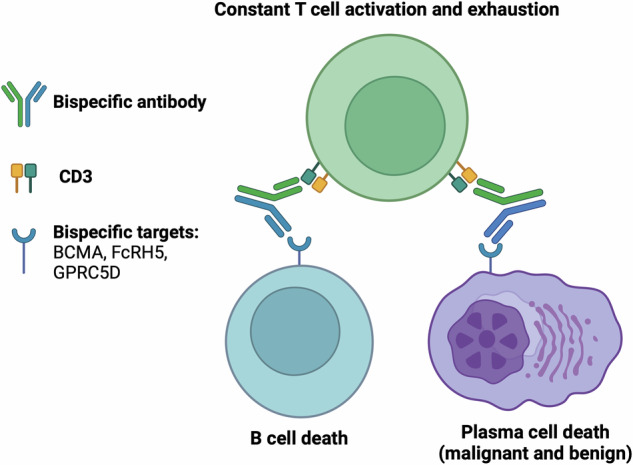
T cell engagers (TCE) such as chimeric antigen receptor (CAR) T cell therapy and bispecific antibodies (BiAbs) for the treatment of multiple myeloma (MM) have significantly improved clinical outcomes, but have also raised awareness for ensuing post-treatment secondary immunodeficiency and hypogammaglobulinemia (HG). As patients with MM live longer, recurrent infections become a significant component of therapy-associated morbidity and mortality. Treatment of HG with immunoglobulin G replacement therapy (IgG-RT) has been a mainstay of the primary immunodeficiency (PI) world, and extrapolation to MM has recently started to show promising clinical outcomes. However, IgG-RT initiation, dosing, route, timing, monitoring, and management in MM has not been standardized in the setting of TCE. Progress in MM treatment will involve greater recognition and screening of underlying secondary immunodeficiency, identification of risk-stratification markers, optimizing IgG-RT management, and implementing other approaches to decrease the risk of infection. In this review, we summarize infection risk, risk of HG, and management strategies for IgG-RT in patients with relapsed MM after TCE.
嵌合抗原受体 (CAR) T 细胞疗法和双特异性抗体 (BiAb) 等 T 细胞衔接器 (TCE) 已显著改善了多发性骨髓瘤 (MM) 的临床结局,但也引起了人们对随之而来的治疗后继发性免疫缺陷和低丙种球蛋白血症 (HG) 的关注。随着 MM 患者的生存期延长,复发性感染成为治疗相关发病率和死亡率的重要组成部分。免疫球蛋白 G 替代疗法 (IgG-RT) 治疗 HG 一直是原发性免疫缺陷 (PI) 领域的主要方法,最近在 MM 中的应用也开始显示出有前景的临床结局。然而,在 TCE 背景下,MM 中 IgG-RT 的起始、剂量、途径、时机、监测和管理尚未标准化。MM 治疗的进展将涉及更深入地认识和筛查潜在的继发性免疫缺陷,确定风险分层标志物,优化 IgG-RT 管理,并采取其他方法降低感染风险。在这篇综述中,我们总结了 TCE 后复发 MM 患者的感染风险、HG 风险和 IgG-RT 管理策略。