Centre for Research in Infectious Diseases (CRID), P.O. Box 13501, Yaoundé, Cameroon.
Department of Animal Biology and Physiology, Faculty of Science, University of Yaoundé 1, P.O. Box 812, Yaoundé, Cameroon.
BMC Infect Dis. 2024 Jul 25;24(1):733. doi: 10.1186/s12879-024-09630-4.
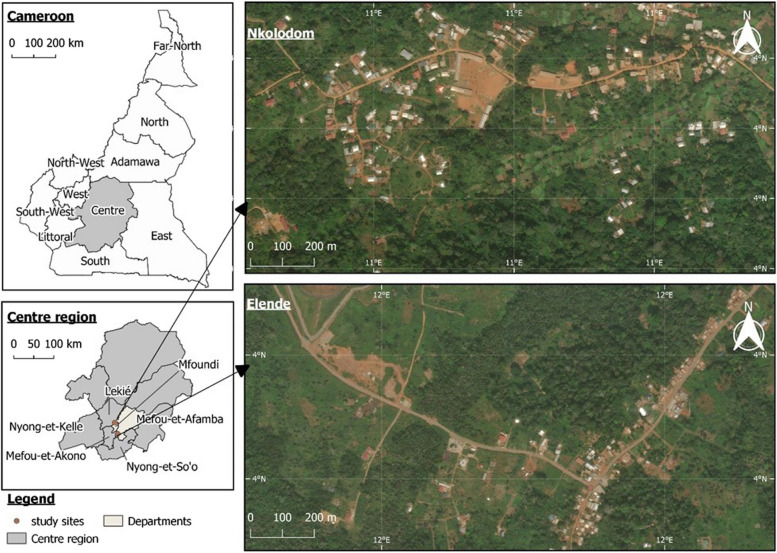
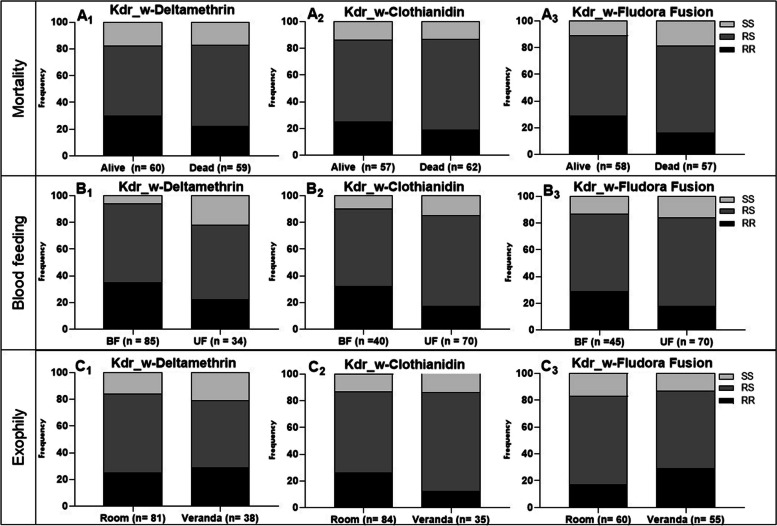
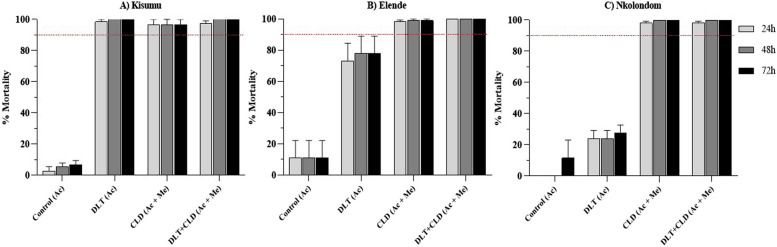
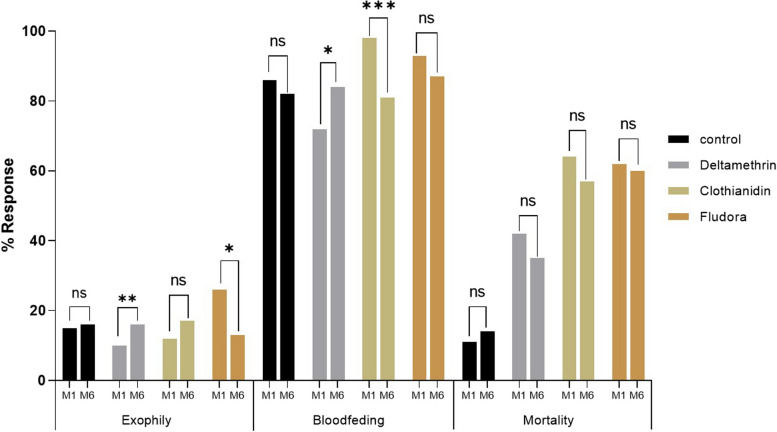
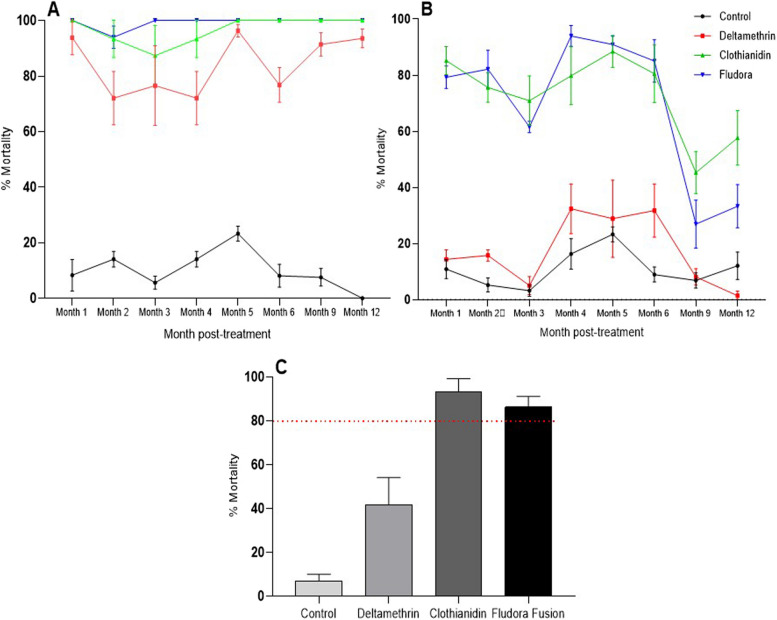
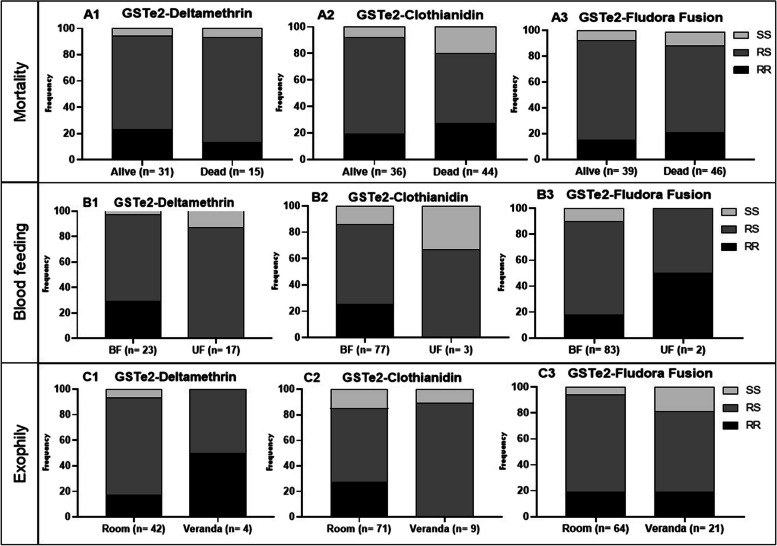
Elevated resistance to pyrethroids in major malaria vectors has led to the introduction of novel insecticides including neonicotinoids. There is a fear that efficacy of these new insecticides could be impacted by cross-resistance mechanisms from metabolic resistance to pyrethroids. In this study, after evaluating the resistance to deltamethrin, clothianidin and mixture of clothianidin + deltamethrin in the lab using CDC bottle assays, the efficacy of the new IRS formulation Fludora® Fusion was tested in comparison to clothianidin and deltamethrin applied alone using experimental hut trials against wild free-flying pyrethroid-resistant Anopheles funestus from Elende and field An. gambiae collected from Nkolondom reared in the lab and released in the huts. Additionally, cone tests on the treated walls were performed each month for a period of twelve months to evaluate the residual efficacy of the sprayed products. Furthermore, the L1014F-kdr target-site mutation and the L119F-GSTe2 mediated metabolic resistance to pyrethroids were genotyped on a subset of mosquitoes from the EHT to assess the potential cross-resistance. All Anopheles species tested were fully susceptible to clothianidin and clothianidin + deltamethrin mixture in CDC bottle assay while resistance was noted to deltamethrin. Accordingly, Fludora® Fusion (62.83% vs 42.42%) and clothianidin (64.42% vs 42.42%) induced significantly higher mortality rates in EHT than deltamethrin (42.42%) against free flying An. funestus from Elende in month 1 (M1) and no significant difference in mortality was observed between the first (M1) and sixth (M6) months of the evaluation (P > 0.05). However, lower mortality rates were recorded against An. gambiae s.s from Nkolondom (mortality rates 50%, 45.56% and 26.68%). In-situ cone test on the wall showed a high residual efficacy of Fludora® Fusion and clothianidin on the susceptible strain KISUMU (> 12 months) and moderately on the highly pyrethroid-resistant An. gambiae strain from Nkolondom (6 months). Interestingly, no association was observed between the L119F-GSTe2 mutation and the ability of mosquitoes to survive exposure to Fludora® Fusion, whereas a trend was observed with the L1014F-kdr mutation. This study highlights that Fludora® Fusion, through its clothianidin component, has good potential of controlling pyrethroid-resistant mosquitoes with prolonged residual efficacy. This could be therefore an appropriate tool for vector control in several malaria endemic regions.
主要疟疾传播媒介对拟除虫菊酯的抗药性升高,导致包括新烟碱类在内的新型杀虫剂的引入。人们担心这些新杀虫剂的效果可能会受到代谢抗性导致的交叉抗性机制的影响。在这项研究中,在使用 CDC 瓶法评估了对溴氰虫酰胺、噻虫啉和噻虫啉+溴氰虫酰胺混合物的抗药性后,使用实验小屋试验测试了新 IRS 制剂 Fludora® Fusion 的功效,与单独使用噻虫啉和溴氰虫酰胺进行了比较,该试验针对的是来自 Elende 的野外抗药性拟除虫菊酯的自由飞行的致倦库蚊和从野外采集的、在实验室中饲养并释放到小屋中的按蚊 gambiae。此外,在 12 个月的时间里,每月对处理过的墙壁进行锥虫试验,以评估喷洒产品的残留效果。此外,在 EHT 的蚊子亚群上对 L1014F-kdr 靶位突变和 L119F-GSTe2 介导的对拟除虫菊酯的代谢抗性进行了基因分型,以评估潜在的交叉抗性。在 CDC 瓶试验中,所有测试的按蚊种均对噻虫啉和噻虫啉+溴氰虫酰胺混合物完全敏感,而对溴氰虫酰胺有抗药性。因此,在第一个月(M1),与 Elende 的自由飞行的致倦库蚊相比,Fludora® Fusion(62.83%比 42.42%)和噻虫啉(64.42%比 42.42%)诱导的死亡率显著更高,而在评估的第六个月(M6),死亡率之间没有观察到显著差异(P>0.05)。然而,在 Nkolondom 的致倦库蚊 s.s. 上记录到的死亡率较低(死亡率为 50%、45.56%和 26.68%)。现场锥虫试验表明,Fludora® Fusion 和噻虫啉在敏感株 KISUMU 上(>12 个月)和在高度抗拟除虫菊酯的 Nkolondom 来源的按蚊株上(6 个月)具有较高的残留效果。有趣的是,L119F-GSTe2 突变与蚊子对 Fludora® Fusion 的耐受力之间没有观察到相关性,而与 L1014F-kdr 突变则存在相关性。本研究表明,Fludora® Fusion 通过其噻虫啉成分,具有控制对拟除虫菊酯产生抗药性的蚊子的良好潜力,并具有较长的残留效果。因此,它可能是几个疟疾流行地区的一种适当的病媒控制工具。