Yuan Zijun, Zhang Yinping, Wang Xiang, Wang Xingyue, Ren Siqi, He Xinyu, Su Jiahong, Zheng Anfu, Guo Sipeng, Chen Yu, Deng Shuai, Wu Xu, Li Mingxing, Du Fukuan, Zhao Yueshui, Shen Jing, Wang Zechen, Xiao Zhangang
Gulin Traditional Chinese Medicine Hospital, Luzhou, China.
Laboratory of Molecular Pharmacology, Department of Pharmacology, School of Pharmacy, Southwest Medical University, Luzhou, China.
Front Oncol. 2024 Jul 10;14:1423143. doi: 10.3389/fonc.2024.1423143. eCollection 2024.
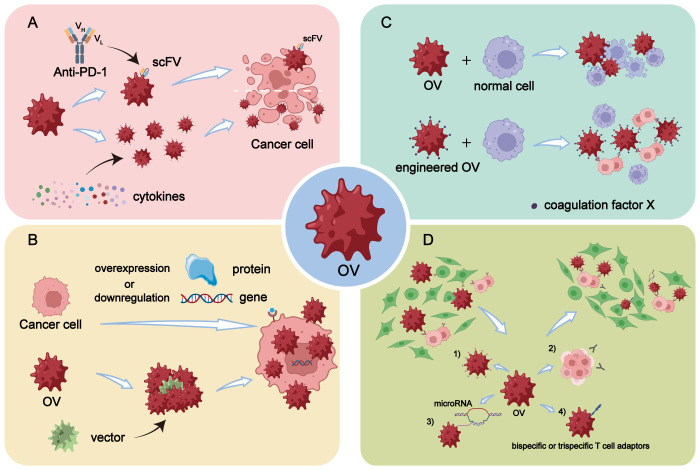
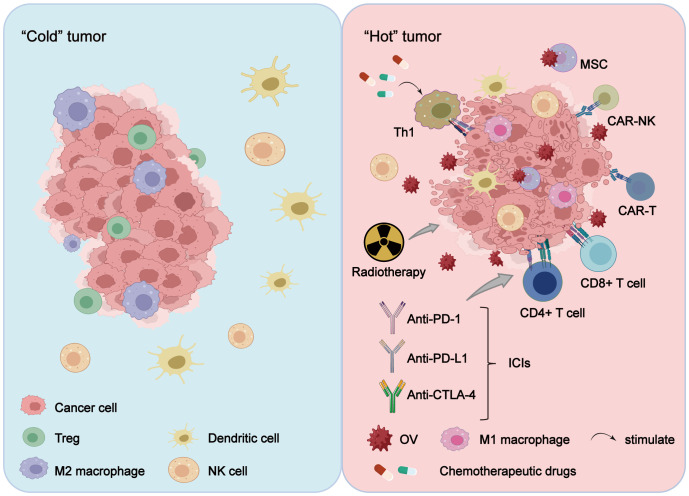
Oncolytic viruses (OVs) have emerged as a potential strategy for tumor treatment due to their ability to selectively replicate in tumor cells, induce apoptosis, and stimulate immune responses. However, the therapeutic efficacy of single OVs is limited by the complexity and immunosuppressive nature of the tumor microenvironment (TME). To overcome these challenges, engineering OVs has become an important research direction. This review focuses on engineering methods and multi-modal combination therapies for OVs aimed at addressing delivery barriers, viral phagocytosis, and antiviral immunity in tumor therapy. The engineering approaches discussed include enhancing immune response, improving replication efficiency within the tumor cells, enhancing safety profiles, and improving targeting capabilities. In addition, this review describes the potential mechanisms of OVs combined with radiotherapy, chemotherapy, cell therapy and immune checkpoint inhibitors (ICIs), and summarizes the data of ongoing clinical trials. By continuously optimizing engineering strategies and combination therapy programs, we can achieve improved treatment outcomes and quality of life for cancer patients.
溶瘤病毒(OVs)因其能够在肿瘤细胞中选择性复制、诱导细胞凋亡并刺激免疫反应,已成为一种潜在的肿瘤治疗策略。然而,单一溶瘤病毒的治疗效果受到肿瘤微环境(TME)的复杂性和免疫抑制特性的限制。为了克服这些挑战,对溶瘤病毒进行工程改造已成为一个重要的研究方向。本综述聚焦于溶瘤病毒的工程改造方法和多模式联合疗法,旨在解决肿瘤治疗中的递送障碍、病毒吞噬作用和抗病毒免疫问题。所讨论的工程改造方法包括增强免疫反应、提高肿瘤细胞内的复制效率、增强安全性以及提高靶向能力。此外,本综述描述了溶瘤病毒与放疗、化疗、细胞疗法和免疫检查点抑制剂(ICIs)联合使用的潜在机制,并总结了正在进行的临床试验数据。通过不断优化工程改造策略和联合治疗方案,我们可以为癌症患者实现更好的治疗效果和生活质量。