Jost Robin, Kespohl Sabine, Paulus-Tremel Kathrin E, Zimmer Julia, Bonertz Andreas, Sander Ingrid, Klose Thomas, Altin Lena-Maria, Heller Simone, Heimke-Brinck Ralph, Dörje Frank, Philippus Susanne, Meyer Matthias, Segebrecht Sabrina, Wessel Torsten, Starke Dieter, Schülke Stefan, Raulf Monika, Mahler Vera
Allergology Division, Paul-Ehrlich-Institut (PEI), Langen (Hesse).
Friedrich-Alexander-Universität Erlangen-Nürnberg (FAU), Erlangen.
Allergol Select. 2024 Jul 22;8:251-264. doi: 10.5414/ALX02514E. eCollection 2024.
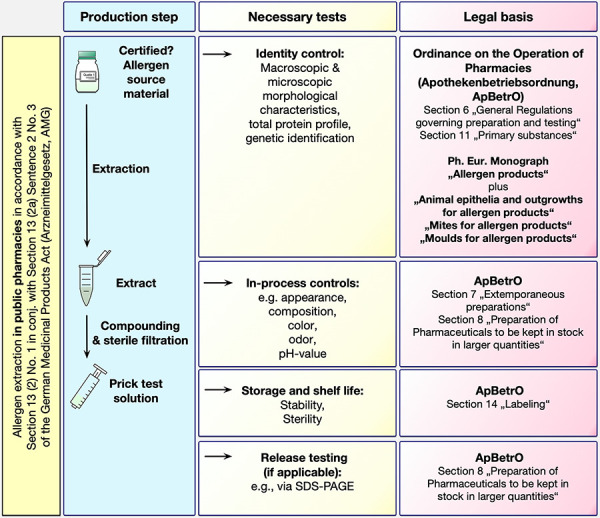
The availability of high-quality skin test allergens is a prerequisite for the reliable diagnosis of occupational type I allergies. Due to the withdrawal of existing marketing authorizations (MAs) by pharmaceutical companies and the lack of new MAs for commercial test allergens, there is an increasing diagnostic gap in Germany and other EU member states, which makes it necessary to investigate alternative ways of providing in vivo diagnostics. The German Medicinal Products Act (Arzneimittelgesetz = AMG) allows for the possibility of preparing medicinal products in pharmacies without the need for an MA or a manufacturing authorization pursuant to Section 13 (2) No. 1 in conjunction with Section 13 (2a) Sentence 2 No. 3 AMG. This also includes test allergens. In addition to the AMG, the requirements of the German Ordinance on the Operation of Pharmacies (Apothekenbetriebsordnung - ApBetrO) and the European Pharmacopoeia apply in particular. Medicolegal and practical challenges, as well as potentials of manufacturing skin prick test solutions in public pharmacies are presented based on examples of different allergen source materials.
高质量皮肤试验变应原的可获得性是可靠诊断职业性I型过敏的前提条件。由于制药公司撤回了现有的上市许可(MA),且商业试验变应原缺乏新的上市许可,德国和其他欧盟成员国的诊断差距日益增大,这使得有必要研究提供体内诊断的替代方法。德国《药品法》(Arzneimittelgesetz = AMG)允许根据AMG第13条第(2)款第1项结合第13条第(2a)款第2句第3项,在无需上市许可或生产许可的情况下在药店配制药品。这也包括试验变应原。除了《药品法》之外,德国《药店运营条例》(Apothekenbetriebsordnung - ApBetrO)和《欧洲药典》的要求也特别适用。基于不同变应原源材料的实例,介绍了在公共药店生产皮肤点刺试验溶液的法医学和实际挑战以及潜力。