Marcus Gil, Najjar Mohammad, Monayer Antionette, Orbach Ady, Maymon Shiri L, Kalmanovich Eran, Moravsky Gil, Grupper Avishay, Fuchs Shmuel, Minha Sa'ar
Department of Cardiology, Shamir Medical Center, Zeriffin, Israel.
Faculty of Medicine, Tel-Aviv University, Ramat-Aviv, Israel.
Int J Cardiol Cardiovasc Risk Prev. 2024 Jul 4;22:200306. doi: 10.1016/j.ijcrp.2024.200306. eCollection 2024 Sep.
Acute Decompensated Heart Failure (ADHF) is associated with frequent hospitalizations, posing a significant health and economic burden globally. Despite advancements in heart failure management, studies delineating temporal trends in ADHF outcomes are sparse.Methods: in this retrospective analysis, ADHF patients admitted to Shamir Medical Center from 2007 to 2017 were categorized into two cohorts: early (2007-2011) and recent (2012-2017). Clinical characteristics, in-hospital interventions, and outcomes were compared. Survival analysis was performed using Kaplan-Meier methods with log-rank tests.
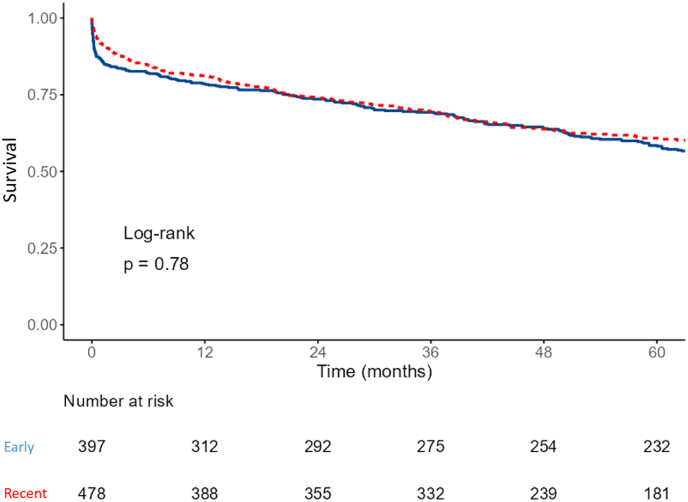
8332 admitted patients were analyzed, 4366 (52.4 %) in the early period, and 3966 (47.6 %) in the recent period. In the recent cohort, ischemic heart disease decreased significantly (from 45.2 % to 34.7 %), while hypertension and smoking rates increased. Additionally, a significant increase in coronary artery bypass grafting (from 0.8 % to 3.5 %) and beta-blockers prescription (from 45.5 % to 63.4 %) post-discharge was observed. However, no substantial improvement in in-hospital mortality (8.9 % in early vs. 8.0 % in recent), 30-day (3.2 % in early vs. 3.1 % in recent), 1-year (23.3 % in early vs. 23.8 % in recent), or 5-year survival rates was noted between cohorts. A subset analysis of patients admitted to cardiology departments showed a significant reduction in in-hospital mortality in the recent cohort (12.3 % in early vs. 6.3 % in recent), yet without a corresponding long-term survival benefit.
Advancements in heart failure management over the 11-year study period did not demonstrate an improvement in clinical outcomes for ADHF patients, highlighting the challenge of translating advancements in the medical care of ADHF patients into long-term survival benefits.
急性失代偿性心力衰竭(ADHF)与频繁住院相关,在全球范围内造成了重大的健康和经济负担。尽管心力衰竭管理取得了进展,但描述ADHF结局时间趋势的研究却很稀少。
在这项回顾性分析中,2007年至2017年入住沙米尔医疗中心的ADHF患者被分为两个队列:早期(2007 - 2011年)和近期(2012 - 2017年)。比较了临床特征、住院期间的干预措施和结局。使用Kaplan-Meier方法和对数秩检验进行生存分析。
共分析了8332例入院患者,早期为4366例(52.4%),近期为3966例(47.6%)。在近期队列中,缺血性心脏病显著减少(从45.2%降至34.7%),而高血压和吸烟率增加。此外,观察到出院后冠状动脉旁路移植术(从0.8%增至3.5%)和β受体阻滞剂处方(从45.5%增至63.4%)显著增加。然而,队列之间在住院死亡率(早期为8.9%,近期为8.0%)、30天死亡率(早期为3.2%,近期为3.1%)、1年生存率(早期为23.3%,近期为23.8%)或5年生存率方面未发现实质性改善。对心内科住院患者的亚组分析显示,近期队列的住院死亡率显著降低(早期为12.3%,近期为6.3%),但没有相应的长期生存益处。
在11年的研究期间,心力衰竭管理的进展并未显示ADHF患者的临床结局有所改善,这凸显了将ADHF患者医疗护理方面的进展转化为长期生存益处的挑战。