Centre for Health Economics, University of York, UK.
Department of Pharmacy, University of Washington, Seattle, USA.
Med Decis Making. 2024 Oct;44(7):756-769. doi: 10.1177/0272989X241263356. Epub 2024 Jul 26.
Recent developments in causal inference and machine learning (ML) allow for the estimation of individualized treatment effects (ITEs), which reveal whether treatment effectiveness varies according to patients' observed covariates. ITEs can be used to stratify health policy decisions according to individual characteristics and potentially achieve greater population health. Little is known about the appropriateness of available ML methods for use in health technology assessment.
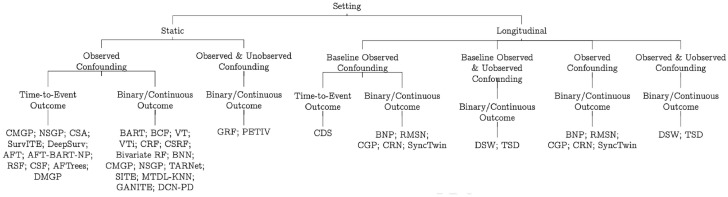
In this scoping review, we evaluate ML methods available for estimating ITEs, aiming to help practitioners assess their suitability in health technology assessment. We present a taxonomy of ML approaches, categorized by key challenges in health technology assessment using observational data, including handling time-varying confounding and time-to event data and quantifying uncertainty.
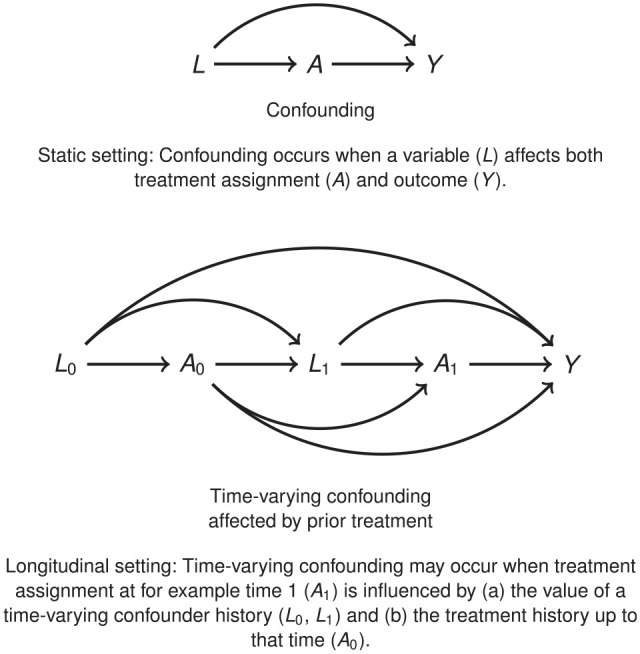
We found a wide range of algorithms for simpler settings with baseline confounding and continuous or binary outcomes. Not many ML algorithms can handle time-varying or unobserved confounding, and at the time of writing, no ML algorithm was capable of estimating ITEs for time-to-event outcomes while accounting for time-varying confounding. Many of the ML algorithms that estimate ITEs in longitudinal settings do not formally quantify uncertainty around the point estimates.
This scoping review may not cover all relevant ML methods and algorithms as they are continuously evolving.
Existing ML methods available for ITE estimation are limited in handling important challenges posed by observational data when used for cost-effectiveness analysis, such as time-to-event outcomes, time-varying and hidden confounding, or the need to estimate sampling uncertainty around the estimates.
ML methods are promising but need further development before they can be used to estimate ITEs for health technology assessments.
Estimating individualized treatment effects (ITEs) using observational data and machine learning (ML) can support personalized treatment advice and help deliver more customized information on the effectiveness and cost-effectiveness of health technologies.ML methods for ITE estimation are mostly designed for handling confounding at baseline but not time-varying or unobserved confounding. The few models that account for time-varying confounding are designed for continuous or binary outcomes, not time-to-event outcomes.Not all ML methods for estimating ITEs can quantify the uncertainty of their predictions.Future work on developing ML that addresses the concerns summarized in this review is needed before these methods can be widely used in clinical and health technology assessment-like decision making.
因果推断和机器学习(ML)的最新发展使得个体化治疗效果(ITE)的估计成为可能,这揭示了治疗效果是否根据患者的观测协变量而有所不同。ITE 可用于根据个体特征对卫生政策决策进行分层,并有可能实现更大的人群健康。目前对于可用的 ML 方法在卫生技术评估中的适用性知之甚少。
在本次范围界定综述中,我们评估了用于估计 ITE 的 ML 方法,旨在帮助从业者评估它们在卫生技术评估中的适用性。我们提出了一种 ML 方法分类法,根据使用观察数据进行卫生技术评估的关键挑战进行分类,包括处理时变混杂和事件时间数据以及量化不确定性。
我们发现了一系列用于更简单设置的算法,这些设置具有基线混杂和连续或二分类结局。没有多少 ML 算法可以处理时变或未观测到的混杂,并且在撰写本文时,没有任何 ML 算法能够在考虑时变混杂的情况下估计事件时间结局的 ITE。许多在纵向设置中估计 ITE 的 ML 算法并没有正式量化点估计周围的不确定性。
由于 ML 方法和算法不断发展,本次范围界定综述可能无法涵盖所有相关的 ML 方法和算法。
现有的用于 ITE 估计的 ML 方法在用于成本效益分析时,在处理观察数据带来的重要挑战方面存在局限性,例如事件时间结局、时变和隐藏混杂,或者需要估计估计值周围的抽样不确定性。
ML 方法很有前途,但在它们可以用于卫生技术评估的 ITE 估计之前,还需要进一步开发。
使用观察数据和机器学习(ML)估计个体化治疗效果(ITE)可以支持个性化治疗建议,并帮助提供有关卫生技术的有效性和成本效益的更具针对性的信息。用于 ITE 估计的 ML 方法主要设计用于处理基线混杂,但不能处理时变或未观测到的混杂。少数能够处理时变混杂的模型则是为连续或二分类结局设计的,而不是为事件时间结局设计的。并非所有用于估计 ITE 的 ML 方法都可以量化其预测的不确定性。在这些方法可以广泛用于临床和卫生技术评估决策等领域之前,需要开展关于开发能够解决综述中总结的问题的 ML 的工作。