Martínez Rodríguez Erick J, Phelan P Larry, Canas Luis, Acosta Nuris, Rakotondraibe Harinantenaina L, Piermarini Peter M
College of Food, Agriculture and Environmental Sciences, The Ohio State University, Wooster, OH 44691, USA.
College of Pharmacy, The Ohio State University, Columbus, OH 43210, USA.
Insects. 2024 Jul 10;15(7):517. doi: 10.3390/insects15070517.
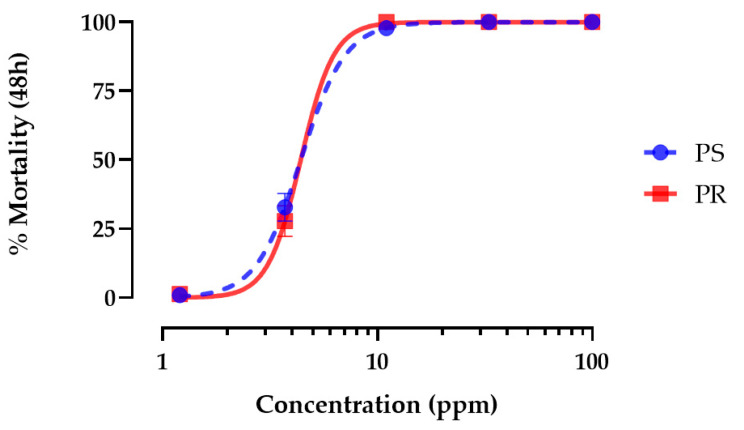
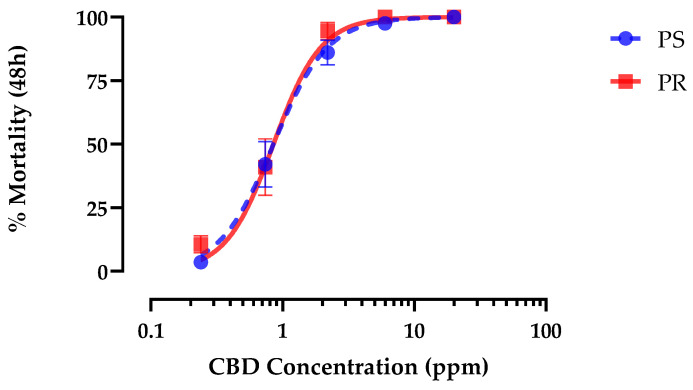
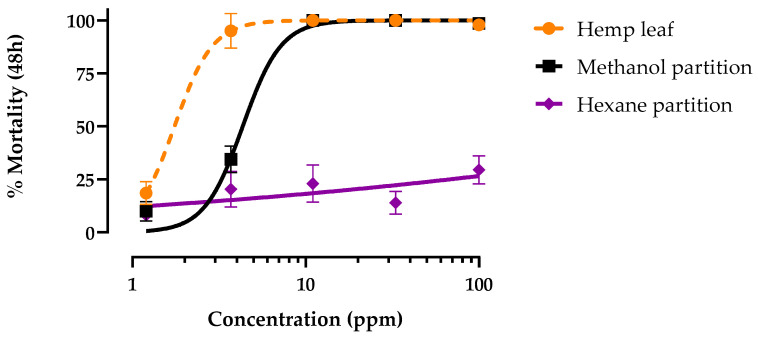
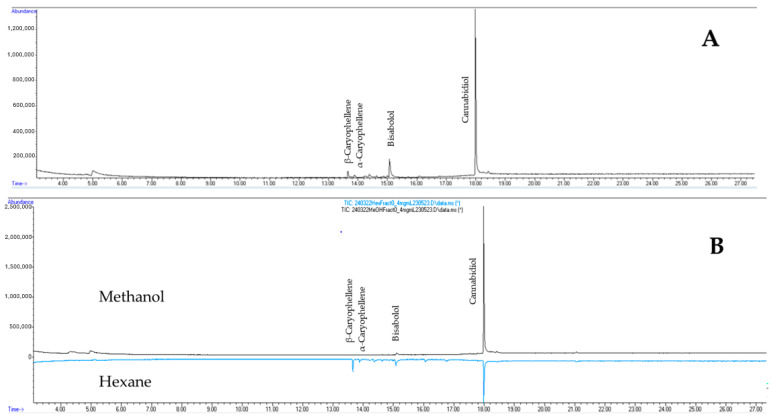
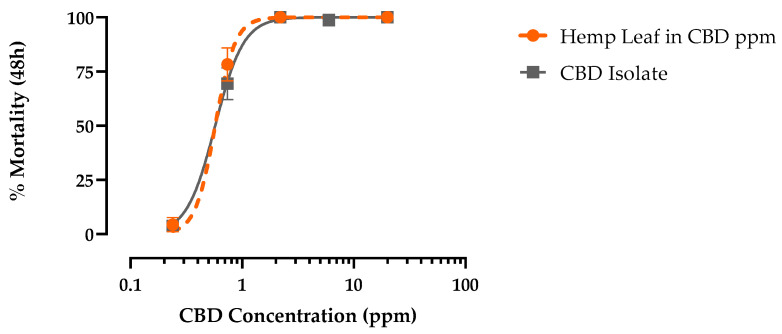
To mitigate pyrethroid resistance in mosquito vectors of emerging and re-emerging human pathogens, there is an urgent need to discover insecticides with novel modes of action. Natural alternatives, such as extracts derived from plants, may serve as substitutes for traditional synthetic insecticides if they prove to be sustainable, cost-effective, and safe for non-target organisms. Hemp () is a sustainable plant known to produce various secondary metabolites with insecticidal properties, including terpenoids and flavonoids. The goal of this study was to assess the larvicidal activity of hemp leaf extract on mosquito larvae from both pyrethroid-susceptible (PS) and pyrethroid-resistant (PR) strains of . Another goal was to identify which components of the extract were responsible for any observed larvicidal activity. We found that a methanol extract of hemp leaves induced similar concentration-dependent larvicidal activity against PS (LC: 4.4 ppm) and PR (LC: 4.3 ppm) strains within 48 h. Partitioning of the leaf extract between methanol and hexane fractions revealed that full larvicidal activity was restricted to the methanol fraction. Analysis of this fraction by gas chromatography-mass spectrometry and nuclear magnetic resonance showed it to be dominated by cannabidiol (CBD). Larvicidal assays using authentic CBD confirmed this compound was primarily responsible for the toxicity of the hemp leaf extract against both strains. We conclude that hemp leaf extracts and CBD have the potential to serve as viable sources for the development of novel mosquito larvicides.
为减轻新兴和再发人类病原体的蚊媒对拟除虫菊酯的抗性,迫切需要发现具有新作用方式的杀虫剂。天然替代品,如植物提取物,如果被证明具有可持续性、成本效益且对非靶标生物安全,可能会替代传统的合成杀虫剂。大麻()是一种可持续植物,已知能产生多种具有杀虫特性的次生代谢产物,包括萜类化合物和黄酮类化合物。本研究的目的是评估大麻叶提取物对拟除虫菊酯敏感(PS)和拟除虫菊酯抗性(PR)品系蚊虫幼虫的杀幼虫活性。另一个目的是确定提取物中哪些成分导致了所观察到的杀幼虫活性。我们发现,大麻叶的甲醇提取物在48小时内对PS品系(LC:4.4 ppm)和PR品系(LC:4.3 ppm)诱导出相似的浓度依赖性杀幼虫活性。叶提取物在甲醇和己烷馏分之间的分配显示,全部杀幼虫活性局限于甲醇馏分。通过气相色谱 - 质谱联用和核磁共振对该馏分进行分析表明,其主要成分是大麻二酚(CBD)。使用纯CBD进行的杀幼虫试验证实,该化合物是大麻叶提取物对两个品系毒性的主要原因。我们得出结论,大麻叶提取物和CBD有潜力成为开发新型蚊虫杀幼虫剂的可行来源。