CBQF-Centro de Biotecnologia e Química Fina Laboratório Associado, Escola Superior de Biotecnologia, Universidade Católica Portuguesa, Rua Diogo Botelho 1327, 4169-005 Porto, Portugal.
i3S-Instituto de Investigacão e Inovacão em Saúde, Universidade do Porto, 4200-135 Porto, Portugal.
Mar Drugs. 2024 Jul 18;22(7):319. doi: 10.3390/md22070319.
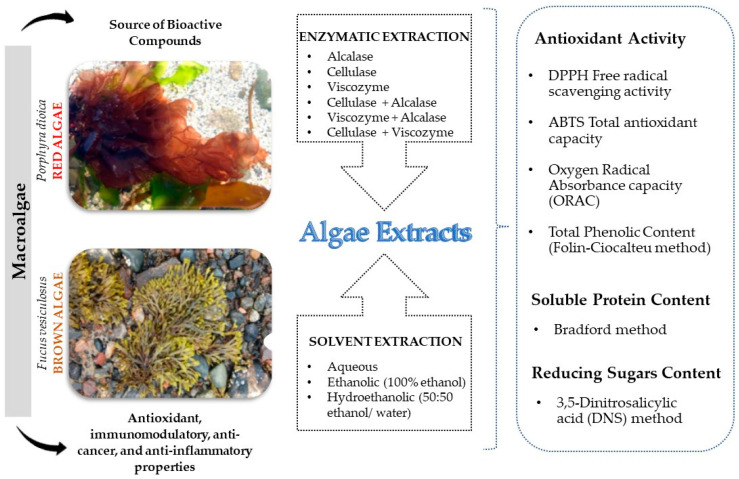
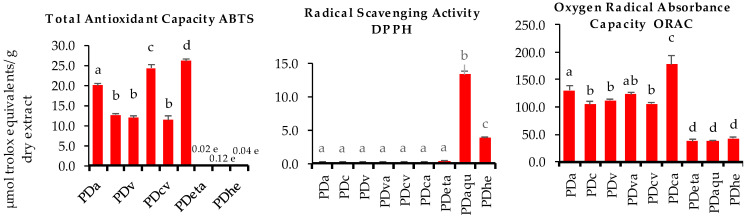
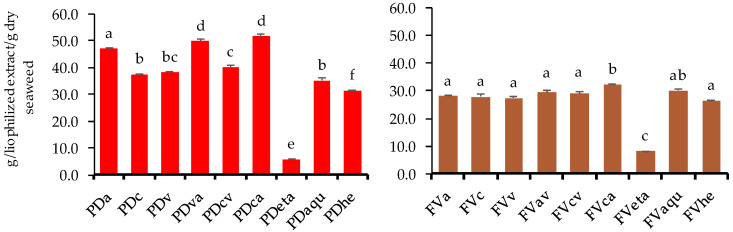
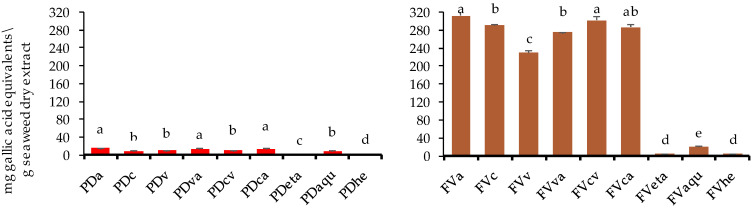
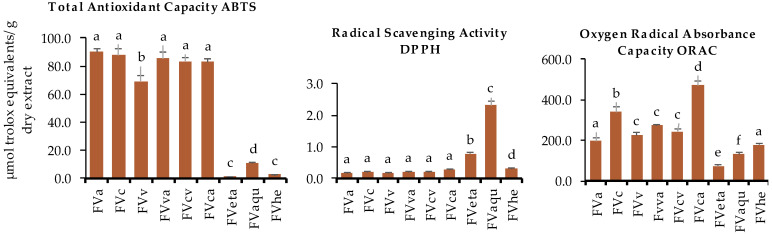
Extraction strategies impact the efficiency and nature of extracted compounds. This work assessed the chemical composition and antioxidant capacity of ethanolic, hydroethanolic, and aqueous versus enzyme-assisted extracts (isolated or with the sequential use of alcalase, cellulase, and viscozyme) of the macroalgae (brown, ) and (red, . For both macroalgae, enzyme-assisted extraction (EAE) was the most efficient process compared to solvent-assisted extraction (SAE), independent of solvent. extraction yields were higher for EAE than for SAE (27.4% to 32.2% and 8.2% to 30.0%, respectively). Total phenolics content (TPC) was at least 10-fold higher in EAE extracts (229.2 to 311.3 GAE/g) than in SAE (4.34 to 19.6 GAE/g) counterparts and correlated well with antioxidant capacity (ABTS and ORAC methods), with EAE achieving values up to 8- and 2.6-fold higher than those achieved by SAE, respectively. followed trend for extraction yields (37.5% to 51.6% for EAE and 5.7% to 35.1% for SAE), TPC, although of a lower magnitude, (0.77 to 8.95 GAE/g for SE and 9.37 to 14.73 GAE/g for EAE), and antioxidant capacity. Aqueous extracts registered the highest DPPH values for both macroalgae, with 2.3 µmol TE/g and 13.3 µmol TE/g for and , respectively. EAE was a more efficient process in the extraction of soluble protein and reducing sugars in comparison to SAE. Furthermore, an improved effect of enzyme-assisted combinations was observed for almost all analyzed parameters. This study shows the promising application of enzyme-assisted extraction for the extraction of valuable compounds from and , making them excellent functional ingredients for a wide range of health and food industrial applications.
提取策略会影响提取化合物的效率和性质。本研究评估了乙醇、水醇和水与酶辅助提取(单独或依次使用碱性蛋白酶、纤维素酶和黏多糖酶)对大型藻类(褐藻和红藻)的化学成分和抗氧化能力的影响。对于这两种大型藻类,与溶剂辅助提取(SAE)相比,酶辅助提取(EAE)是最有效的工艺,而与溶剂无关。EAE 的提取产率高于 SAE(分别为 27.4%至 32.2%和 8.2%至 30.0%)。EAE 提取物中的总酚含量(TPC)至少比 SAE 提取物高 10 倍(分别为 229.2 至 311.3 GAE/g 和 4.34 至 19.6 GAE/g),并且与抗氧化能力(ABTS 和 ORAC 方法)密切相关,EAE 提取物的抗氧化能力最高可达 SAE 的 8 倍和 2.6 倍。EAE 也遵循了提取产率(分别为 37.5%至 51.6%和 5.7%至 35.1%)、TPC(尽管幅度较小,分别为 0.77 至 8.95 GAE/g 和 9.37 至 14.73 GAE/g)和抗氧化能力的趋势。对于这两种大型藻类,水提取物的 DPPH 值最高,分别为 2.3 µmol TE/g 和 13.3 µmol TE/g。与 SAE 相比,EAE 是提取可溶性蛋白质和还原糖的更有效工艺。此外,几乎所有分析参数都观察到酶辅助组合的效果得到了改善。本研究表明,酶辅助提取在提取和 的有价值化合物方面具有广阔的应用前景,使其成为广泛的健康和食品工业应用的优秀功能成分。