Gómez-Mesa Juan Esteban, Escalante Manuela, Muñoz-Ordoñez Juan Andrés, Azcárate-Rodriguez Valeria, Peláez-Martínez Juan David, Arteaga-Tobar Andrea Alejandra, León-Giraldo Hoover, Valencia-Orozco Andrea, Perna Eduardo Roque, Romero Alexander, Mendoza Iván, Wyss Fernando, Barisani José Luis, Speranza Mario, Alarco Walter, Herrera Cesar, Lugo-Peña Julián, Cárdenas-Aldaz Liliana Patricia, Rossel Victor, Sierra Daniel
Departamento de Cardiología, Fundación Valle del Lili, Cali 760032, Colombia.
Facultad de Ciencias de Salud, Universidad Icesi, Cali 760031, Colombia.
J Cardiovasc Dev Dis. 2024 Jun 30;11(7):205. doi: 10.3390/jcdd11070205.
The COVID-19 pandemic has highlighted a correlation between cardiac complications and elevated cardiac biomarkers, which are linked to poorer clinical outcomes.
This study aims to determine the clinical impact of cardiac biomarkers in COVID-19 patients in Latin America.
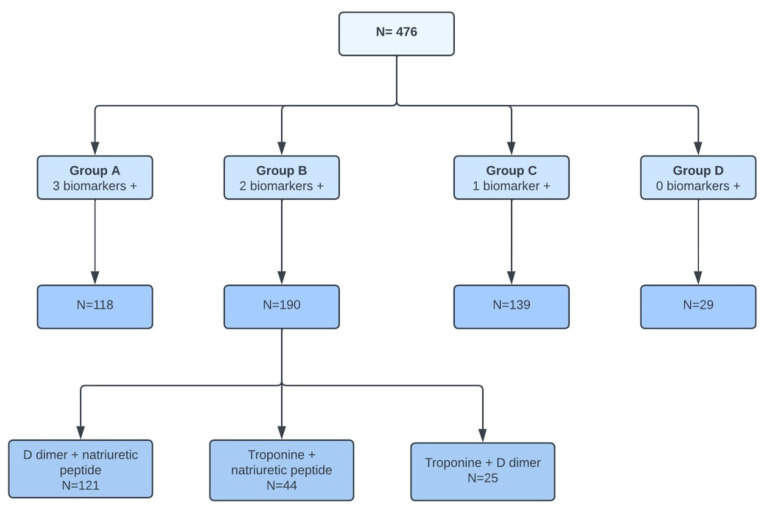
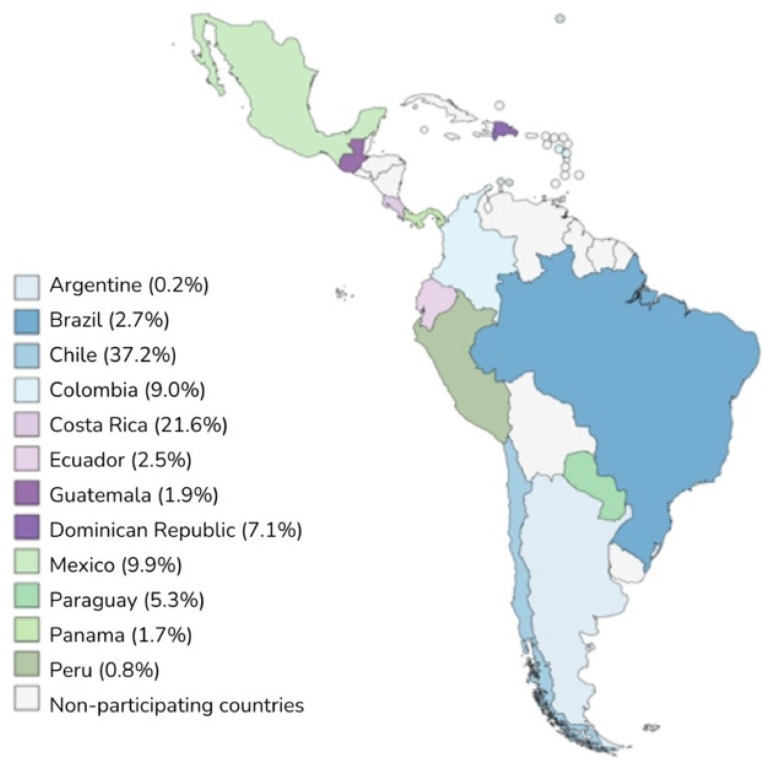
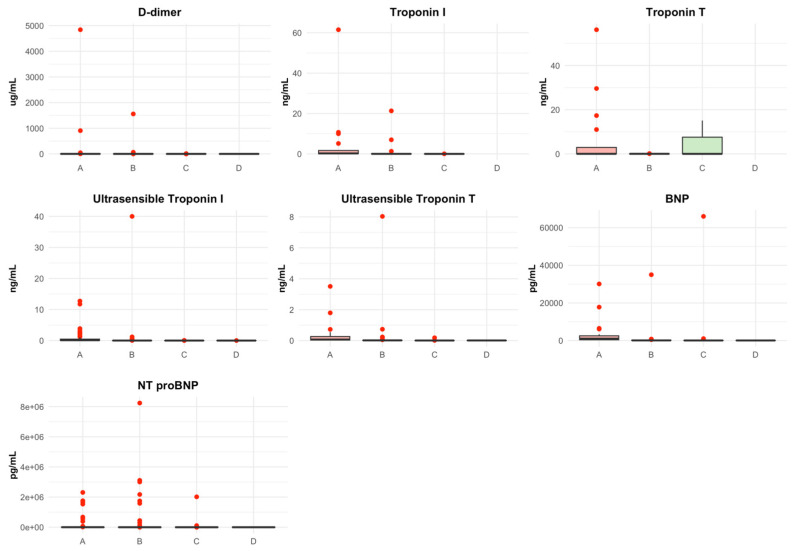
The CARDIO COVID 19-20 Registry is a multicenter observational study across 44 hospitals in Latin America and the Caribbean. It included hospitalized COVID-19 patients ( = 476) who underwent troponin, natriuretic peptide, and D-dimer tests. Patients were grouped based on the number of positive biomarkers.
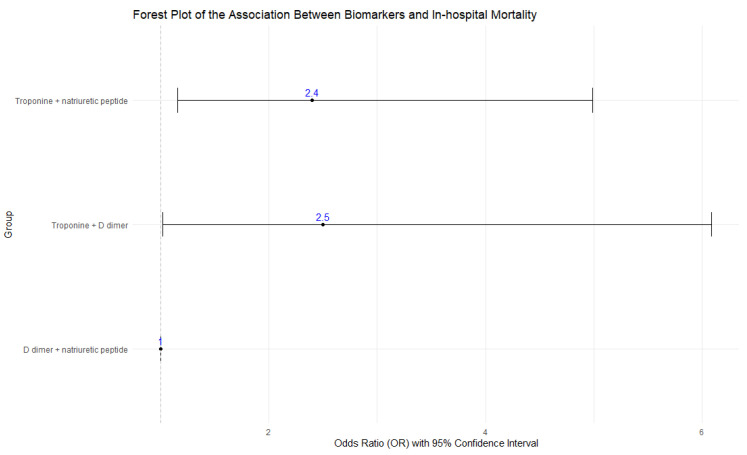
Among the 476 patients tested, 139 had one positive biomarker (Group C), 190 had two (Group B), 118 had three (Group A), and 29 had none (Group D). A directly proportional relationship was observed between the number of positive biomarkers and the incidence of decompensated heart failure. Similarly, there was a proportional relationship between the number of positive biomarkers and increased mortality. In Group B, patients with elevated troponin and natriuretic peptide and those with elevated troponin and D-dimer had 1.4 and 1.5 times higher mortality, respectively, than those with elevated natriuretic peptide and D-dimer.
In Latin American COVID-19 patients, a higher number of positive cardiac biomarkers is associated with increased cardiovascular complications and mortality. These findings suggest that cardiac biomarkers should be utilized to guide acute-phase treatment strategies.
新冠疫情凸显了心脏并发症与心脏生物标志物升高之间的关联,而这与较差的临床结局相关。
本研究旨在确定心脏生物标志物对拉丁美洲新冠患者的临床影响。
CARDIO COVID 19 - 20登记研究是一项在拉丁美洲和加勒比地区44家医院开展的多中心观察性研究。纳入了接受肌钙蛋白、利钠肽和D - 二聚体检测的住院新冠患者(n = 476)。患者根据阳性生物标志物的数量进行分组。
在476例接受检测的患者中,139例有一项阳性生物标志物(C组),190例有两项(B组),118例有三项(A组),29例无阳性生物标志物(D组)。观察到阳性生物标志物的数量与失代偿性心力衰竭的发生率之间存在正比关系。同样,阳性生物标志物的数量与死亡率增加之间也存在比例关系。在B组中,肌钙蛋白和利钠肽升高的患者以及肌钙蛋白和D - 二聚体升高的患者的死亡率分别比利钠肽和D - 二聚体升高的患者高1.4倍和1.5倍。
在拉丁美洲的新冠患者中,心脏生物标志物阳性数量越多,心血管并发症和死亡率越高。这些发现表明,心脏生物标志物应用于指导急性期治疗策略。