Department of Biomedical Engineering, Virginia Commonwealth University, Richmond, VA, 23284, USA.
Department of Biomedical Engineering, Virginia Commonwealth University, Richmond, VA, 23284, USA.
Acta Biomater. 2024 Sep 1;185:190-202. doi: 10.1016/j.actbio.2024.07.014. Epub 2024 Jul 24.
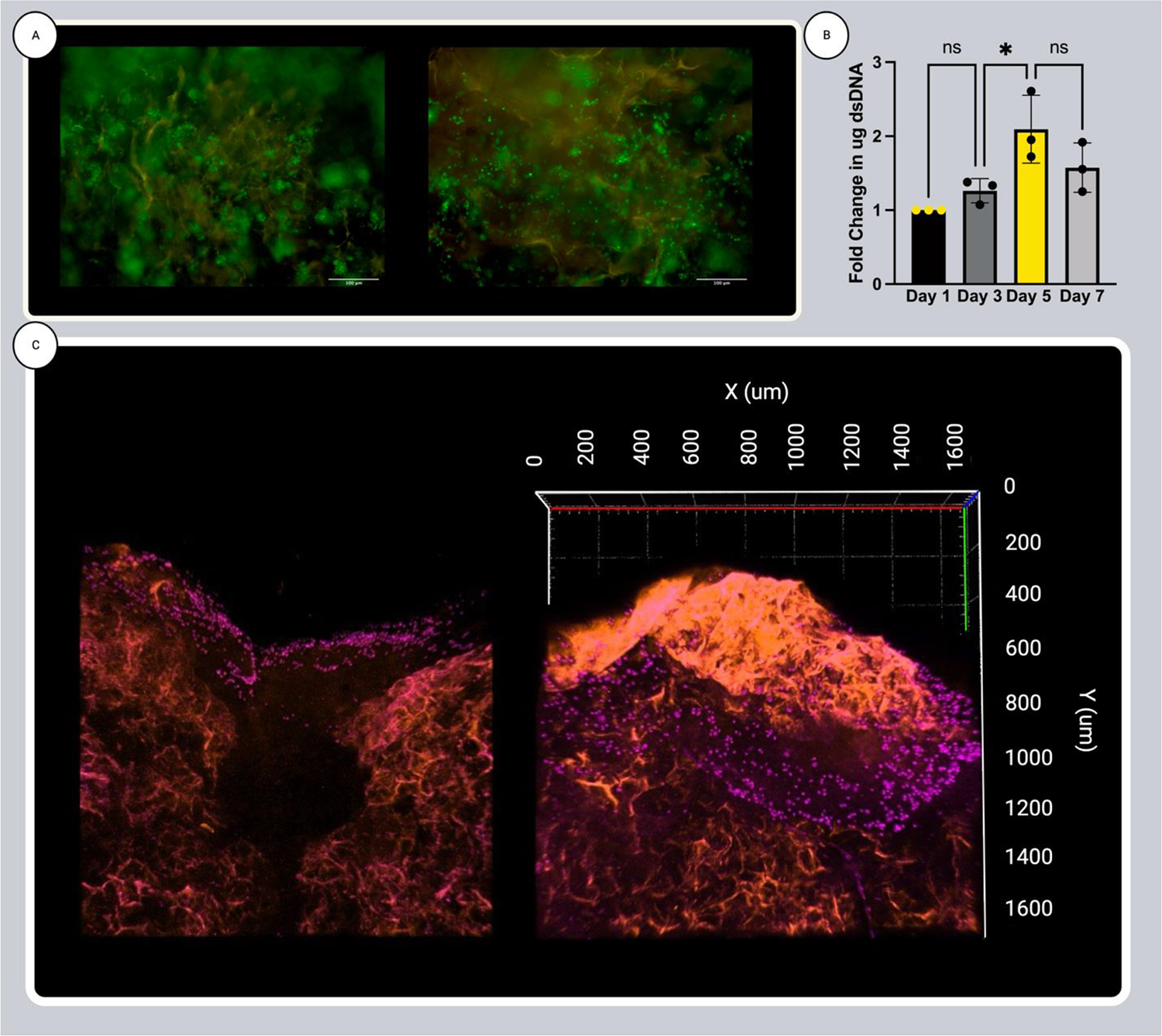
Limited treatments and a lack of appropriate animal models have spurred the study of scaffolds to mimic lung disease in vitro. Decellularized human lung and its application in extracellular matrix (ECM) hydrogels has advanced the development of these lung ECM models. Controlling the biochemical and mechanical properties of decellularized ECM hydrogels continues to be of interest due to inherent discrepancies of hydrogels when compared to their source tissue. To optimize the physiologic relevance of ECM hydrogel lung models without sacrificing the native composition we engineered a binary fabrication system to produce a Hybridgel composed of an ECM hydrogel reinforced with an ECM cryogel. Further, we compared the effect of ECM-altering disease on the properties of the gels using elastin poor Chronic Obstructive Pulmonary Disease (COPD) vs non-diseased (ND) human lung source tissue. Nanoindentation confirmed the significant loss of elasticity in hydrogels compared to that of ND human lung and further demonstrated the recovery of elastic moduli in ECM cryogels and Hybridgels. These findings were supported by similar observations in diseased tissue and gels. Successful cell encapsulation, distribution, cytotoxicity, and infiltration were observed and characterized via confocal microscopy. Cells were uniformly distributed throughout the Hybridgel and capable of survival for 7 days. Cell-laden ECM hybridgels were found to have elasticity similar to that of ND human lung. Compositional investigation into diseased and ND gels indicated the conservation of disease-specific elastin to collagen ratios. In brief, we have engineered a composited ECM hybridgel for the 3D study of cell-matrix interactions of varying lung disease states that optimizes the application of decellularized lung ECM materials to more closely mimic the human lung while conserving the compositional bioactivity of the native ECM. STATEMENT OF SIGNIFICANCE: The lack of an appropriate disease model for the study of chronic lung diseases continues to severely inhibit the advancement of treatments and preventions of these otherwise fatal illnesses due to the inability to recapture the biocomplexity of pathologic cell-ECM interactions. Engineering biomaterials that utilize decellularized lungs offers an opportunity to deconstruct, understand, and rebuild models that highlight and investigate how disease specific characteristics of the extracellular environment are involved in driving disease progression. We have advanced this space by designing a binary fabrication system for a ECM Hybridgel that retains properties from its source material required to observe native matrix interactions. This design simulates a 3D lung environment that is both mechanically elastic and compositionally relevant when derived from non-diseased tissue and pathologically diminished both mechanically and compositionally when derived from COPD tissue. Here we describe the ECM hybridgel as a model for the study of cell-ECM interactions involved in COPD.

有限的治疗方法和缺乏合适的动物模型促使人们研究支架来模拟体外的肺部疾病。脱细胞人肺及其在细胞外基质 (ECM) 水凝胶中的应用促进了这些肺 ECM 模型的发展。由于水凝胶与其来源组织之间存在固有差异,因此控制脱细胞 ECM 水凝胶的生化和机械性能仍然是人们感兴趣的话题。为了在不牺牲天然成分的情况下优化 ECM 水凝胶肺模型的生理相关性,我们设计了一种二元制造系统来生产一种由 ECM 水凝胶增强的 ECM 冷冻凝胶组成的 Hybridgel。此外,我们比较了 ECM 改变疾病对凝胶性质的影响,使用弹性蛋白缺乏的慢性阻塞性肺疾病 (COPD) 与非疾病 (ND) 人肺源组织。纳米压痕证实了水凝胶的弹性明显低于 ND 人肺,进一步证明了 ECM 冷冻凝胶和 Hybridgel 中弹性模量的恢复。这些发现得到了疾病组织和凝胶中类似观察结果的支持。通过共聚焦显微镜成功观察和表征了细胞的包封、分布、细胞毒性和浸润。细胞均匀分布在 Hybridgel 中,并能够存活 7 天。发现细胞负载的 ECM 混合凝胶的弹性与人 ND 肺相似。对疾病和 ND 凝胶的组成研究表明,保留了疾病特异性弹性蛋白与胶原蛋白的比例。简而言之,我们已经为不同的肺部疾病状态下细胞-基质相互作用的 3D 研究设计了一种组合 ECM 混合凝胶,该凝胶优化了脱细胞肺 ECM 材料的应用,使其更接近模拟人类肺,同时保留了天然 ECM 的组成生物活性。意义声明:由于无法重现病理性细胞-ECM 相互作用的生物复杂性,用于研究慢性肺部疾病的合适疾病模型的缺乏继续严重抑制了这些疾病的治疗和预防的进展。利用脱细胞肺的工程生物材料提供了一个解构、理解和重建模型的机会,突出和研究细胞外环境的疾病特异性特征如何参与驱动疾病进展。我们通过设计一种用于 ECM Hybridgel 的二元制造系统来推进这一领域,该系统保留了其来源材料所需的特性,以观察天然基质相互作用。当从非疾病组织中提取时,这种设计模拟了一个机械弹性的 3D 肺环境,并且当从 COPD 组织中提取时,在机械和组成方面都具有病理上的减弱。在这里,我们将 ECM Hybridgel 描述为 COPD 中细胞-ECM 相互作用研究的模型。