Oliveira Susana Mendonça, Carvalho Patrícia Dias, Serra-Roma André, Oliveira Patrícia, Ribeiro Andreia, Carvalho Joana, Martins Flávia, Machado Ana Luísa, Oliveira Maria José, Velho Sérgia
i3S-Instituto de Investigação e Inovação em Saúde, Universidade do Porto, Rua Alfredo Allen 208, 4200-135 Porto, Portugal.
IPATIMUP-Instituto de Patologia e Imunologia Molecular, Universidade do Porto, Rua Júlio Amaral de Carvalho 45, 4200-135 Porto, Portugal.
Cancers (Basel). 2024 Jul 20;16(14):2595. doi: 10.3390/cancers16142595.
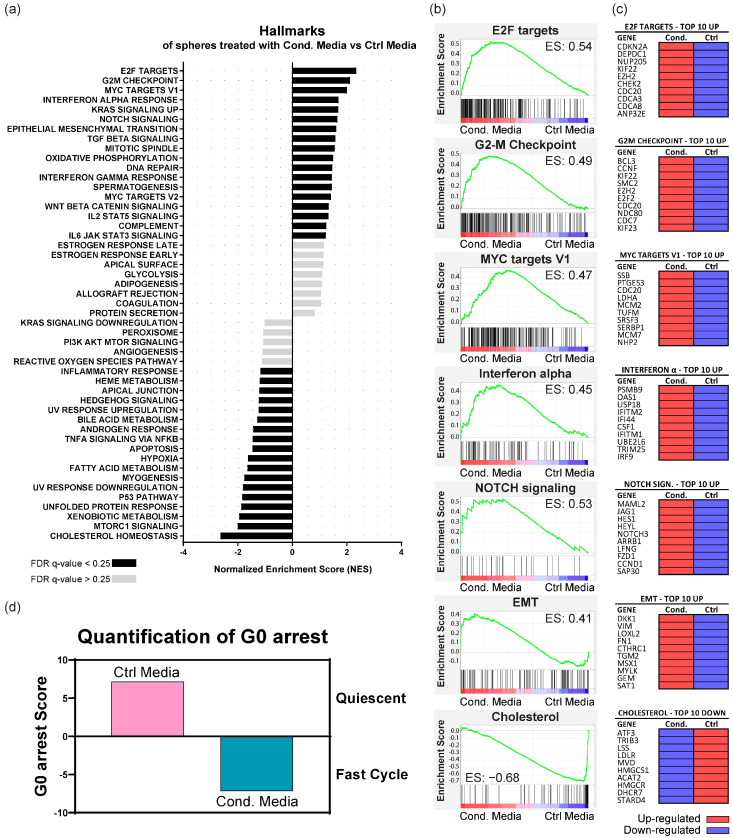
Colorectal cancer (CRC) responses to KRAS-targeted inhibition have been limited due to low response rates, the mechanisms of which remain unknown. Herein, we explored the cancer-associated fibroblasts (CAFs) secretome as a mediator of resistance to KRAS silencing. CRC cell lines HCT15, HCT116, and SW480 were cultured either in recommended media or in conditioned media from a normal colon fibroblast cell line (CCD-18Co) activated with rhTGF-β1 to induce a CAF-like phenotype. The expression of membrane stem cell markers was analyzed by flow cytometry. Stem cell potential was evaluated by a sphere formation assay. RNAseq was performed in KRAS-silenced HCT116 colonospheres treated with either control media or conditioned media from CAFs. Our results demonstrated that KRAS-silencing up-regulated CD24 and down-regulated CD49f and CD104 in the three cell lines, leading to a reduction in sphere-forming efficiency. However, CAF-secreted factors restored stem cell marker expression and increased stemness. RNA sequencing showed that CAF-secreted factors up-regulated genes associated with pro-tumorigenic pathways in KRAS-silenced cells, including KRAS, TGFβ, NOTCH, WNT, MYC, cell cycle progression and exit from quiescence, epithelial-mesenchymal transition, and immune regulation. Overall, our results suggest that resistance to KRAS-targeted inhibition might derive not only from cell-intrinsic causes but also from external elements, such as fibroblast-secreted factors.
由于反应率较低,结直肠癌(CRC)对KRAS靶向抑制的反应一直有限,其机制尚不清楚。在此,我们探索了癌症相关成纤维细胞(CAF)分泌组作为对KRAS沉默耐药的介质。将CRC细胞系HCT15、HCT116和SW480分别培养在推荐培养基中或来自用rhTGF-β1激活以诱导CAF样表型的正常结肠成纤维细胞系(CCD-18Co)的条件培养基中。通过流式细胞术分析膜干细胞标志物的表达。通过球体形成试验评估干细胞潜能。对用对照培养基或CAF条件培养基处理的KRAS沉默的HCT116结肠球进行RNA测序。我们的结果表明,KRAS沉默在这三种细胞系中上调了CD24并下调了CD49f和CD104,导致球体形成效率降低。然而,CAF分泌的因子恢复了干细胞标志物的表达并增加了干性。RNA测序表明,CAF分泌的因子上调了KRAS沉默细胞中与促肿瘤发生途径相关的基因,包括KRAS、TGFβ、NOTCH、WNT、MYC、细胞周期进程和从静止状态退出、上皮-间质转化以及免疫调节。总体而言,我们的结果表明,对KRAS靶向抑制的耐药性可能不仅源于细胞内在原因,还源于外部因素,如成纤维细胞分泌的因子。