Naji Franjo Husam, Alatic Jan, Balevski Igor, Suran David
University Clinical Center, 2000 Maribor, Slovenia.
Faculty of Medicine, University of Maribor, 2000 Maribor, Slovenia.
Diagnostics (Basel). 2024 Jul 19;14(14):1570. doi: 10.3390/diagnostics14141570.
It has been shown that obesity and a higher body mass index (BMI) are associated with a higher recurrence rate of atrial fibrillation (AF) after successful catheter ablation (CA). The same has been proven for the left atrial volume index (LAVI). It has also been shown that there is a correlation between LAVI and BMI. However, whether the LAVI's prognostic impact on AF recurrence is BMI-independent remains unclear.
We prospectively included 62 patients with paroxysmal AF who were referred to our institution for CA. All patients underwent radiofrequency CA with standard pulmonary veins isolation. Transthoracic 2-D echocardiography was performed one day after CA to obtain standard measures of cardiac function and morphology. Recurrence was defined as documented AF within 6 months of the follow-up period. Patients were also instructed to visit our outpatient clinic earlier in case of symptoms suggesting AF recurrence.
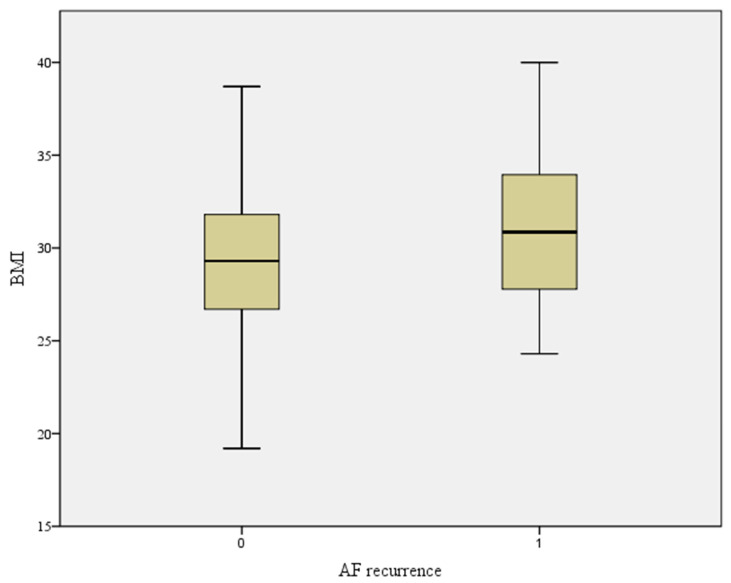
We observed AF recurrence in 27% of patients after 6 months. The mean BMI in our cohort was 29.65 ± 5.08 kg/cm and the mean LAVI was 38.04 ± 11.38 mL/m. We further divided patients into two groups according to BMI. Even though the LAVI was similar in both groups, we found it to be a significant predictor of AF recurrence only in obese patients (BMI ≥ 30) and not in the non-obese group (BMI < 30). There was also no significant difference in AF recurrence between both cohorts. The significance of the LAVI as an AF recurrence predictor in the obesity group was also confirmed in a multivariate model.
According to our results, the LAVI tends to be a significant predictor of AF recurrence after successful catheter ablation in obese patients, but not in normal-weight or overweight patients. This would suggest different mechanisms of AF in non-obese patients in comparison to obese patients. Further studies are needed in this regard.
研究表明,肥胖和较高的体重指数(BMI)与成功进行导管消融(CA)后房颤(AF)的较高复发率相关。左心房容积指数(LAVI)也被证实有同样的情况。还表明LAVI与BMI之间存在相关性。然而,LAVI对AF复发的预后影响是否独立于BMI仍不清楚。
我们前瞻性纳入了62例因CA转诊至我院的阵发性AF患者。所有患者均接受标准肺静脉隔离的射频CA。CA术后一天进行经胸二维超声心动图检查,以获取心脏功能和形态的标准测量值。复发定义为随访期6个月内记录到的AF。还指示患者在出现提示AF复发的症状时尽早到门诊就诊。
6个月后,我们观察到27%的患者出现AF复发。我们队列中的平均BMI为29.65±5.08kg/cm,平均LAVI为38.04±11.38mL/m。我们根据BMI将患者进一步分为两组。尽管两组的LAVI相似,但我们发现它仅在肥胖患者(BMI≥30)中是AF复发的显著预测因子,而在非肥胖组(BMI<30)中不是。两组之间的AF复发也没有显著差异。多变量模型也证实了LAVI作为肥胖组AF复发预测因子的意义。
根据我们的结果,LAVI倾向于成为肥胖患者成功进行导管消融后AF复发的显著预测因子,但在正常体重或超重患者中不是。这表明与肥胖患者相比,非肥胖患者的AF机制不同。在这方面需要进一步研究。