Huang Sheng, Ziros Panos G, Chartoumpekis Dionysios V, Psarias Georgios, Duntas Leonidas, Zuo Xinhe, Li Xinyi, Ding Zhiguo, Sykiotis Gerasimos P
Department of Thyropathy, Dongzhimen Hospital, Beijing University of Chinese Medicine, Beijing 100700, China.
Service of Endocrinology, Diabetology and Metabolism, Lausanne University Hospital and University of Lausanne, 1011 Lausanne, Switzerland.
Antioxidants (Basel). 2024 Jul 19;13(7):868. doi: 10.3390/antiox13070868.
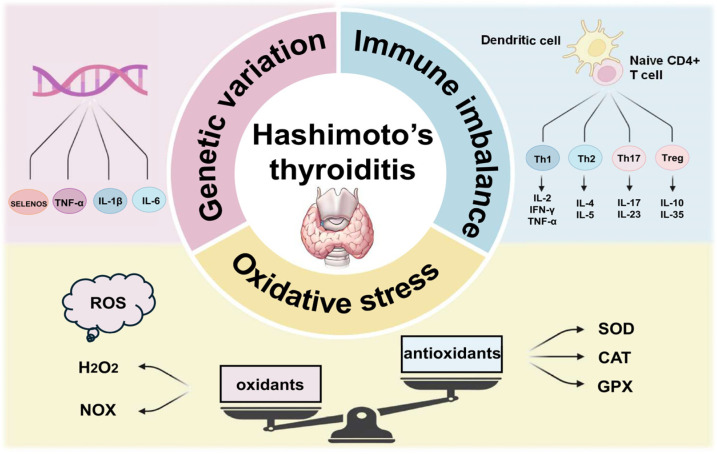
Hashimoto's thyroiditis (HT) is not only the most frequent autoimmune thyroid disease (AITD), but it also has a significant impact on patients' health-related quality of life (HRQoL), and it has been variably associated with differentiated thyroid carcinoma. Even though its pathogenesis is still incompletely understood, oxidative stress is believed to play an important role. Hypothyroidism related to later stages of HT can be treated with levothyroxine substitution therapy; various approaches such as selenium supplementation and iodine-restricted diets have been proposed as disease-modifying treatments for earlier stages, and even thyroidectomy has been suggested for refractory cases of painful HT. Nevertheless, many patients still report suboptimal HRQoL, highlighting an unmet medical need in this area. The concepts and approaches of traditional Chinese medicine (TCM) in treating HT are not broadly known in the West. Here, we provide an overview of TCM for HT, including combinations of TCM with selenium. We encompass evidence from clinical trials and other studies related to complex TCM prescriptions, single herbs used in TCM, and phytochemicals; wherever possible, we delineate the probable underlying molecular mechanisms. The findings show that the main active components of TCM for HT have commonly known or presumed antioxidant and anti-inflammatory activities, which may account for their potential utility in HT. Further exploring the practices of TCM for HT and combining them with evidence- and mechanism-based approaches according to Western standards may help to identify new strategies to alter the clinical course of the disease and/or to treat patients' symptoms better and improve their HRQoL.
桥本甲状腺炎(HT)不仅是最常见的自身免疫性甲状腺疾病(AITD),还对患者的健康相关生活质量(HRQoL)有重大影响,并且它与分化型甲状腺癌存在不同程度的关联。尽管其发病机制仍未完全明确,但氧化应激被认为起着重要作用。与HT后期相关的甲状腺功能减退可用左甲状腺素替代疗法治疗;已提出多种方法,如补充硒和限制碘饮食作为早期疾病改善治疗方法,甚至对于难治性疼痛性HT病例还建议进行甲状腺切除术。然而,许多患者仍报告生活质量未达最佳,凸显了该领域未满足的医疗需求。中医(TCM)治疗HT的概念和方法在西方并不广为人知。在此,我们概述中医治疗HT的方法,包括中医与硒的联合应用。我们涵盖来自临床试验和其他与复杂中医方剂、中医使用的单味草药及植物化学物质相关研究的证据;只要有可能,我们就描述其可能的潜在分子机制。研究结果表明,中医治疗HT的主要活性成分通常具有已知或推测的抗氧化和抗炎活性,这可能解释了它们在HT中的潜在效用。进一步探索中医治疗HT的实践,并根据西方标准将其与基于证据和机制的方法相结合,可能有助于确定改变疾病临床进程和/或更好地治疗患者症状并改善其生活质量的新策略。