Engineering Research Center of Cell & Therapeutic Antibody, Ministry of Education, School of Pharmacy, Shanghai Jiao Tong University, Shanghai 200240, China.
Nanozyme Medical Center, School of Basic Medical Sciences, Zhengzhou University, Zhengzhou 450001, China.
Int J Mol Sci. 2024 Jul 16;25(14):7798. doi: 10.3390/ijms25147798.
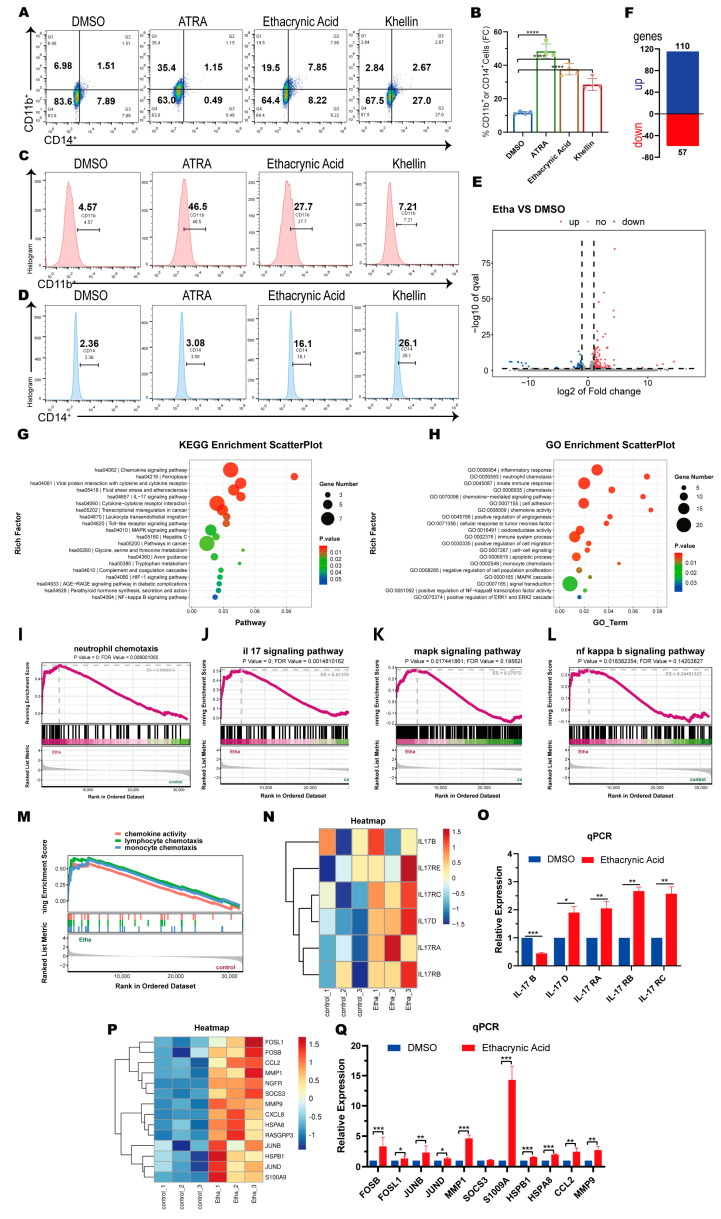
Acute myeloid leukemia (AML) is characterized by the abnormal proliferation and differentiation arrest of myeloid progenitor cells. The clinical treatment of AML remains challenging. Promoting AML cell differentiation is a valid strategy, but effective differentiation drugs are lacking for most types of AML. In this study, we generated Tg() zebrafish, in which overexpression was driven in hematopoietic cells and myeloid differentiation arrest was exhibited. Using Tg() embryos, we performed chemical screening and identified four FDA-approved drugs, ethacrynic acid, khellin, oxcarbazepine, and alendronate, that efficiently restored myeloid differentiation. The four drugs also induced AML cell differentiation, with ethacrynic acid being the most effective. By an RNA-seq analysis, we found that during differentiation, ethacrynic acid activated the IL-17 and MAPK signaling pathways, which are known to promote granulopoiesis. Furthermore, we found that ethacrynic acid enhanced all-trans retinoic acid (ATRA)-induced differentiation, and both types of signaling converged on the IL-17/MAPK pathways. Inhibiting the IL-17/MAPK pathways impaired ethacrynic acid and ATRA-induced differentiation. In addition, we showed that ethacrynic acid is less toxic to embryogenesis and less disruptive to normal hematopoiesis than ATRA. Thus, the combination of ethacrynic acid and ATRA may have broader clinical applications. In conclusion, through zebrafish-aided screening, our study identified four drugs that can be repurposed to induce AML differentiation, thus providing new agents for AML therapy.
急性髓系白血病(AML)的特征是髓系祖细胞的异常增殖和分化阻滞。AML 的临床治疗仍然具有挑战性。促进 AML 细胞分化是一种有效的策略,但大多数类型的 AML 缺乏有效的分化药物。在这项研究中,我们生成了 Tg()斑马鱼,其中在造血细胞中过表达,并表现出髓系分化阻滞。我们使用 Tg()胚胎进行了化学筛选,并鉴定出四种已获得 FDA 批准的药物,即依他尼酸、茴三硫、奥卡西平和阿仑膦酸钠,它们能有效地恢复髓系分化。这四种药物也能诱导 AML 细胞分化,其中依他尼酸的效果最显著。通过 RNA-seq 分析,我们发现依他尼酸在分化过程中激活了已知能促进粒细胞生成的 IL-17 和 MAPK 信号通路。此外,我们发现依他尼酸增强了全反式维甲酸(ATRA)诱导的分化,两种类型的信号通路都集中在 IL-17/MAPK 信号通路上。抑制 IL-17/MAPK 信号通路会损害依他尼酸和 ATRA 诱导的分化。此外,我们还表明,依他尼酸对胚胎发生的毒性比 ATRA 小,对正常造血的干扰也比 ATRA 小。因此,依他尼酸和 ATRA 的联合使用可能具有更广泛的临床应用。总之,通过斑马鱼辅助筛选,我们的研究鉴定出了四种可重新用于诱导 AML 分化的药物,从而为 AML 治疗提供了新的药物。