Department of Cytophysiology, Chair of Histology and Embryology, Faculty of Medical Sciences in Katowice, Medical University of Silesia in Katowice, 40-752 Katowice, Poland.
Students Scientific Society, Chair of Histology and Embryology, Faculty of Medical Sciences in Katowice, Medical University of Silesia in Katowice, 40-752 Katowice, Poland.
Int J Mol Sci. 2024 Jul 17;25(14):7806. doi: 10.3390/ijms25147806.
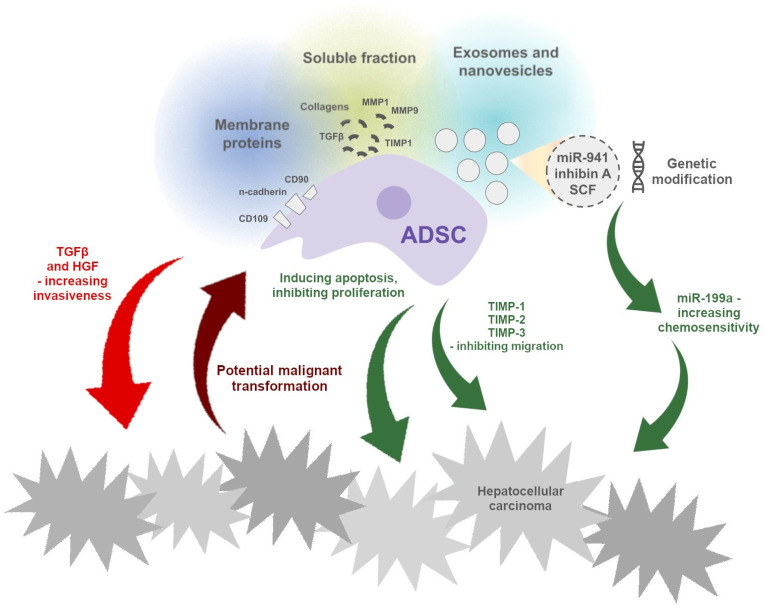
Hepatocellular carcinoma (HCC) ranks as the most prevalent of primary liver cancers and stands as the third leading cause of cancer-related deaths. Early-stage HCC can be effectively managed with available treatment modalities ranging from invasive techniques, such as liver resection and thermoablation, to systemic therapies primarily employing tyrosine kinase inhibitors. Unfortunately, these interventions take a significant toll on the body, either through physical trauma or the adverse effects of pharmacotherapy. Consequently, there is an understandable drive to develop novel HCC therapies. Adipose-derived stem cells (ADSCs) are a promising therapeutic tool. Their facile extraction process, coupled with the distinctive immunomodulatory capabilities of their secretome, make them an intriguing subject for investigation in both oncology and regenerative medicine. The factors they produce are both enzymes affecting the extracellular matrix (specifically, metalloproteinases and their inhibitors) as well as cytokines and growth factors affecting cell proliferation and invasiveness. So far, the interactions observed with various cancer cell types have not led to clear conclusions. The evidence shows both inhibitory and stimulatory effects on tumor growth. Notably, these effects appear to be dependent on the tumor type, prompting speculation regarding their potential inhibitory impact on HCC. This review briefly synthesizes findings from preclinical and clinical studies examining the effects of ADSCs on cancers, with a specific focus on HCC, and emphasizes the need for further research.
肝细胞癌 (HCC) 是最常见的原发性肝癌,也是癌症相关死亡的第三大主要原因。早期 HCC 可以通过从肝切除术和热消融等侵入性技术到主要使用酪氨酸激酶抑制剂的系统治疗等多种治疗方式进行有效管理。不幸的是,这些干预措施会对身体造成重大影响,无论是通过身体创伤还是药物治疗的不良反应。因此,人们有理由开发新的 HCC 治疗方法。脂肪来源的干细胞 (ADSCs) 是一种很有前途的治疗工具。它们易于提取,其分泌组具有独特的免疫调节能力,这使得它们成为肿瘤学和再生医学领域研究的一个有趣课题。它们产生的因子既有影响细胞外基质的酶(具体来说是金属蛋白酶及其抑制剂),也有影响细胞增殖和侵袭性的细胞因子和生长因子。到目前为止,与各种癌细胞类型观察到的相互作用并未得出明确的结论。有证据表明对肿瘤生长既有抑制作用,也有刺激作用。值得注意的是,这些作用似乎取决于肿瘤类型,这促使人们猜测它们对 HCC 可能具有抑制作用。这篇综述简要总结了检查 ADSC 对癌症(特别是 HCC)影响的临床前和临床研究结果,并强调需要进一步研究。