Leslie and Michael Gaffin Center for Neuro-Oncology, Agnes Ginges Center for Human Neurogenetics, Department of Neurology, Hadassah Medical Center, Faculty of Medicine, The Hebrew University of Jerusalem, Jerusalem 9112002, Israel.
Int J Mol Sci. 2024 Jul 22;25(14):7984. doi: 10.3390/ijms25147984.
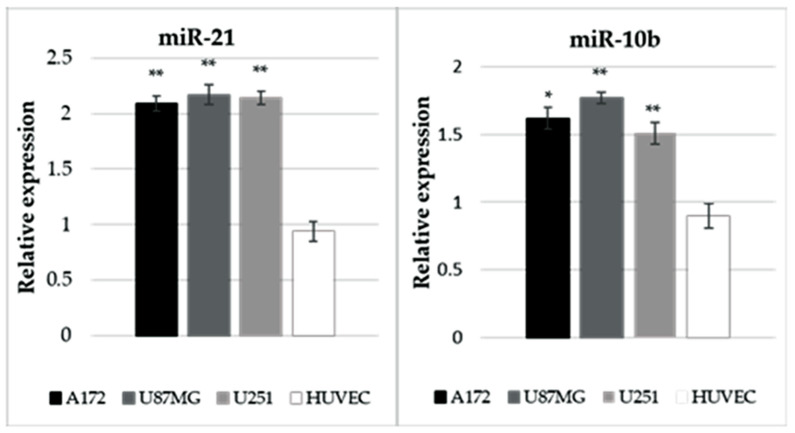
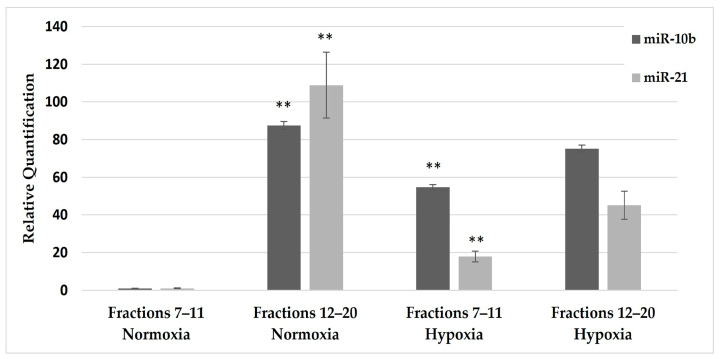
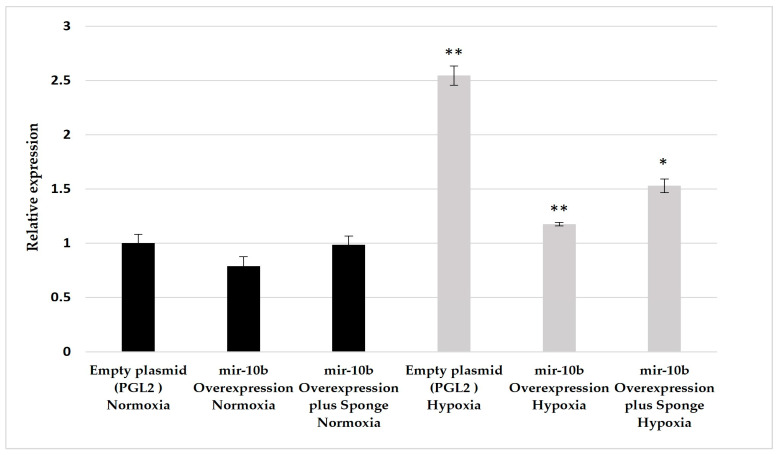
Glioblastoma poses significant challenges in oncology, with bevacizumab showing promise as an antiangiogenic treatment but with limited efficacy. microRNAs (miRNAs) 10b and 21 have emerged as potential biomarkers for bevacizumab response in glioblastoma patients. This study delves into the expression dynamics of miR-21 and miR-10b in response to hypoxia and explores their circulation mechanisms. In vitro experiments exposed glioma cells (A172, U87MG, U251) and human umbilical vein endothelial cells (HUVEC) to hypoxic conditions (1% oxygen) for 24 h, revealing heightened levels of miR-10b and miR-21 in glioblastoma cells. Manipulating miR-10b expression in U87MG, demonstrating a significant decrease in VEGF alpha (VEGFA) following miR-10b overexpression under hypoxic conditions. Size exclusion chromatography illustrated a notable shift towards miR-21 and miR-10b exosomal packaging during hypoxia. A proposed model suggests that effective bevacizumab treatment reduces VEGFA levels, heightening hypoxia and subsequently upregulating miR-21 and miR-10b expression. These miRNAs, released via exosomes, might impact various cellular processes, with miR-10b notably contributing to VEGFA level reduction. However, post-treatment increases in miR-10b and miR-21 could potentially restore cells to normoxic conditions through the downregulation of VEGF. This study highlights the intricate feedback loop involving miR-10b, miR-21, and VEGFA in glioblastoma treatment, underscoring the necessity for personalized therapeutic strategies. Further research should explore clinical implications for personalized glioma treatments.
胶质母细胞瘤在肿瘤学领域带来了重大挑战,贝伐单抗作为一种抗血管生成治疗方法具有一定的疗效。微小 RNA(miRNA)10b 和 21 已成为胶质母细胞瘤患者对贝伐单抗反应的潜在生物标志物。本研究深入探讨了 miR-21 和 miR-10b 在应对缺氧时的表达动态,并探讨了它们的循环机制。体外实验将神经胶质瘤细胞(A172、U87MG、U251)和人脐静脉内皮细胞(HUVEC)暴露于缺氧条件(1%氧气)下 24 小时,结果显示胶质母细胞瘤细胞中 miR-10b 和 miR-21 的水平升高。在 U87MG 中操纵 miR-10b 的表达,结果表明在缺氧条件下过表达 miR-10b 后 VEGF alpha(VEGFA)显著减少。排阻色谱法表明,在缺氧条件下,miR-21 和 miR-10b 外泌体包装明显向小尺寸方向转移。提出的模型表明,有效的贝伐单抗治疗可降低 VEGFA 水平,加剧缺氧,随后上调 miR-21 和 miR-10b 的表达。这些 miRNA 通过外泌体释放,可能会影响各种细胞过程,其中 miR-10b 显著促进 VEGFA 水平的降低。然而,治疗后 miR-10b 和 miR-21 的增加可能通过下调 VEGF 使细胞恢复到正常氧条件。本研究强调了胶质母细胞瘤治疗中 miR-10b、miR-21 和 VEGFA 之间复杂的反馈回路,突出了个性化治疗策略的必要性。进一步的研究应该探索针对个性化胶质瘤治疗的临床意义。