Van Booven Derek J, Chen Cheng-Bang, Malpani Sheetal, Mirzabeigi Yasamin, Mohammadi Maral, Wang Yujie, Kryvenko Oleksander N, Punnen Sanoj, Arora Himanshu
John P Hussman Institute for Human Genomics, Miller School of Medicine, University of Miami, Miami, FL 33136, USA.
Department of Industrial and Systems Engineering, University of Miami, Coral Gables, FL 33146, USA.
J Pers Med. 2024 Jun 30;14(7):703. doi: 10.3390/jpm14070703.
In the realm of computational pathology, the scarcity and restricted diversity of genitourinary (GU) tissue datasets pose significant challenges for training robust diagnostic models. This study explores the potential of Generative Adversarial Networks (GANs) to mitigate these limitations by generating high-quality synthetic images of rare or underrepresented GU tissues. We hypothesized that augmenting the training data of computational pathology models with these GAN-generated images, validated through pathologist evaluation and quantitative similarity measures, would significantly enhance model performance in tasks such as tissue classification, segmentation, and disease detection.
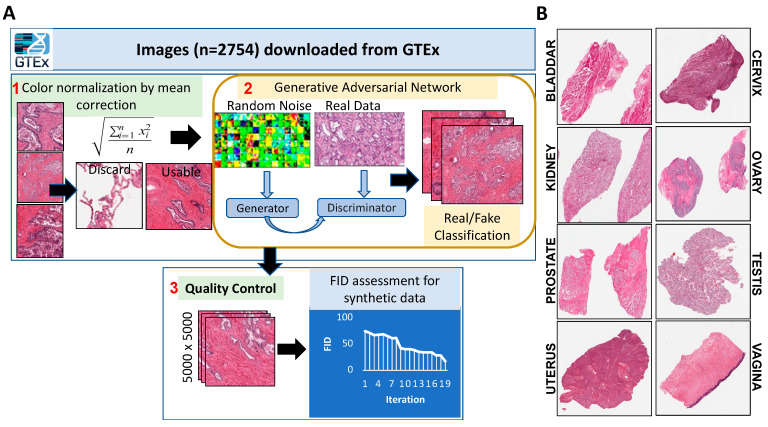
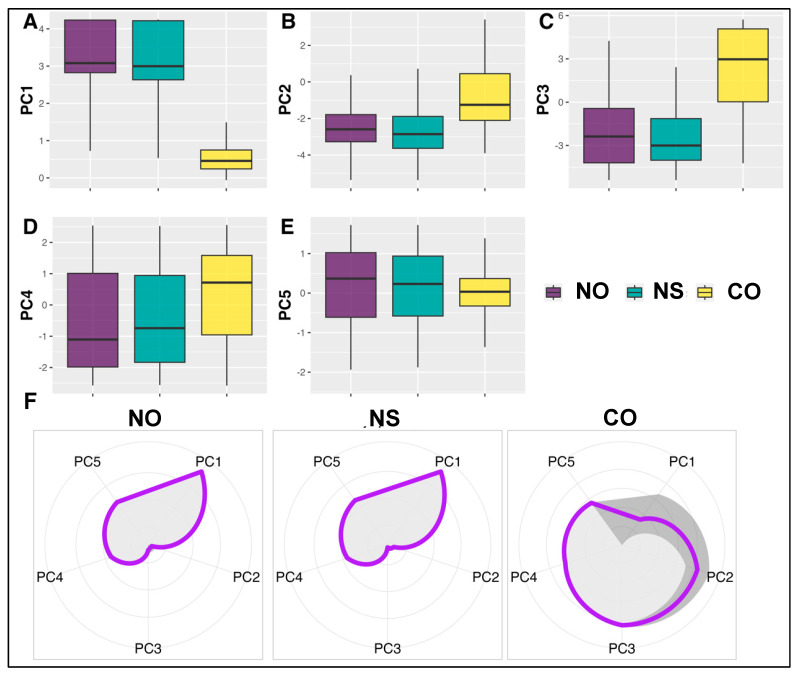
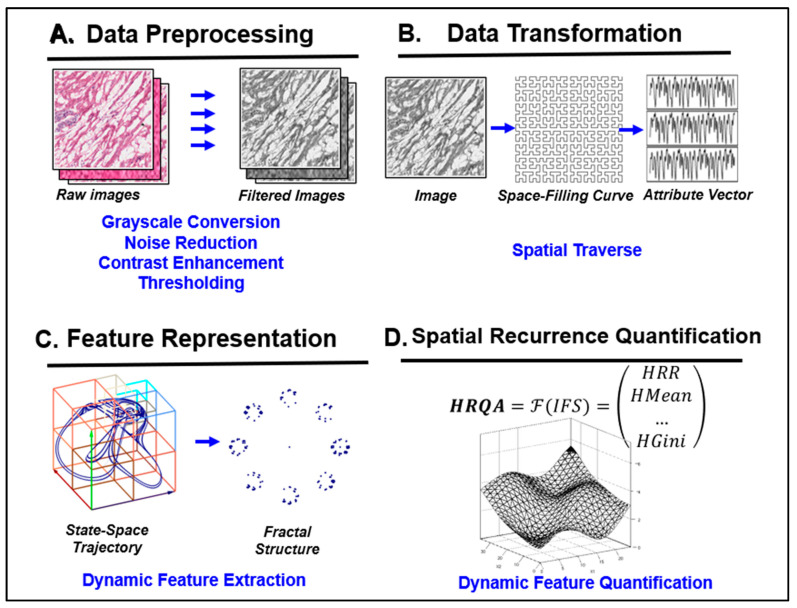
To test this hypothesis, we employed a GAN model to produce synthetic images of eight different GU tissues. The quality of these images was rigorously assessed using a Relative Inception Score (RIS) of 1.27 ± 0.15 and a Fréchet Inception Distance (FID) that stabilized at 120, metrics that reflect the visual and statistical fidelity of the generated images to real histopathological images. Additionally, the synthetic images received an 80% approval rating from board-certified pathologists, further validating their realism and diagnostic utility. We used an alternative Spatial Heterogeneous Recurrence Quantification Analysis (SHRQA) to assess the quality of prostate tissue. This allowed us to make a comparison between original and synthetic data in the context of features, which were further validated by the pathologist's evaluation. Future work will focus on implementing a deep learning model to evaluate the performance of the augmented datasets in tasks such as tissue classification, segmentation, and disease detection. This will provide a more comprehensive understanding of the utility of GAN-generated synthetic images in enhancing computational pathology workflows.
This study not only confirms the feasibility of using GANs for data augmentation in medical image analysis but also highlights the critical role of synthetic data in addressing the challenges of dataset scarcity and imbalance.
Future work will focus on refining the generative models to produce even more diverse and complex tissue representations, potentially transforming the landscape of medical diagnostics with AI-driven solutions.
在计算病理学领域,泌尿生殖系统(GU)组织数据集的稀缺性和有限的多样性给训练强大的诊断模型带来了重大挑战。本研究探讨了生成对抗网络(GAN)通过生成罕见或代表性不足的GU组织的高质量合成图像来缓解这些限制的潜力。我们假设,通过病理学家评估和定量相似性度量验证的这些GAN生成的图像增强计算病理学模型的训练数据,将显著提高模型在组织分类、分割和疾病检测等任务中的性能。
为了验证这一假设,我们使用GAN模型生成了八种不同GU组织的合成图像。使用相对初始得分(RIS)为1.27±0.15和稳定在120的弗雷歇初始距离(FID)对这些图像的质量进行了严格评估,这些指标反映了生成图像与真实组织病理学图像的视觉和统计保真度。此外,合成图像获得了经董事会认证的病理学家80%的认可率,进一步验证了它们的真实性和诊断效用。我们使用了另一种空间异质递归量化分析(SHRQA)来评估前列腺组织的质量。这使我们能够在特征背景下对原始数据和合成数据进行比较,并通过病理学家的评估进一步验证。未来的工作将集中在实施深度学习模型,以评估增强数据集在组织分类、分割和疾病检测等任务中的性能。这将更全面地了解GAN生成的合成图像在增强计算病理学工作流程中的效用。
本研究不仅证实了在医学图像分析中使用GAN进行数据增强的可行性,还强调了合成数据在应对数据集稀缺和不平衡挑战中的关键作用。
未来的工作将集中在改进生成模型,以产生更多样化和复杂的组织表示,有可能通过人工智能驱动的解决方案改变医学诊断的格局。