Morariu Silviu-Horia, Cotoi Ovidiu Simion, Tiucă Oana Mirela, Baican Adrian, Gheucă-Solovăstru Laura, Decean Hana, Brihan Ilarie, Silaghi Katalin, Biro Viorica, Șerban-Pescar Diana, Măgureanu Ioana, Ambros Mircea, Ilcuș Roxana Ioana, Prodan Lavinia, Bălan Andreea Beatrix, Husariu Mădălina, Gugulus Dumitrita Lenuta, Stan Radu Alexandru, Voiculescu Vlad, Nicolescu Alin Codruț
Dermatology Department, George Emil Palade University of Medicine, Pharmacy, Science, and Technology of Targu Mures, 540142 Targu Mures, Romania.
Pathophysiology Department, George Emil Palade University of Medicine, Pharmacy, Science, and Technology of Targu Mures, 540142 Targu Mures, Romania.
J Clin Med. 2024 Jul 9;13(14):3992. doi: 10.3390/jcm13143992.
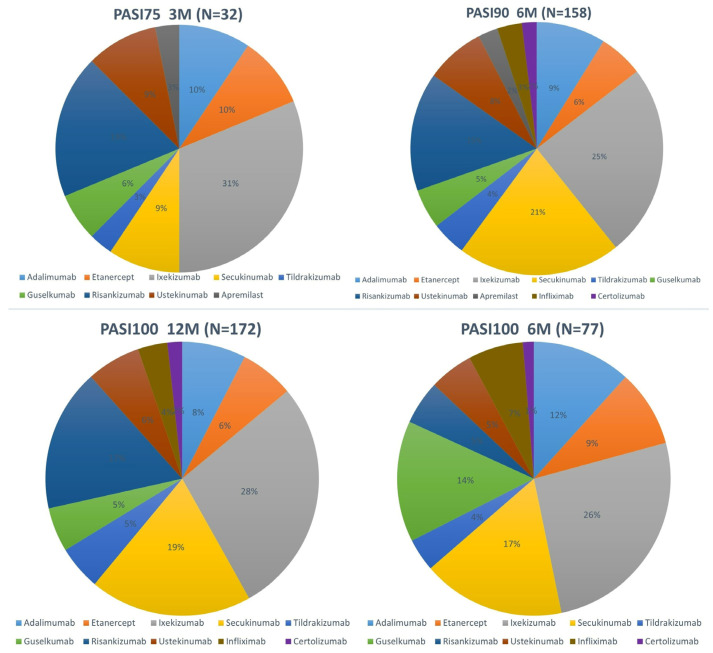
: Psoriasis is an immune-mediated chronic disorder associated with various comorbidities. Even though biologics and small-molecule inhibitors are the mainstay treatment for moderate-to-severe psoriasis, there is no current consensus regarding which agent should be used for a specific type of patient. This paper aims to test the reliability of blood-count-derived inflammatory markers in assessing treatment response to biologics and small-molecule inhibitors in psoriasis. : Bio-naïve adult patients diagnosed with chronic plaque psoriasis fulfilling the inclusion criteria were enrolled. They were divided into study subgroups based on treatment of choice, and blood-count-derived inflammatory markers were analyzed at baseline, three-month, six-month, and at twelve-month visits. : A total of 240 patients were included. The highest number of patients underwent treatment with ixekizumab. The neutrophil-to-lymphocyte ratio (NLR), platelet-to-lymphocyte ratio (PLR), platelet-to-monocyte ratio (PMR), monocyte-to-lymphocyte ratio (MLR), derived neutrophil-to-lymphocyte ratio (d-NLR), systemic inflammation response index (SIRI), systemic immune inflammation index (SII), and aggregate index of systemic inflammation (AISI) all varied significantly ( < 0.005) between the four visits. The psoriasis area severity index (PASI) score correlated with PLR, d-NLR, and SII, while the psoriasis scalp severity index (PSSI) score correlated with AISI and SIRI. More than half of patients reached the target goal of PASI90 at the six-month visit. A total of 77 patients were super-responders, with the highest number undergoing treatment with ixekizumab. Higher baseline values of d-NLR and SIRI are independent predictors of the super-responder status. : Blood-count-derived inflammatory markers can serve as indicators of treatment response to biologics in psoriasis, while d-NLR and SIRI were independent predictors of super-responders in our study.
银屑病是一种与多种合并症相关的免疫介导性慢性疾病。尽管生物制剂和小分子抑制剂是中重度银屑病的主要治疗方法,但目前对于特定类型的患者应使用哪种药物尚无共识。本文旨在测试血常规衍生的炎症标志物在评估银屑病患者对生物制剂和小分子抑制剂治疗反应中的可靠性。
符合纳入标准的初治成年慢性斑块状银屑病患者入组。根据治疗选择将他们分为研究亚组,并在基线、三个月、六个月和十二个月随访时分析血常规衍生的炎症标志物。
共纳入240例患者。接受司库奇尤单抗治疗的患者数量最多。中性粒细胞与淋巴细胞比值(NLR)、血小板与淋巴细胞比值(PLR)、血小板与单核细胞比值(PMR)、单核细胞与淋巴细胞比值(MLR)、衍生中性粒细胞与淋巴细胞比值(d-NLR)、全身炎症反应指数(SIRI)、全身免疫炎症指数(SII)和全身炎症聚集指数(AISI)在四次随访之间均有显著差异(<0.005)。银屑病面积和严重程度指数(PASI)评分与PLR、d-NLR和SII相关,而银屑病头皮严重程度指数(PSSI)评分与AISI和SIRI相关。超过一半的患者在六个月随访时达到了PASI90的目标。共有77例患者为超级反应者,接受司库奇尤单抗治疗的患者数量最多。d-NLR和SIRI的较高基线值是超级反应者状态的独立预测因素。
血常规衍生的炎症标志物可作为银屑病患者对生物制剂治疗反应的指标,而在我们的研究中,d-NLR和SIRI是超级反应者的独立预测因素。