Department of Dermatology, Shanghai Skin Disease Hospital, Tongji University School of Medicine, Shanghai, China.
Institute of Psoriasis, Tongji University School of Medicine, Shanghai, China.
Front Immunol. 2024 Feb 13;15:1323174. doi: 10.3389/fimmu.2024.1323174. eCollection 2024.
The systemic immune-inflammation index (SII) and systemic inflammation response index (SIRI) are both novel biomarkers and predictors of inflammation. Psoriasis is a skin disease characterized by chronic inflammation. This study aimed to investigate the potential association between SII, SIRI, and adult psoriasis.
Data of adults aged 20 to 80 years from the National Health and Nutrition Examination Survey (NHANES) (2003-2006, 2009-2014) were utilized. The K-means method was used to group SII and SIRI into low, medium, and high-level clusters. Additionally, SII or SIRI levels were categorized into three groups: low (1-3 quintiles), medium (4 quintile), and high (5 quintile). The association between SII-SIRI pattern, SII or SIRI individually, and psoriasis was assessed using multivariate logistic regression models. The results were presented as odds ratios (ORs) and confidence intervals (CIs). Restricted cubic spline (RCS) regression, subgroup, and interaction analyses were also conducted to explore the potential non-linear and independent relationships between natural log-transformed SII (lnSII) levels or SIRI levels and psoriasis, respectively.
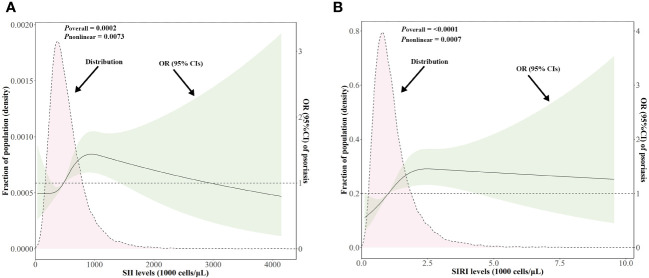
Of the 18208 adults included in the study, 511 (2.81%) were diagnosed with psoriasis. Compared to the low-level group of the SII-SIRI pattern, participants in the medium-level group had a significantly higher risk for psoriasis (OR = 1.40, 95% CI: 1.09, 1.81, -trend = 0.0031). In the analysis of SII or SIRI individually, both SII and SIRI were found to be positively associated with the risk of psoriasis (high vs. low group OR = 1.52, 95% CI: 1.18, 1.95, -trend = 0.0014; OR = 1.48, 95% CI: 1.12, 1.95, -trend = 0.007, respectively). Non-linear relationships were observed between lnSII/SIRI and psoriasis (both -values for overall < 0.05, -values for nonlinearity < 0.05). The association between SII levels and psoriasis was stronger in females, obese individuals, people with type 2 diabetes, and those without hypercholesterolemia.
We observed positive associations between SII-SIRI pattern, SII, SIRI, and psoriasis among U.S. adults. Further well-designed studies are needed to gain a better understanding of these findings.
系统性免疫炎症指数(SII)和系统性炎症反应指数(SIRI)都是新型炎症生物标志物和预测因子。银屑病是一种以慢性炎症为特征的皮肤病。本研究旨在探讨 SII、SIRI 与成人银屑病之间的潜在关联。
利用 2003-2006 年和 2009-2014 年全国健康与营养调查(NHANES)中 20-80 岁成年人的数据。采用 K-均值方法将 SII 和 SIRI 分为低、中、高水平组。此外,还将 SII 或 SIRI 水平分为三组:低(1-3 五分位)、中(4 五分位)和高(5 五分位)。采用多变量 logistic 回归模型评估 SII-SIRI 模式、SII 或 SIRI 单独与银屑病之间的关联。结果表示为比值比(OR)和置信区间(CI)。还进行了受限立方样条(RCS)回归、亚组和交互分析,以分别探讨自然对数转换的 SII(lnSII)水平或 SIRI 水平与银屑病之间的潜在非线性和独立关系。
在纳入的 18208 名成年人中,有 511 人(2.81%)被诊断患有银屑病。与 SII-SIRI 模式的低水平组相比,中水平组参与者患银屑病的风险显著更高(OR=1.40,95%CI:1.09,1.81,-趋势=0.0031)。在单独分析 SII 或 SIRI 时,SII 和 SIRI 均与银屑病风险呈正相关(高水平组与低水平组 OR=1.52,95%CI:1.18,1.95,-趋势=0.0014;OR=1.48,95%CI:1.12,1.95,-趋势=0.007,分别)。lnSII/SIRI 与银屑病之间存在非线性关系(两者整体-值均<0.05,非线性-值均<0.05)。SII 水平与银屑病的关联在女性、肥胖者、2 型糖尿病患者和无高胆固醇血症患者中更强。
我们在美国成年人中观察到 SII-SIRI 模式、SII、SIRI 与银屑病之间存在正相关关系。需要进一步进行精心设计的研究,以更好地了解这些发现。