Nikolaev Dmitrii M, Mironov Vladimir N, Metelkina Ekaterina M, Shtyrov Andrey A, Mereshchenko Andrey S, Demidov Nikita A, Vyazmin Sergey Yu, Tennikova Tatiana B, Moskalenko Svetlana E, Bondarev Stanislav A, Zhouravleva Galina A, Vasin Andrey V, Panov Maxim S, Ryazantsev Mikhail N
Institute of Chemistry, Saint Petersburg State University, 26 Universitetskii pr, St. Petersburg 198504, Russia.
Institute of Biomedical Systems and Biotechnologies, Peter the Great St. Petersburg Polytechnic University, 29 Polytechnicheskaya Str., St. Petersburg 195251, Russia.
ACS Phys Chem Au. 2024 Apr 29;4(4):347-362. doi: 10.1021/acsphyschemau.3c00073. eCollection 2024 Jul 24.
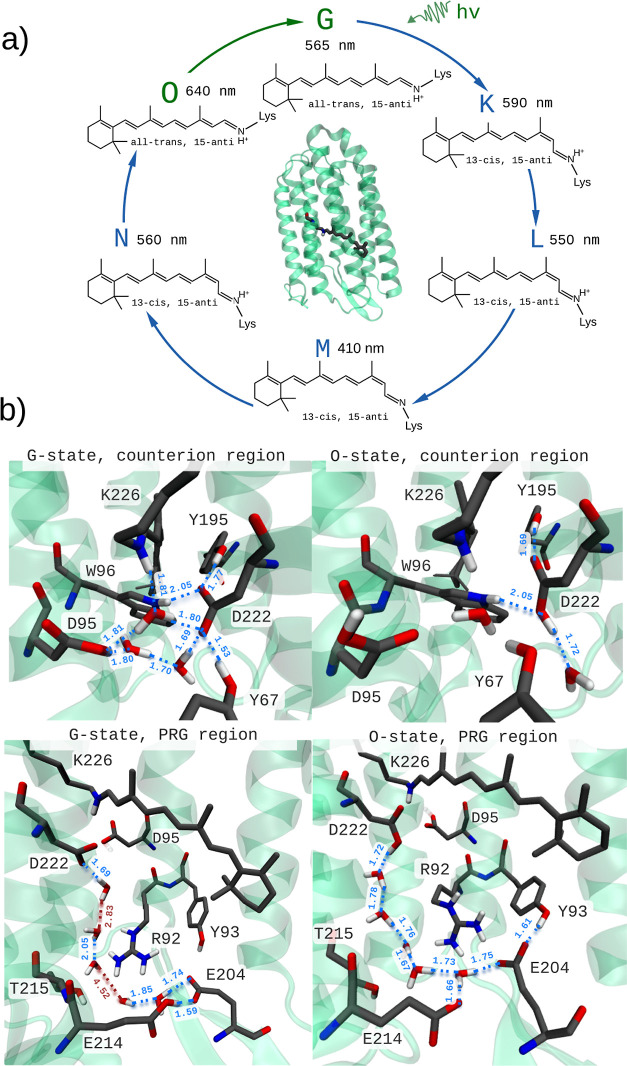
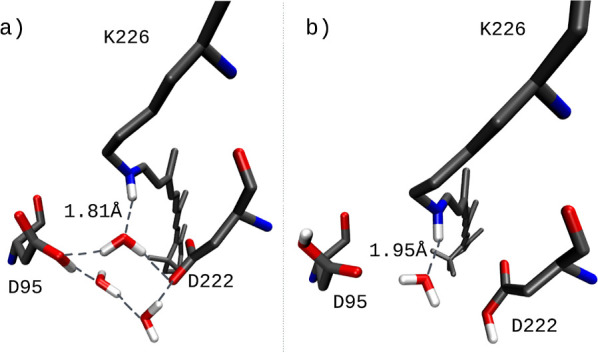
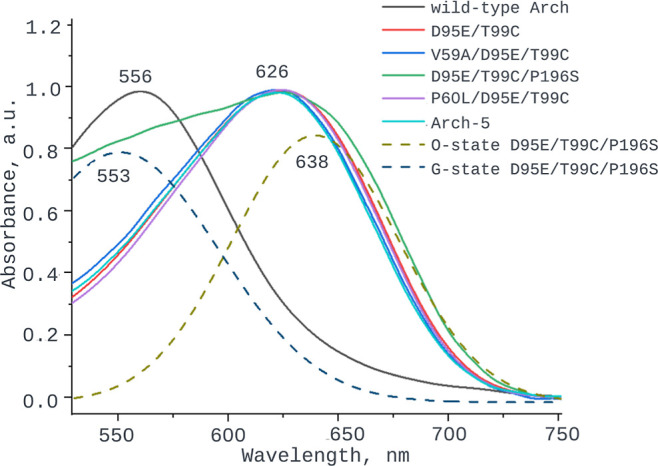
Genetically encoded voltage indicators (GEVIs) have found wide applications as molecular tools for visualization of changes in cell membrane potential. Among others, several classes of archaerhodopsin-3-based GEVIs have been developed and have proved themselves promising in various molecular imaging studies. To expand the application range for this type of GEVIs, new variants with absorption band maxima shifted toward the first biological window and enhanced fluorescence signal are required. Here, we integrate computational and experimental strategies to reveal structural factors that distinguish far-red bright archaerhodopsin-3-based GEVIs, Archers, obtained by directed evolution in a previous study (McIsaac et al., 2014) and the wild-type archaerhodopsin-3 with an extremely dim fluorescence signal, aiming to use the obtained information in subsequent rational design. We found that the fluorescence can be enhanced by stabilization of a certain conformation of the protein, which, in turn, can be achieved by tuning the p value of two titratable residues. These findings were supported further by introducing mutations into wild-type archeorhodopsin-3 and detecting the enhancement of the fluorescence signal. Finally, we came up with a rational design and proposed previously unknown Archers variants with red-shifted absorption bands (λ up to 640 nm) and potential-dependent bright fluorescence (quantum yield up to 0.97%).
基因编码电压指示剂(GEVIs)作为用于可视化细胞膜电位变化的分子工具已得到广泛应用。其中,已经开发了几类基于古紫质-3的GEVIs,并在各种分子成像研究中证明了它们的潜力。为了扩大这类GEVIs的应用范围,需要吸收带最大值向第一个生物窗口移动且荧光信号增强的新变体。在这里,我们整合计算和实验策略,以揭示区分基于远红明亮古紫质-3的GEVIs(Archers)与具有极弱荧光信号的野生型古紫质-3的结构因素,旨在将获得的信息用于后续的合理设计。我们发现,通过稳定蛋白质的特定构象可以增强荧光,而这又可以通过调节两个可滴定残基的pH值来实现。通过在野生型古紫质-3中引入突变并检测荧光信号的增强,进一步支持了这些发现。最后,我们提出了一种合理设计,并提出了以前未知的具有红移吸收带(波长高达640 nm)和电位依赖性明亮荧光(量子产率高达0.97%)的Archers变体。