Zeng Joy S, Padia Vineet, Chen Grace Y, Maalouf Joseph H, Limaye Aditya M, Liu Alexander H, Yusov Michael A, Hunter Ian W, Manthiram Karthish
Department of Chemical Engineering, Massachusetts Institute of Technology, 77 Massachusetts Avenue, Cambridge, Massachusetts 02139, United States.
Department of Mechanical Engineering, Massachusetts Institute of Technology, 77 Massachusetts Avenue, Cambridge, Massachusetts 02139, United States.
ACS Cent Sci. 2024 Jun 28;10(7):1348-1356. doi: 10.1021/acscentsci.3c01295. eCollection 2024 Jul 24.
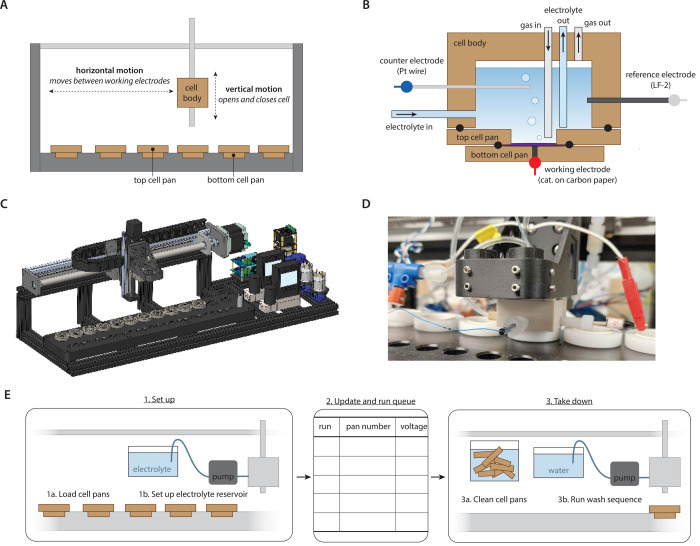
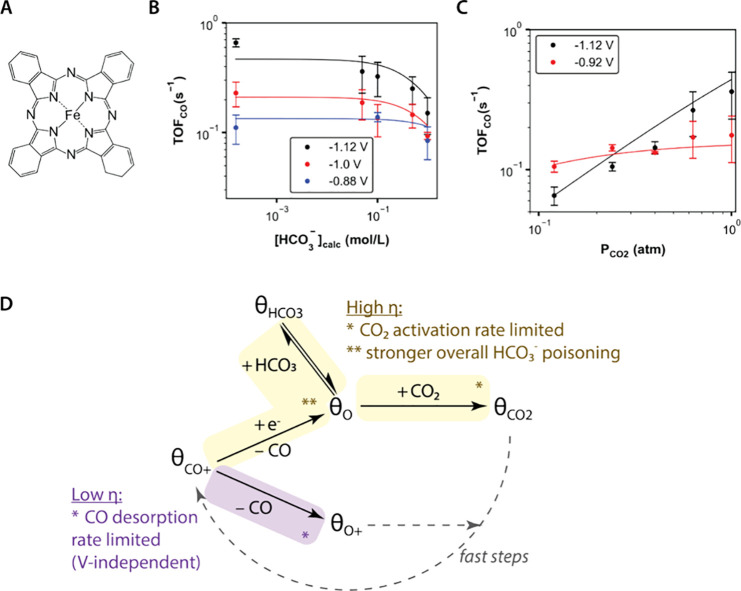
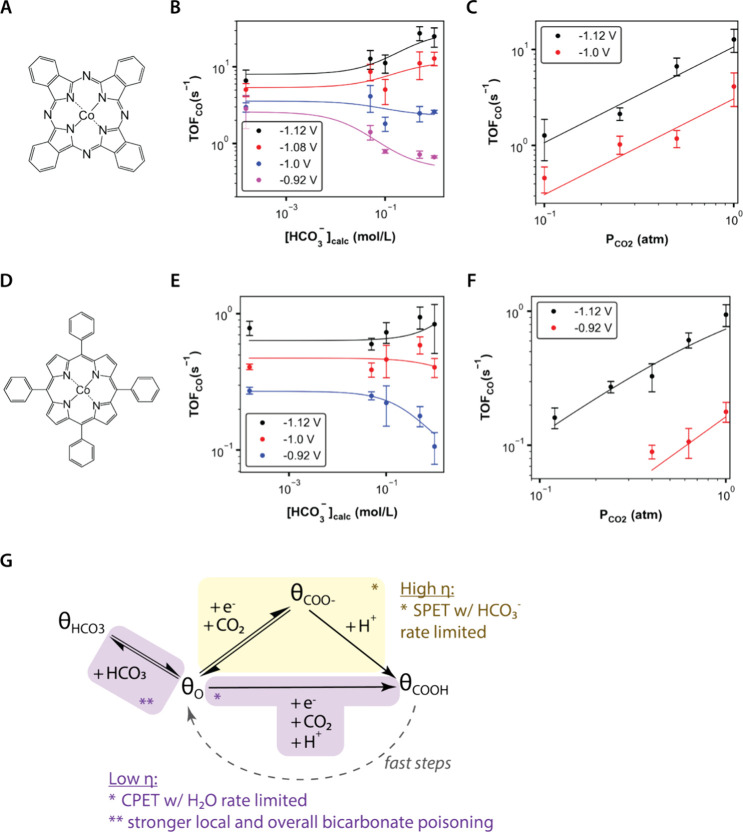
In electrocatalysis, mechanistic analysis of reaction rate data often relies on the linearization of relatively simple rate equations; this is the basis for typical Tafel and reactant order dependence analyses. However, for more complex reaction phenomena, such as surface coverage effects or mixed control, these common linearization strategies will yield incomplete or uninterpretable results. Cohesive kinetic analysis, which is often used in thermocatalysis and involves quantitative model fitting for data collected over a wide range of reaction conditions, requires more data but also provides a more robust strategy for interrogating reaction mechanisms. In this work, we report a robotic system that improves the experimental workflow for collecting electrochemical rate data by automating sequential testing of up to 10 electrochemical cells, where each cell can have a different electrode, electrolyte, gas-phase reactant composition, and applied voltage. We used this system to investigate the mechanism of carbon dioxide electroreduction to carbon monoxide at several immobilized metal tetrapyrroles. Specifically, at cobalt phthalocyanine (CoPc), cobalt tetraphenylporphyrin (CoTPP), and iron phthalocyanine (FePc), we see signatures of complex reaction mechanisms, where observed bicarbonate and CO order dependences change with applied potential. We illustrate how phenomena such as electrolyte poisoning and potential-dependent degrees of rate control can explain the observed kinetic behaviors. Our mechanistic analysis suggests that CoPc and CoTPP share a similar reaction mechanism, akin to one previously proposed, whereas the mechanism for FePc likely involves a species later in the catalytic cycle as the most abundant reactive intermediate. Our study illustrates that complex reaction mechanisms that are not amenable to common Tafel and order dependence analyses may be quite prevalent across this class of immobilized metal tetrapyrrole electrocatalysts.
在电催化中,反应速率数据的机理分析通常依赖于相对简单的速率方程的线性化;这是典型的塔菲尔分析和反应物级数依赖性分析的基础。然而,对于更复杂的反应现象,如表面覆盖效应或混合控制,这些常见的线性化策略将产生不完整或无法解释的结果。凝聚动力学分析常用于热催化,涉及对在广泛反应条件下收集的数据进行定量模型拟合,它需要更多的数据,但也为探究反应机理提供了更可靠的策略。在这项工作中,我们报告了一种机器人系统,该系统通过自动对多达10个电化学电池进行顺序测试来改进收集电化学速率数据的实验工作流程,每个电池可以有不同的电极、电解质、气相反应物组成和施加电压。我们使用这个系统研究了几种固定化金属四吡咯上二氧化碳电还原为一氧化碳的机理。具体而言,在钴酞菁(CoPc)、钴四苯基卟啉(CoTPP)和铁酞菁(FePc)上,我们看到了复杂反应机理的特征,其中观察到的碳酸氢盐和CO的级数依赖性随施加电位而变化。我们说明了诸如电解质中毒和电位依赖性速率控制程度等现象如何解释观察到的动力学行为。我们的机理分析表明,CoPc和CoTPP具有相似的反应机理,类似于先前提出的一种机理,而FePc的机理可能涉及催化循环中较晚的一种物质作为最丰富的反应中间体。我们的研究表明,这类固定化金属四吡咯电催化剂中,不适合常见塔菲尔分析和级数依赖性分析的复杂反应机理可能相当普遍。