Liu Yingshuo, McCrory Charles C L
Department of Chemistry, University of Michigan, Ann Arbor, MI, 48109, USA.
Nat Commun. 2019 Apr 11;10(1):1683. doi: 10.1038/s41467-019-09626-8.
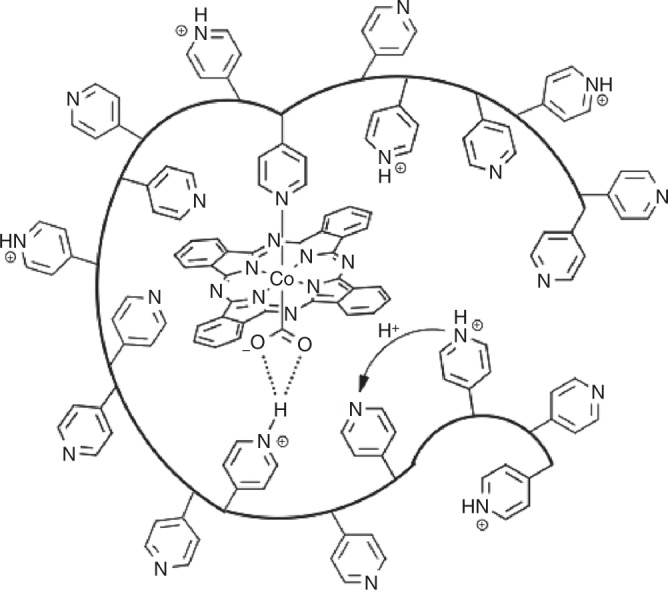
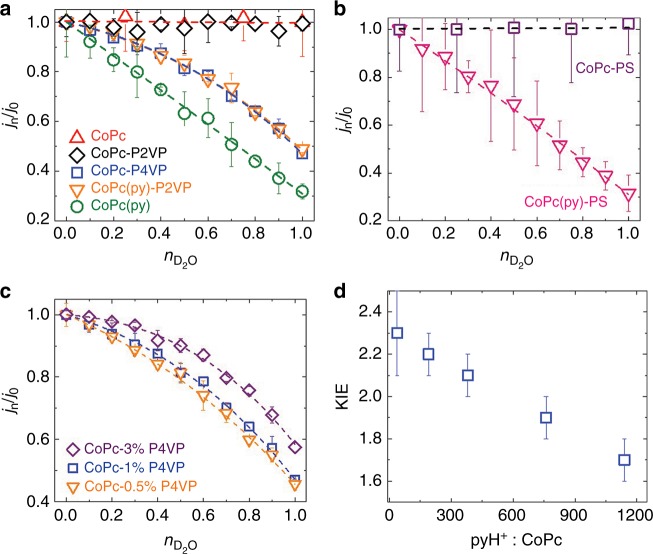
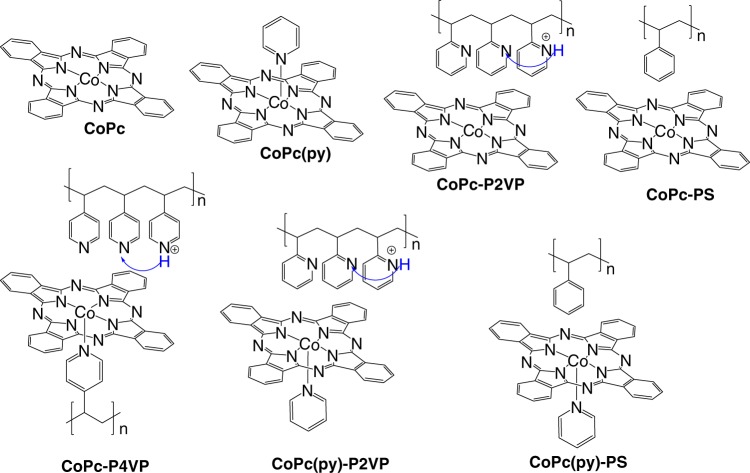
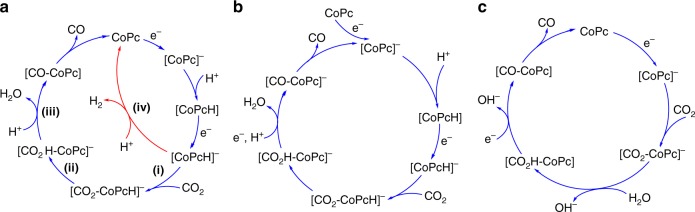
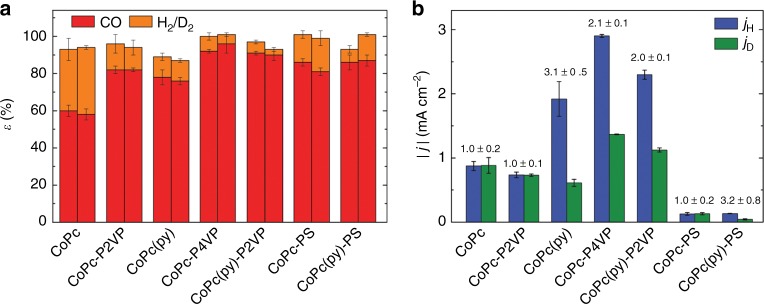
The selective and efficient electrochemical reduction of CO to single products is crucial for solar fuels development. Encapsulating molecular catalysts such as cobalt phthalocyanine within coordination polymers such as poly-4-vinylpyridine leads to dramatically increased activity and selectivity for CO reduction. In this study, we use a combination of kinetic isotope effect and proton inventory studies to explain the observed increase in activity and selectivity upon polymer encapsulation. We provide evidence that axial-coordination from the pyridyl moieties in poly-4-vinylpyridine to the cobalt phthalocyanine complex changes the rate-determining step in the CO reduction mechanism accounting for the increased activity in the catalyst-polymer composite. Moreover, we show that proton delivery to cobalt centers within the polymer is controlled by a proton relay mechanism that inhibits competitive hydrogen evolution. These mechanistic findings provide design strategies for selective CO reduction electrocatalysts and serve as a model for understanding the catalytic mechanism of related heterogeneous systems.
将CO选择性高效地电化学还原为单一产物对于太阳能燃料的开发至关重要。将诸如钴酞菁之类的分子催化剂封装在诸如聚4-乙烯基吡啶之类的配位聚合物中会导致CO还原的活性和选择性显著提高。在本研究中,我们结合动力学同位素效应和质子存量研究来解释聚合物封装后观察到的活性和选择性增加。我们提供的证据表明,聚4-乙烯基吡啶中的吡啶基部分与钴酞菁络合物的轴向配位改变了CO还原机理中的速率决定步骤,这解释了催化剂-聚合物复合材料活性的增加。此外,我们表明聚合物内钴中心的质子传递受质子中继机制控制,该机制抑制了竞争性析氢反应。这些机理研究结果为选择性CO还原电催化剂提供了设计策略,并作为理解相关多相体系催化机理的模型。