Banerjee Ankona, Nobleza Kenneth, Haddad Cynthia, Eubanks Joshua, Rana Ruchit, Rider Nicholas L, Pompeii Lisa, Nguyen Duc, Anvari Sara
Division of Epidemiology, Department of Pediatrics, Baylor College of Medicine, Houston, TX, USA.
Department of Pediatrics, Baylor College of Medicine, Houston, TX, USA.
Health Serv Res Manag Epidemiol. 2024 Jul 25;11:23333928241264020. doi: 10.1177/23333928241264020. eCollection 2024 Jan-Dec.
Food protein-induced enterocolitis syndrome (FPIES) is a non-IgE-mediated food allergy, characterized by delayed onset of repetitive vomiting occurring 1 to 4 h following ingestion of a food allergen. Managing FPIES requires strict avoidance of the food trigger. The concern with FPIES is determining the risk of another FPIES food trigger reaction due to potential coassociations with other foods or food groups. An effective statistical approach for analyzing FPIES-related data is essential to identify common coallergens and their associations.
This study employed Market Basket Analysis, a data-mining technique, to examine correlations and patterns among allergens in FPIES patients at a Houston, Texas, pediatric tertiary center. A retrospective analysis of electronic medical records from January 2018 to March 2022 for allergist diagnosed FPIES patients was conducted. The analysis utilized R software, specifically the "arules" and "arulesViz" packages, implementing the Apriori algorithm with set minimum support and confidence thresholds.
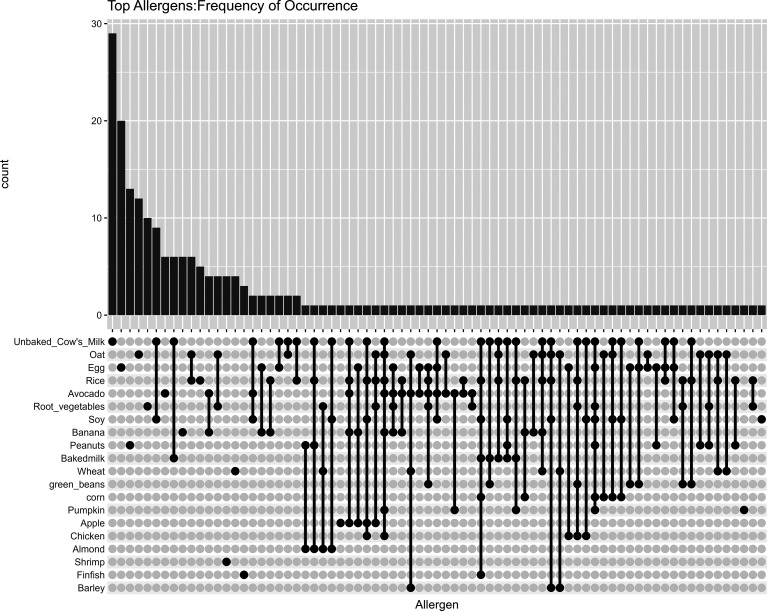
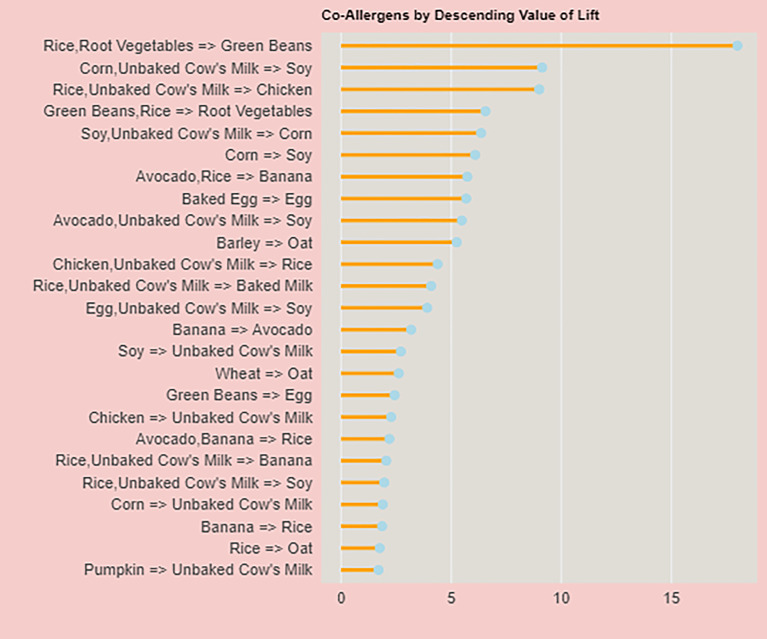
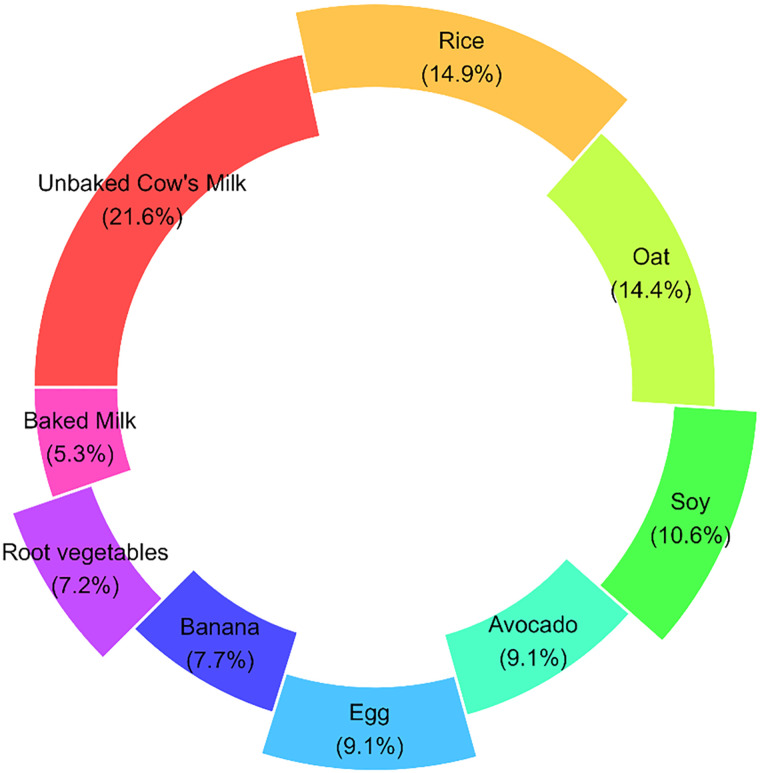
The study included 210 FPIES cases over 4 years, with 112 patients reacting to one food trigger and 98 to more than one trigger. In the latter group, the 5 predominant triggers were cow's milk (45.9%), rice (31.6%), oats (30.6%), soy (22.4%), and avocado (19.4%). Market Basket Analysis identified significant associations between food categories, particularly between soy and dairy, egg and dairy, oat and dairy, rice and dairy, and avocado and dairy.
Market Basket Analysis proved effective in identifying patterns and associations in FPIES data. These insights are crucial for healthcare providers in formulating dietary recommendations for FPIES patients. This approach potentially enhances guidance on food introductions and avoidances, thereby improving management and the quality of life for those affected by FPIES.
食物蛋白诱导的小肠结肠炎综合征(FPIES)是一种非IgE介导的食物过敏,其特征为在摄入食物过敏原后1至4小时出现延迟发作的反复呕吐。管理FPIES需要严格避免触发食物。FPIES的一个问题是,由于与其他食物或食物组可能存在共同关联,要确定发生另一次FPIES食物触发反应的风险。一种有效的统计方法来分析与FPIES相关的数据对于识别常见的共同过敏原及其关联至关重要。
本研究采用数据挖掘技术“购物篮分析”,以检查德克萨斯州休斯顿一家儿科三级中心FPIES患者过敏原之间的相关性和模式。对2018年1月至2022年3月过敏症专科医生诊断的FPIES患者的电子病历进行回顾性分析。该分析使用R软件,特别是“arules”和“arulesViz”包,采用Apriori算法并设置最小支持度和置信度阈值。
该研究在4年期间纳入了210例FPIES病例,其中112例患者对一种触发食物有反应,98例对一种以上触发食物有反应。在后一组中,5种主要的触发食物是牛奶(45.9%)、大米(31.6%)、燕麦(30.6%)、大豆(22.4%)和鳄梨(19.4%)。购物篮分析确定了食物类别之间的显著关联,特别是大豆和乳制品、鸡蛋和乳制品、燕麦和乳制品、大米和乳制品以及鳄梨和乳制品之间。
购物篮分析被证明在识别FPIES数据中的模式和关联方面是有效的。这些见解对于医疗保健提供者为FPIES患者制定饮食建议至关重要。这种方法可能会加强对食物引入和避免的指导,从而改善对FPIES患者的管理和生活质量。