Lemoine Anaïs, Colas Anne-Sophie, Le Sébastien, Delacourt Christophe, Tounian Patrick, Lezmi Guillaume
Department of Pediatric Nutrition and Gastroenterology, Trousseau Hospital, AP-HP, Sorbonne Université, Paris, France.
Pediatric Emergency Unit, Trousseau Hospital, AP-HP, Paris, France.
Clin Transl Allergy. 2022 Feb;12(2):e12112. doi: 10.1002/clt2.12112.
Food protein-induced enterocolitis syndrome (FPIES) is a non-IgE-mediated food allergy, with potential dehydration secondary to vomiting. Differences exist regarding culprit foods, and age of tolerance depending on the country of origin. We aimed at describing the characteristics of a French population of children with FPIES, and define risk factors for failure during challenge.
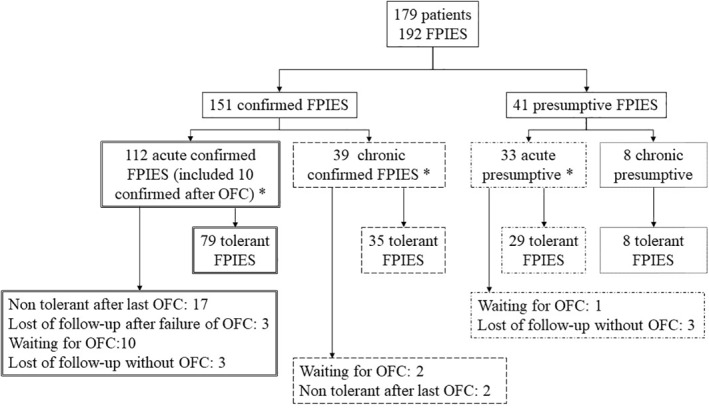
Data from 179 children who were referred for FPIES in two pediatric tertiary centers between 2014 and 2020 were retrospectively collected. The diagnosis of FPIES was based on international consensus guidelines. Clinical characteristics, culprit food, and age at resolution were assessed. Tolerance was defined as no adverse reaction after OFC or accidental exposure.
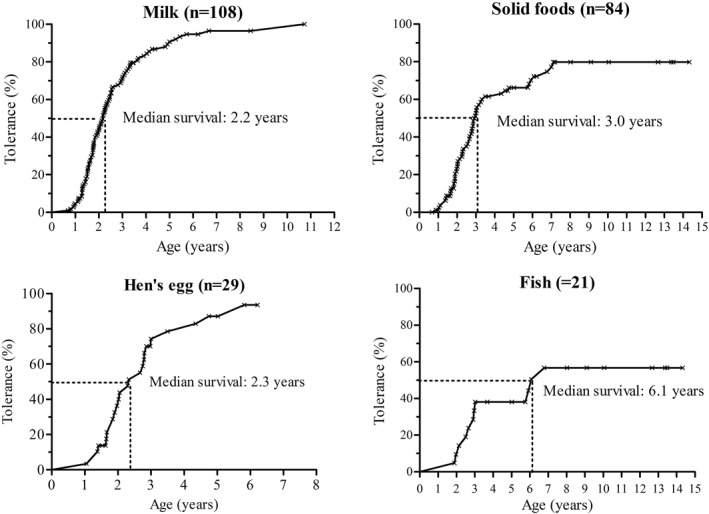
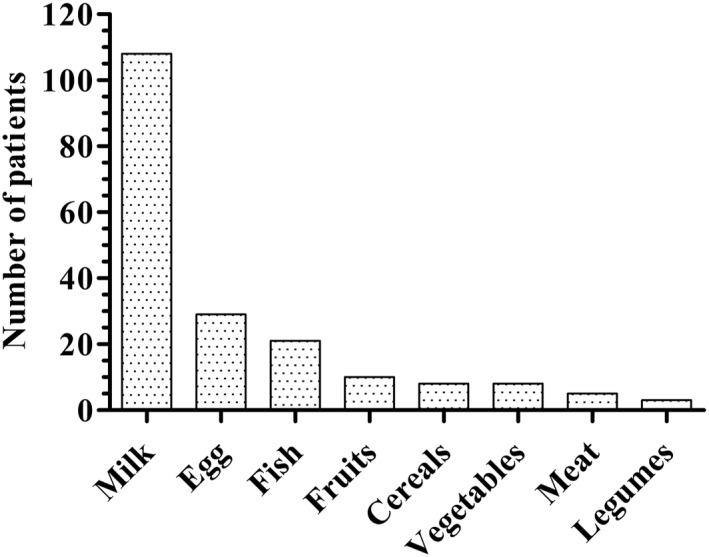
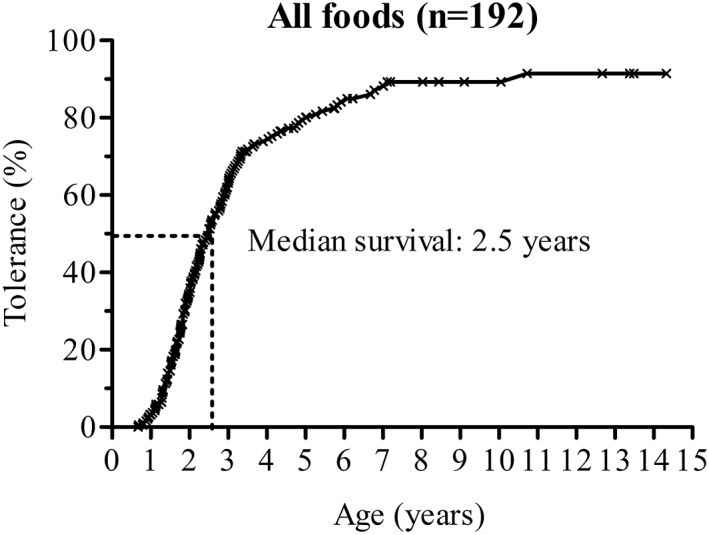
In the 192 described FPIES, the age at first symptoms was 5.8 months old. The main offending foods were cow's milk (60.3%), hen's egg (16.2%), and fish (11.7%). Single FPIES was observed in 94.4% and multiple FPIES in 5.6% of cases. The age at resolution of FPIES was 2.2 years old, and resolution occurred later for fish than for milk (2.9 years vs. 2.0, p = 0.01). Severe acute FPIES was a risk factor for delayed resolution (RR: 3.3 [1.2-9.2]), but not IgE sensitization. Performing a food challenge within 12 months after the first reaction increased the risk of failure (OR: 2.6 [1.1-6.6]).
In this French cohort of children with FPIES, the main culprit foods were ubiquitous. Rice, oat, and soy were rarely or not involved. Multiple FPIES was infrequent. Our data confirmed the overall good prognosis of FPIES, the later resolution of FPIES to fish and in the case of severe acute FPIES.
食物蛋白诱导的小肠结肠炎综合征(FPIES)是一种非IgE介导的食物过敏,可因呕吐继发潜在脱水。致病食物以及耐受年龄因原产国不同而存在差异。我们旨在描述法国FPIES儿童群体的特征,并确定激发试验失败的危险因素。
回顾性收集了2014年至2020年间在两家儿科三级中心因FPIES转诊的179名儿童的数据。FPIES的诊断基于国际共识指南。评估临床特征、致病食物和缓解年龄。耐受定义为口服食物激发试验(OFC)或意外接触后无不良反应。
在192例所述的FPIES中,首次出现症状的年龄为5.8个月。主要致病食物为牛奶(60.3%)、鸡蛋(16.2%)和鱼类(11.7%)。94.4%的病例为单一FPIES,5.6%为多种FPIES。FPIES缓解的年龄为2.2岁,鱼类引起的FPIES缓解时间比牛奶引起的更晚(2.9岁对2.0岁,p = 0.01)。严重急性FPIES是缓解延迟的危险因素(相对危险度:3.3 [1.2 - 9.2]),但IgE致敏不是。在首次反应后12个月内进行食物激发试验会增加失败风险(比值比:2.6 [1.1 - 6.6])。
在这个法国FPIES儿童队列中,主要致病食物很常见。大米、燕麦和大豆很少或未涉及。多种FPIES不常见。我们的数据证实了FPIES总体良好的预后、FPIES对鱼类以及严重急性FPIES情况下缓解较晚的情况。