Lisa Andrea, Bozzo Giulia, Vinci Valeriano, Klinger Francesco Maria, Errico Valentina, Tinterri Corrado, Klinger Marco Ettore Attilio, Testori Alberto
Department of Plastic and Reconstructive Surgery, European Institute of Oncology, IRCCS, Milan, Italy.
Department of Biomedical Sciences, Humanitas University, Milan, Italy.
Front Surg. 2024 Jul 12;11:1401699. doi: 10.3389/fsurg.2024.1401699. eCollection 2024.
Postoperative seroma is most frequent after mastectomy (ME) in combination with axillary lymph node dissection (ALND), and its reported incidence varies from 15.5% up to 90%. Seromas can be responsible for discomfort, infections and can lead to reconstruction failure. Therefore, many ways of seroma prevention have been studied, although from a recent overview it has become clear that no single method is reliably successful. Mechanical closure of the dead space, however, was consistently found to be significantly effective. The aim of our study is to evaluate if quilting of the axilla, in patients undergoing ME, immediate prosthetic breast reconstruction and ALND reduces the duration of drain maintenance, the incidence of seromas that require aspiration (clinically significant seromas, CSS) and reconstruction failure rate.
In our study population we analyzed a total of 81 patients divided into two groups: 27 consecutive patients undergoing mastectomy, axillary lymph node dissection (ALND), breast reconstruction and quilting of the axilla. We subsequently randomly picked up a double number of patients (54) undergoing the same oncological and reconstructive procedures without undergoing axillary quilting, matched for clinical characteristics in order to analyze efficacy of the procedure while reducing any bias. Our observational retrospective data was collected from October 2016 to July 2020 in one single high-volume center. Our median follow-up time was of 40.6 months.
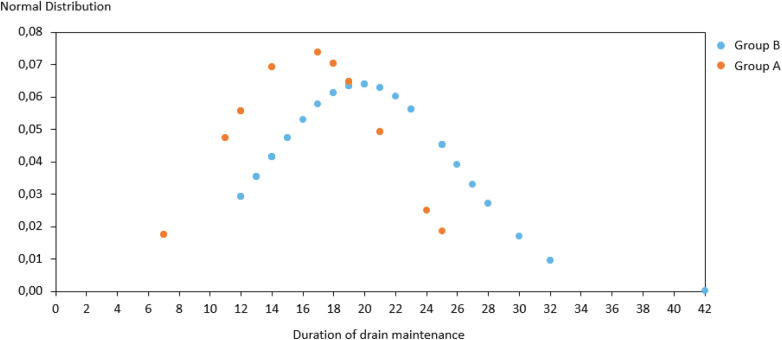
In the case group we observed a reduced time of drain maintenance: 16 vs. 20 days observed in the non-quilted group ( < 0.05). Incidence of seromas that required aspiration was 11% in the control group, while 3,7% in the case group. In addition to that, we observed 6 cases of implant removal in the control group, while in the quilted group we only observed a single case.
Previous literature and our results confirm that quilting of the axilla with flap fixation significantly decreases time of drain maintenance, allowing the earlier removal of the drains as well as decreasing the incidence of seroma, its eventual associated complications and related social costs. Moreover, our work suggests how quilting sutures decrease the incidence of seroma in patients undergoing immediate reconstruction, probably reducing the risk for implant removal.
乳房切除术(ME)联合腋窝淋巴结清扫术(ALND)后,术后血清肿最为常见,其报告发生率从15.5%到90%不等。血清肿可导致不适、感染,并可能导致重建失败。因此,人们研究了多种预防血清肿的方法,尽管从最近的综述来看,很明显没有一种方法能可靠地取得成功。然而,持续发现机械性封闭死腔非常有效。我们研究的目的是评估在接受ME、即刻假体乳房重建和ALND的患者中,腋窝缝合法是否能减少引流管留置时间、需要抽吸的血清肿(临床显著血清肿,CSS)的发生率以及重建失败率。
在我们的研究人群中,我们共分析了81例患者,分为两组:27例连续接受乳房切除术、腋窝淋巴结清扫术(ALND)、乳房重建和腋窝缝合法的患者。随后,我们随机挑选了两倍数量(54例)接受相同肿瘤和重建手术但未进行腋窝缝合的患者,根据临床特征进行匹配,以分析该手术的疗效,同时减少任何偏差。我们的观察性回顾性数据于2016年10月至2020年7月在一个单一的大容量中心收集。我们的中位随访时间为40.6个月。
在病例组中,我们观察到引流管留置时间缩短:缝合法组为16天,未缝合法组为20天(<0.05)。对照组中需要抽吸的血清肿发生率为11%,而病例组为3.7%。此外,我们在对照组中观察到6例植入物取出,而在缝合法组中仅观察到1例。
既往文献和我们的结果证实,采用皮瓣固定的腋窝缝合法可显著缩短引流管留置时间,使引流管能更早拔除,同时降低血清肿的发生率、其最终相关并发症及相关社会成本。此外,我们的研究表明,缝合线可降低即刻重建患者血清肿的发生率,可能降低植入物取出的风险。