Zhao Rui, Xu Wei, Wang Zhao, Yu Cuntao, Yang Yanmin
Department of Cardiovascular Surgery, Fuwai Hospital, National Clinical Research Center for Cardiovascular Diseases, National Center for Cardiovascular Diseases, Chinese Academy of Medical Sciences and Peking Union Medical College, 100037 Beijing, China.
Emergency Center, Fuwai Hospital, National Clinical Research Center for Cardiovascular Diseases, National Center for Cardiovascular Diseases, Chinese Academy of Medical Sciences and Peking Union Medical College, 100037 Beijing, China.
Rev Cardiovasc Med. 2022 May 31;23(6):200. doi: 10.31083/j.rcm2306200. eCollection 2022 Jun.
The present study aimed to clarify the impact of the 2020 COVID-19 pandemic on emergency management of acute type A aortic dissection.
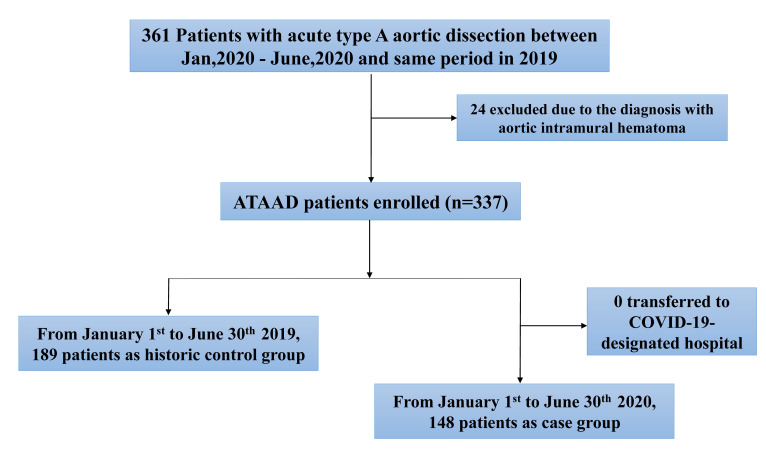
We consecutively enrolled 337 acute type A aortic dissection (ATAAD) patients at emergency room in Fuwai Hospital (Beijing, China) from January to June during the 2020 COVID-19 epidemic (n = 148) and the same period in 2019 as the historical control (n = 189). The primary outcome was defined as in-hospital death. Other outcomes included automatic discharge during emergency admission. The factors with significant differences before and after the epidemic were compared and analyzed by stages with the study endpoint to clarify their changes in different stages of the epidemic.
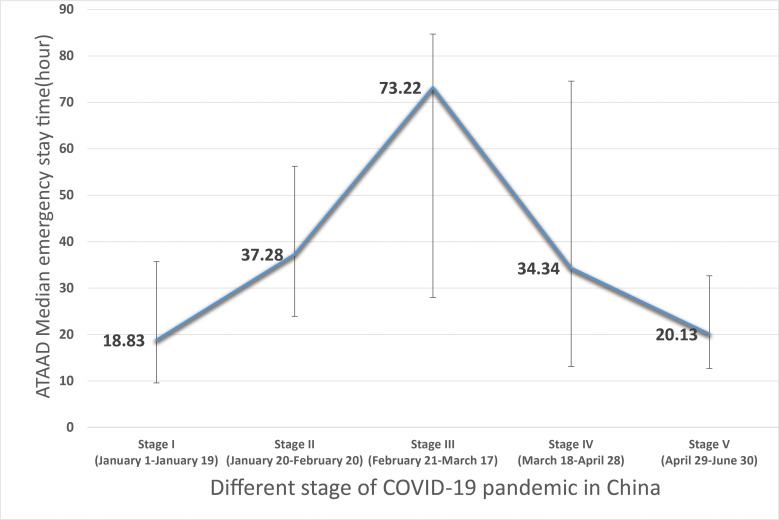
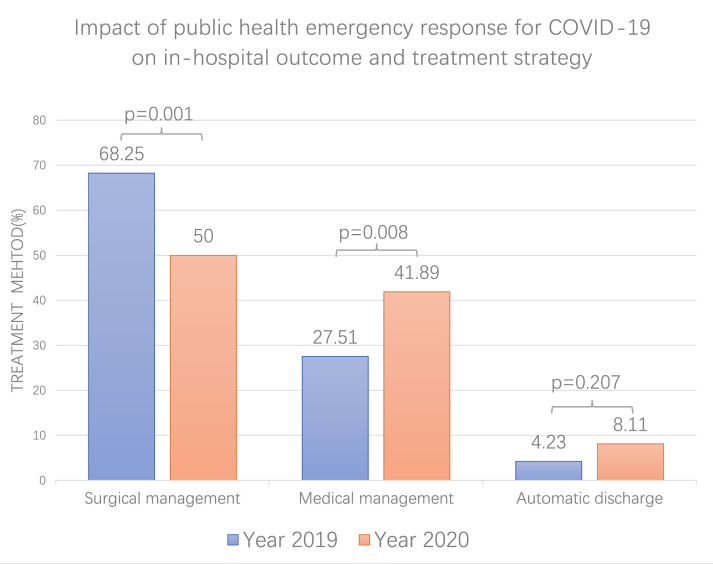
There was no significant difference in in-hospital mortality (35 (20.5%) vs. 23 (17.4%), = 0.472). Compared with year 2019, proportion of patients receiving surgical treatment decreased significantly (74 (50.0%) vs. 129 (68.25%), 0.001). The surgery time of ATAAD patients in 2020 was significantly shorter (6.46 [5.52, 7.51] vs. 7.33 [6.00, 8.85] hours, = 0.01). The length of stay in the emergency department significantly differed at each stage.
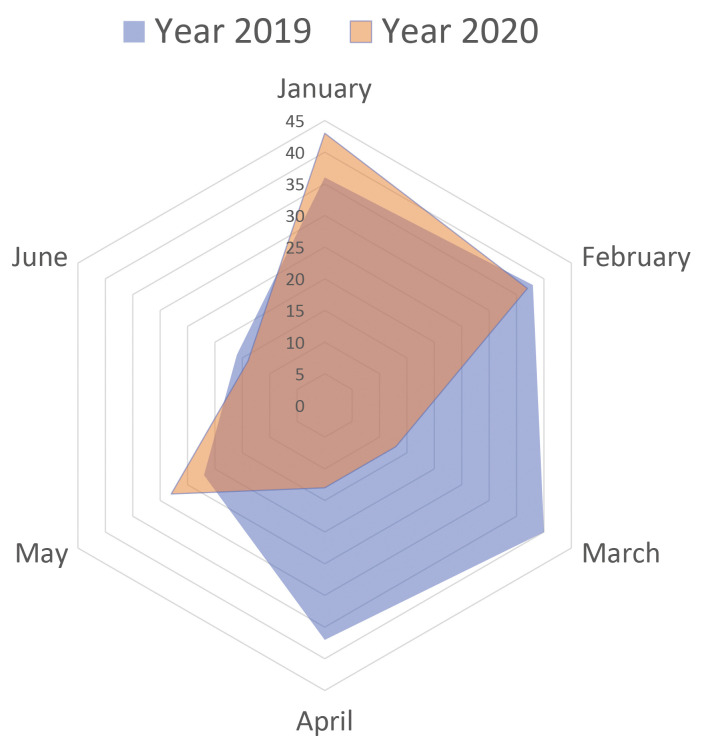
Our study demonstrated a significant reduction in the number of ATAAD patients and surgical treatment during COVID-19 outbreak. The surgical strategy of patients changed, but the overall mortality was largely the same. Patients undergoing surgery had a trend toward longer interval from the onset to the operating room, but they tended to be normal at the end of the epidemic. Proper epidemic prevention policies may avoid COVID-19 hitting patients who are not infected with the virus to the greatest extent.
本研究旨在阐明2020年新冠疫情对急性A型主动脉夹层急诊管理的影响。
我们连续纳入了中国医学科学院阜外医院(北京)急诊科在2020年新冠疫情期间(1月至6月,n = 148)以及2019年同期作为历史对照(n = 189)的337例急性A型主动脉夹层(ATAAD)患者。主要结局定义为院内死亡。其他结局包括急诊入院期间自动出院。对疫情前后有显著差异的因素与研究终点进行分阶段比较和分析,以阐明其在疫情不同阶段的变化。
院内死亡率无显著差异(35例[20.5%] vs. 23例[17.4%],P = 0.472)。与2019年相比,接受手术治疗的患者比例显著下降(74例[50.0%] vs. 129例[68.25%],P < 0.001)。2020年ATAAD患者的手术时间显著缩短(6.46[5.52, 7.51]小时 vs. 7.33[6.00, 8.85]小时,P = 0.01)。急诊科的住院时间在各阶段有显著差异。
我们的研究表明,在新冠疫情爆发期间,ATAAD患者数量和手术治疗显著减少。患者的手术策略发生了变化,但总体死亡率基本相同。接受手术的患者从发病到手术室的间隔时间有延长趋势,但在疫情结束时趋于正常。适当的防疫政策可能最大程度避免新冠疫情冲击未感染病毒的患者。