Zhu Xiaoming, Li Kuibao, Chen Mulei
Heart Center and Beijing Key Laboratory of Hypertension, Beijing Chaoyang Hospital, Capital Medical University, 100020 Beijing, China.
Rev Cardiovasc Med. 2022 May 26;23(6):189. doi: 10.31083/j.rcm2306189. eCollection 2022 Jun.
To establish a nomogram-scoring model for evaluating the risk of death in patients with critical cardiovascular disease after continuous renal replacement therapy (CRRT) in a coronary care unit (CCU).
This retrospective cohort study included data collected on 172 patients, in whom CRRT was initiated in the CCU between January 2017 and June 2021. Predictors of mortality were selected using an adaptive least absolute shrinkage and selection operator logistic model and used to construct a nomogram. The nomogram was evaluated using the concordance index (C-index) and Hosmer-Lemeshow test.
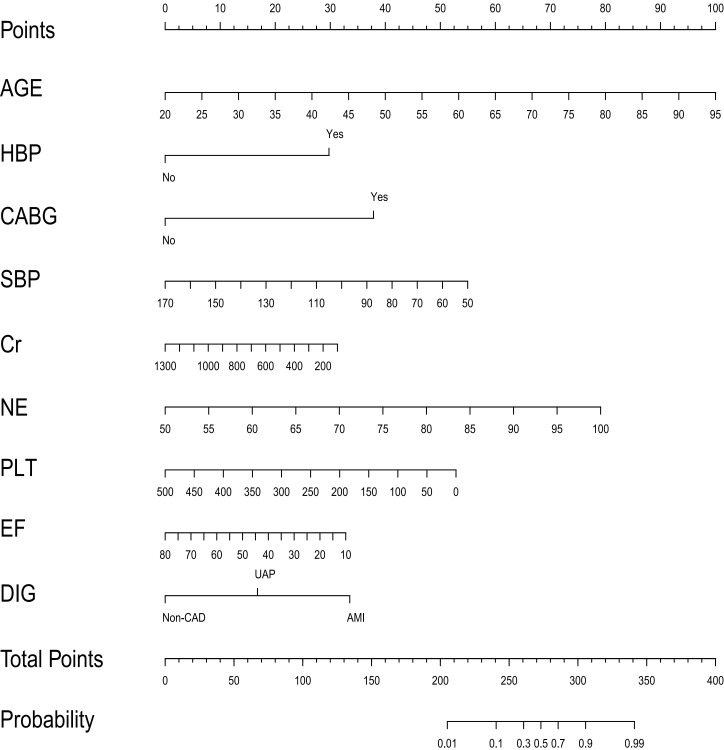
The number of patients who died in-hospital after CRRT was 91 (52.9%). The results of the multivariate logistic regression analyses clarified that age, history of hypertension and/or coronary artery bypass grafting, a diagnosis of unstable angina pectoris or acute myocardial infarction, ejection fraction, systolic blood pressure, creatinine, neutrophil, and platelet counts before CRRT initiation were significant predictors of early mortality in patients treated with CRRT. The nomogram constructed on these predictors demonstrated significant discriminative power with an unadjusted C-index of 0.902 (95% CI: 0.858-0.945) and a bootstrap-corrected C-index of 0.875. Visual inspection showed a good agreement between actual and predicted probabilities (Hosmer-Lemeshow = 5.032, -value = 0.754).
Our nomogram based on nine readily available predictors is a reliable and convenient tool for identifying critical patients undergoing CRRT at risk of mortality in the CCU.
建立一种列线图评分模型,用于评估冠心病监护病房(CCU)中接受连续性肾脏替代治疗(CRRT)的重症心血管疾病患者的死亡风险。
这项回顾性队列研究纳入了2017年1月至2021年6月期间在CCU开始接受CRRT治疗的172例患者的数据。使用自适应最小绝对收缩和选择算子逻辑模型选择死亡率的预测因素,并用于构建列线图。使用一致性指数(C指数)和Hosmer-Lemeshow检验对列线图进行评估。
CRRT治疗后院内死亡患者91例(52.9%)。多因素逻辑回归分析结果表明,年龄、高血压和/或冠状动脉旁路移植术病史、不稳定型心绞痛或急性心肌梗死诊断、射血分数、收缩压、肌酐、中性粒细胞和CRRT开始前的血小板计数是接受CRRT治疗患者早期死亡的重要预测因素。基于这些预测因素构建的列线图显示出显著的判别能力,未调整的C指数为0.902(95%CI:0.858-0.945),经自抽样校正后的C指数为0.875。直观检查显示实际概率与预测概率之间具有良好的一致性(Hosmer-Lemeshow = 5.032,P值 = 0.754)。
我们基于九个易于获得的预测因素构建的列线图是一种可靠且方便的工具,可用于识别CCU中接受CRRT治疗且有死亡风险的重症患者。