Fujii Takashi, Watanabe Sho, Uga Misugi, Matsui Yuuki, Sakaki Kazuomi, Matsukawa Naoki, Machida Tomoyo, Kurihara Masamichi, Tashiro Yoshihiro, Okamoto Eiko, Yauchi Tsunehito, Suzuki Shinji, Koyama Shigeru
Department of Gastroenterology Tokyo Metropolitan Hiroo Hospital Tokyo Japan.
Department of Gastroenterology Soka Municipal Hospital Saitama Japan.
DEN Open. 2024 Jul 28;5(1):e416. doi: 10.1002/deo2.416. eCollection 2025 Apr.
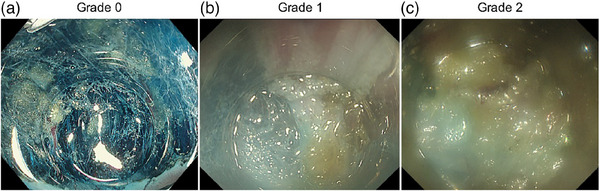
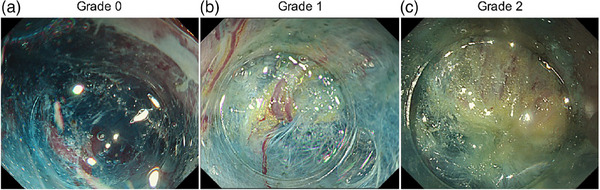
We aimed to identify independent factors for intraoperative endoscopic lens cloudiness during gastric and colorectal endoscopic submucosal dissections, investigate the effectiveness of Cleastay, an endoscope anti-fog solution, and examine factors associated with severe submucosal fat deposition.
A total of 220 patients who underwent gastric or colorectal endoscopic submucosal dissections in two institutions between January 2022 and October 2023 were included. Significant factors related to cloudiness were determined using univariate and multivariate analyses. Patient background and tumor characteristics related to severe submucosal fat deposition were investigated, and the degree of intraoperative endoscopic lens cloudiness and outcomes were compared between the Cleash and Cleastay groups.
In the multivariate analysis, factors increasing lens cloudiness included long procedure time (odds ratio [OR], 17.51; 95% confidence interval [CI], 1.52-202.08), stomach (vs. colon; OR, 5.08; 95% CI, 1.99-12.96), and severe submucosal fat deposition (OR, 12.19; 95% CI, 5.02-29.60). Conversely, the use of Cleastay (vs. Cleash; OR, 0.066; 95% CI, 0.021-0.21) was identified as a factor reducing cloudiness. Location analysis revealed that severe submucosal fat deposition was more common in the upper stomach and right colon.
It was suggested that Cleastay is more useful for endoscopic submucosal dissection of the upper stomach and right colon, where severe submucosal fat deposition is expected.
我们旨在确定胃和结直肠内镜黏膜下剥离术中内镜镜头模糊的独立因素,研究内镜防雾溶液Cleastay的有效性,并检查与严重黏膜下脂肪沉积相关的因素。
纳入2022年1月至2023年10月期间在两家机构接受胃或结直肠内镜黏膜下剥离术的220例患者。使用单因素和多因素分析确定与镜头模糊相关的显著因素。研究与严重黏膜下脂肪沉积相关的患者背景和肿瘤特征,并比较Cleash组和Cleastay组术中内镜镜头模糊程度及结果。
在多因素分析中,增加镜头模糊的因素包括手术时间长(比值比[OR],17.51;95%置信区间[CI],1.52 - 202.08)、胃部手术(与结肠手术相比;OR,5.08;95% CI,1.99 - 12.96)和严重黏膜下脂肪沉积(OR,12.19;95% CI,5.02 - 29.60)。相反,使用Cleastay(与Cleash相比;OR,0.066;95% CI,0.021 - 0.21)被确定为减少镜头模糊的因素。部位分析显示,严重黏膜下脂肪沉积在上胃部和右结肠更为常见。
提示Cleastay对上胃部和右结肠的内镜黏膜下剥离术更有用,因为预计这些部位会有严重的黏膜下脂肪沉积。