Department of Pathology, Zhuzhou Hospital Affiliated to Xiangya School of Medicine, Central South University, Zhuzhou, 412007, Hunan, China.
Trauma Center, Zhuzhou Hospital Affiliated to Xiangya School of Medicine, Central South University, Zhuzhou, 412007, Hunan, China.
BMC Cancer. 2024 Jul 29;24(1):913. doi: 10.1186/s12885-024-12696-7.
In China, the national cervical cancer screening protocol involves initial testing for high-risk human papillomavirus (hrHPV), followed by cytology for hrHPV-positive cases. This study evaluates the effectiveness of PAX1 methylation (PAX1) analysis in identifying precancerous or cancerous lesions in cervical samples from Chinese women positive for non-16/18 hrHPV strains.
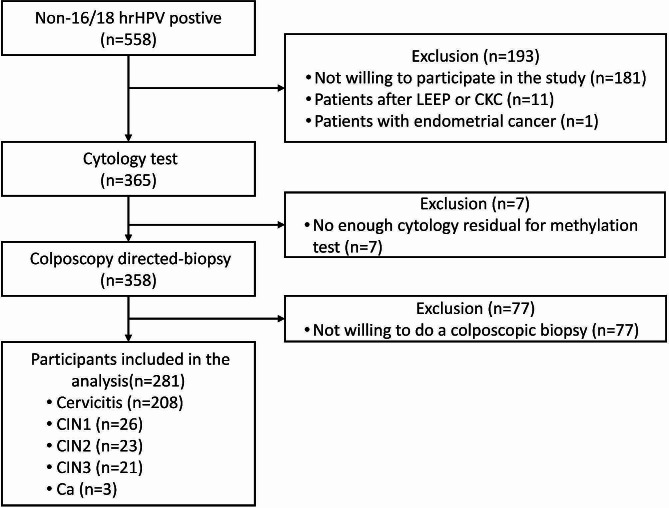
Between February 2022 and March 2023, 281 cervical samples from non-16/18 hrHPV-positive women underwent cytological examination and PAX1 analysis. The study assessed the statistical relationship between PAX1 levels and the presence of cervical lesions, comparing the diagnostic performance of PAX1 to conventional cytology.
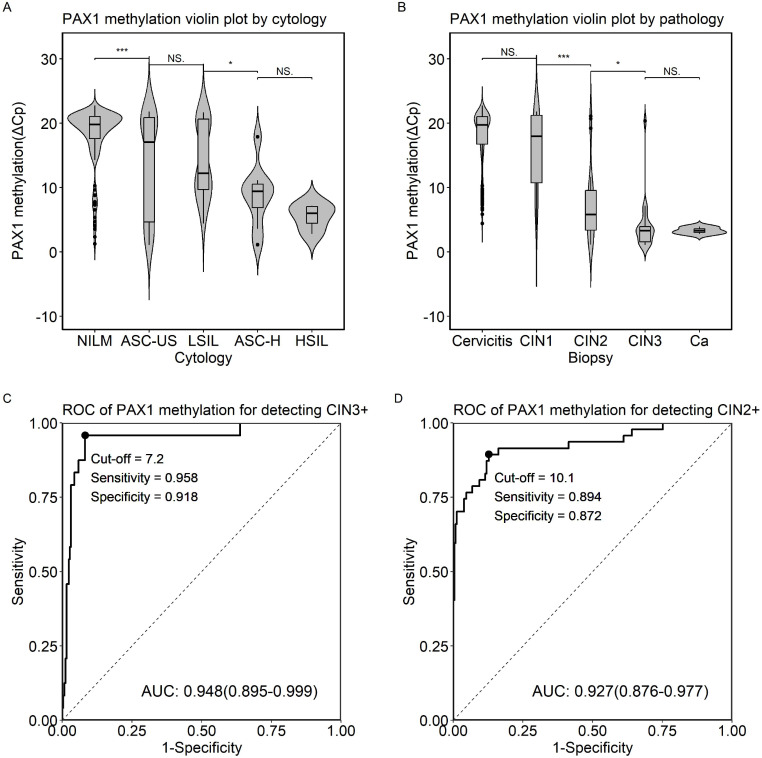
A significant association was found between PAX1 methylation levels and the risk of CIN2 + and CIN3 + lesions, with 47 instances of CIN2 + detected. Odds ratios (ORs) for moderate and high PAX1 levels were 8.86 (95% CI: 2.24-42.17) and 166.32 (95% CI: 47.09-784.97), respectively. The area under the ROC curve for PAX1 in identifying CIN2 + lesions was 0.948 (95% CI: 0.895-0.99). PAX1 demonstrated similar sensitivity and negative predictive value (NPV) to cytology but reduced the colposcopy referral rate from 47.7% with cytology alone to 25.6% with PAX1, showing superior specificity and positive predictive value across age groups.
PAX1 methylation is a strong indicator of CIN2 + and CIN3 + risk, offering diagnostic performance comparable to cytology with the added benefit of reduced unnecessary colposcopy referrals. These findings support the use of PAX1 analysis as a reliable tool for triaging non-16/18 hrHPV-positive women in outpatient settings.
在中国,国家宫颈癌筛查方案包括对高危型人乳头瘤病毒(hrHPV)的初始检测,然后对 hrHPV 阳性病例进行细胞学检测。本研究评估了 PAX1 甲基化(PAX1)分析在识别中国非 16/18 型 hrHPV 阳性妇女宫颈样本中癌前病变或癌症的有效性。
2022 年 2 月至 2023 年 3 月,对 281 例非 16/18 型 hrHPV 阳性妇女的宫颈样本进行了细胞学检查和 PAX1 分析。本研究评估了 PAX1 水平与宫颈病变之间的统计学关系,比较了 PAX1 与传统细胞学的诊断性能。
发现 PAX1 甲基化水平与 CIN2+和 CIN3+病变的风险之间存在显著关联,共检出 47 例 CIN2+。中、高 PAX1 水平的优势比(OR)分别为 8.86(95%CI:2.24-42.17)和 166.32(95%CI:47.09-784.97)。PAX1 识别 CIN2+病变的 ROC 曲线下面积为 0.948(95%CI:0.895-0.99)。PAX1 在细胞学检查中的敏感性和阴性预测值(NPV)相似,但降低了单独细胞学检查时的阴道镜转诊率(47.7%),降至 PAX1 时的 25.6%,并在各年龄段中表现出更高的特异性和阳性预测值。
PAX1 甲基化是 CIN2+和 CIN3+风险的有力指标,其诊断性能与细胞学相似,但具有降低不必要阴道镜转诊的额外益处。这些发现支持将 PAX1 分析作为一种可靠的工具,用于门诊环境中非 16/18 型 hrHPV 阳性妇女的分流。