• 文献检索
  • 文档翻译
  • 深度研究
  • 学术资讯
  • Suppr Zotero 插件Zotero 插件
  • 邀请有礼
  • 套餐&价格
  • 历史记录
应用&插件
Suppr Zotero 插件Zotero 插件浏览器插件Mac 客户端Windows 客户端微信小程序
定价
高级版会员购买积分包购买API积分包
服务
文献检索文档翻译深度研究API 文档MCP 服务
关于我们
关于 Suppr公司介绍联系我们用户协议隐私条款
关注我们

Suppr 超能文献

核心技术专利:CN118964589B侵权必究
粤ICP备2023148730 号-1Suppr @ 2026

文献检索

告别复杂PubMed语法,用中文像聊天一样搜索,搜遍4000万医学文献。AI智能推荐,让科研检索更轻松。

立即免费搜索

文件翻译

保留排版,准确专业,支持PDF/Word/PPT等文件格式,支持 12+语言互译。

免费翻译文档

深度研究

AI帮你快速写综述,25分钟生成高质量综述,智能提取关键信息,辅助科研写作。

立即免费体验

一种机器学习方法,用于确定多发性硬化症患者跌倒的风险因素。

A machine learning approach to determine the risk factors for fall in multiple sclerosis.

机构信息

Department of Biostatistics and Medical Informatics, Ege University Faculty of Medicine, Izmir, Türkiye.

Ege University Faculty of Medicine, EgeSAM-Translational Pulmonary Research Center, Bornova, İzmir, Türkiye.

出版信息

BMC Med Inform Decis Mak. 2024 Jul 30;24(1):215. doi: 10.1186/s12911-024-02621-0.

DOI:10.1186/s12911-024-02621-0
PMID:39080657
原文链接:https://pmc.ncbi.nlm.nih.gov/articles/PMC11289943/
Abstract

BACKGROUND

Falls in multiple sclerosis can result in numerous problems, including injuries and functional loss. Therefore, determining the factors contributing to falls in people with Multiple Sclerosis (PwMS) is crucial. This study aims to investigate the contributing factors to falls in multiple sclerosis using a machine learning approach.

METHODS

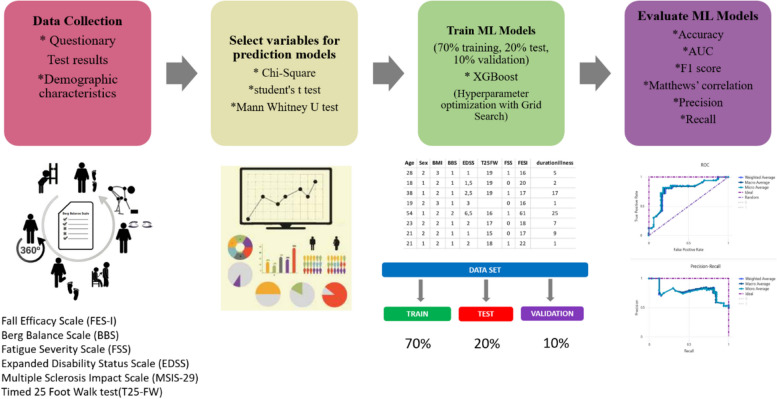
This cross-sectional study was conducted with 253 PwMS admitted to the outpatient clinic of a university hospital between February and August 2023. A sociodemographic data collection form, Fall Efficacy Scale (FES-I), Berg Balance Scale (BBS), Fatigue Severity Scale (FSS), Expanded Disability Status Scale (EDSS), Multiple Sclerosis Impact Scale (MSIS-29), and Timed 25 Foot Walk Test (T25-FW) were used for data collection. Gradient-boosting algorithms were employed to predict the important variables for falls in PwMS. The XGBoost algorithm emerged as the best performed model in this study.

RESULTS

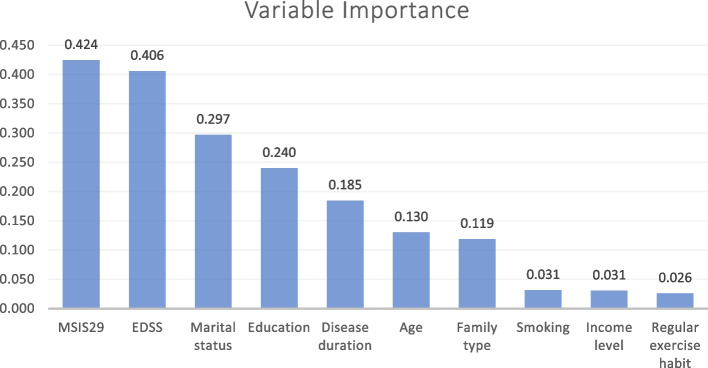
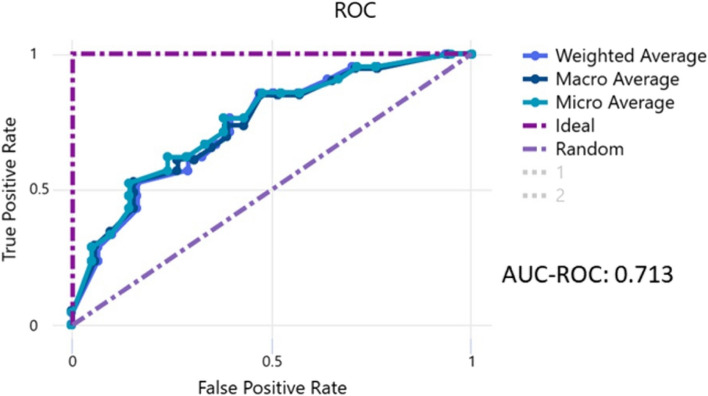
Most of the participants (70.0%) were female, with a mean age of 40.44 ± 10.88 years. Among the participants, 40.7% reported a fall history in the last year. The area under the curve value of the model was 0.713. Risk factors of falls in PwMS included MSIS-29 (0.424), EDSS (0.406), marital status (0.297), education level (0.240), disease duration (0.185), age (0.130), family type (0.119), smoking (0.031), income level (0.031), and regular exercise habit (0.026).

CONCLUSIONS

In this study, smoking and regular exercise were the modifiable factors contributing to falls in PwMS. We recommend that clinicians facilitate the modification of these factors in PwMS. Age and disease duration were non-modifiable factors. These should be considered as risk increasing factors and used to identify PwMS at risk. Interventions aimed at reducing MSIS-29 and EDSS scores will help to prevent falls in PwMS. Education of individuals to increase knowledge and awareness is recommended. Financial support policies for those with low income will help to reduce the risk of falls.

摘要

背景

多发性硬化症患者的跌倒可能会导致诸多问题,包括受伤和功能丧失。因此,确定导致多发性硬化症患者(PwMS)跌倒的因素至关重要。本研究旨在使用机器学习方法探究多发性硬化症患者跌倒的相关因素。

方法

本横断面研究纳入了 2023 年 2 月至 8 月期间在某大学医院门诊就诊的 253 例 PwMS。使用一般资料收集表、跌倒效能量表(FES-I)、伯格平衡量表(BBS)、疲劳严重程度量表(FSS)、扩展残疾状况量表(EDSS)、多发性硬化影响量表(MSIS-29)和 25 英尺步行计时测试(T25-FW)进行数据收集。采用梯度提升算法预测 PwMS 跌倒的重要变量。在本研究中,XGBoost 算法表现最佳。

结果

大多数参与者(70.0%)为女性,平均年龄为 40.44±10.88 岁。参与者中有 40.7%在过去一年中报告有跌倒史。模型的曲线下面积值为 0.713。PwMS 跌倒的危险因素包括 MSIS-29(0.424)、EDSS(0.406)、婚姻状况(0.297)、教育程度(0.240)、病程(0.185)、年龄(0.130)、家庭类型(0.119)、吸烟(0.031)、收入水平(0.031)和定期运动习惯(0.026)。

结论

在本研究中,吸烟和定期运动是导致 PwMS 跌倒的可改变因素。我们建议临床医生促进 PwMS 改变这些因素。年龄和病程是不可改变的因素。这些因素应被视为增加风险的因素,并用于识别有跌倒风险的 PwMS。旨在降低 MSIS-29 和 EDSS 评分的干预措施将有助于预防 PwMS 跌倒。建议对个体进行教育以增加知识和意识。为低收入者提供经济支持政策将有助于降低跌倒风险。
https://cdn.ncbi.nlm.nih.gov/pmc/blobs/a2c9/11289943/85d27a21083e/12911_2024_2621_Fig5_HTML.jpg
https://cdn.ncbi.nlm.nih.gov/pmc/blobs/a2c9/11289943/26b72d044033/12911_2024_2621_Fig1_HTML.jpg
https://cdn.ncbi.nlm.nih.gov/pmc/blobs/a2c9/11289943/5c253d1779d4/12911_2024_2621_Fig2_HTML.jpg
https://cdn.ncbi.nlm.nih.gov/pmc/blobs/a2c9/11289943/aa1be955b634/12911_2024_2621_Fig3_HTML.jpg
https://cdn.ncbi.nlm.nih.gov/pmc/blobs/a2c9/11289943/d93efe84f707/12911_2024_2621_Fig4_HTML.jpg
https://cdn.ncbi.nlm.nih.gov/pmc/blobs/a2c9/11289943/85d27a21083e/12911_2024_2621_Fig5_HTML.jpg
https://cdn.ncbi.nlm.nih.gov/pmc/blobs/a2c9/11289943/26b72d044033/12911_2024_2621_Fig1_HTML.jpg
https://cdn.ncbi.nlm.nih.gov/pmc/blobs/a2c9/11289943/5c253d1779d4/12911_2024_2621_Fig2_HTML.jpg
https://cdn.ncbi.nlm.nih.gov/pmc/blobs/a2c9/11289943/aa1be955b634/12911_2024_2621_Fig3_HTML.jpg
https://cdn.ncbi.nlm.nih.gov/pmc/blobs/a2c9/11289943/d93efe84f707/12911_2024_2621_Fig4_HTML.jpg
https://cdn.ncbi.nlm.nih.gov/pmc/blobs/a2c9/11289943/85d27a21083e/12911_2024_2621_Fig5_HTML.jpg

相似文献

1
A machine learning approach to determine the risk factors for fall in multiple sclerosis.一种机器学习方法,用于确定多发性硬化症患者跌倒的风险因素。
BMC Med Inform Decis Mak. 2024 Jul 30;24(1):215. doi: 10.1186/s12911-024-02621-0.
2
Fear of falling, not falls, impacts leisure-time physical activity in people with multiple sclerosis.对跌倒的恐惧而非跌倒本身,会影响多发性硬化症患者的休闲体育活动。
Gait Posture. 2018 Sep;65:33-38. doi: 10.1016/j.gaitpost.2018.06.174. Epub 2018 Jun 30.
3
Prevalence and determinants of falls in persons with multiple sclerosis without a clinical disability.无临床残疾的多发性硬化症患者跌倒的患病率及决定因素
Mult Scler Relat Disord. 2021 Apr;49:102771. doi: 10.1016/j.msard.2021.102771. Epub 2021 Jan 18.
4
Erratum.勘误
Mult Scler. 2016 Oct;22(12):NP9-NP11. doi: 10.1177/1352458515585718. Epub 2015 Jun 3.
5
Using machine learning algorithms to detect fear of falling in people with multiple sclerosis in standardized gait analysis.使用机器学习算法在标准化步态分析中检测多发性硬化症患者的跌倒恐惧。
Mult Scler Relat Disord. 2024 Aug;88:105721. doi: 10.1016/j.msard.2024.105721. Epub 2024 Jun 10.
6
Examining the validity and sensitivity to change of the 5 and 10 sit-to-stand tests in people with multiple sclerosis.研究多发性硬化症患者5次和10次坐立试验的有效性及对变化的敏感性。
Physiother Res Int. 2017 Oct;22(4). doi: 10.1002/pri.1681. Epub 2017 Jan 3.
7
Fall risk is related to cognitive functioning in ambulatory multiple sclerosis patients.在行动自如的多发性硬化症患者中,跌倒风险与认知功能有关。
Neurol Sci. 2023 Sep;44(9):3233-3242. doi: 10.1007/s10072-023-06770-4. Epub 2023 Mar 30.
8
Further construct validity of the Timed Up-and-Go Test as a measure of ambulation in multiple sclerosis patients.作为衡量多发性硬化症患者活动能力的计时起立行走测试的进一步构建效度。
Eur J Phys Rehabil Med. 2017 Dec;53(6):841-847. doi: 10.23736/S1973-9087.17.04599-3. Epub 2017 Mar 13.
9
Quantifying the impact of upper limb tremor on the quality of life of people with multiple sclerosis: a comparison between the QUEST and MSIS-29 scales.定量评估多发性硬化症患者上肢震颤对其生活质量的影响:QUEST 量表和 MSIS-29 量表的比较。
Mult Scler Relat Disord. 2022 Feb;58:103495. doi: 10.1016/j.msard.2022.103495. Epub 2022 Jan 4.
10
Construct Validity of the Four Square Step Test in Multiple Sclerosis.四方步试验在多发性硬化症中的结构效度
Arch Phys Med Rehabil. 2016 Sep;97(9):1496-1501. doi: 10.1016/j.apmr.2016.04.012. Epub 2016 Jun 1.

引用本文的文献

1
A machine learning approach to predict self-efficacy in breast cancer survivors.一种预测乳腺癌幸存者自我效能的机器学习方法。
BMC Med Inform Decis Mak. 2025 Aug 19;25(1):313. doi: 10.1186/s12911-025-03155-9.
2
Linking Pathogenesis to Fall Risk in Multiple Sclerosis.将多发性硬化症的发病机制与跌倒风险相联系
Arch Intern Med Res. 2025;8(1):36-47. doi: 10.26502/aimr.0194. Epub 2025 Jan 30.

本文引用的文献

1
An enhanced and efficient approach for feature selection for chronic human disease prediction: A breast cancer study.一种用于慢性人类疾病预测的特征选择的增强型高效方法:一项乳腺癌研究。
Heliyon. 2024 Feb 28;10(5):e26799. doi: 10.1016/j.heliyon.2024.e26799. eCollection 2024 Mar 15.
2
Examination of Risk Factors Associated With Falls and Injurious Falls in People With Multiple Sclerosis: An Updated Nationwide Study.对多发性硬化症患者跌倒和致伤性跌倒相关风险因素的研究:一项更新的全国性研究。
Arch Phys Med Rehabil. 2024 Apr;105(4):717-724. doi: 10.1016/j.apmr.2023.11.011. Epub 2023 Dec 1.
3
Insomnia in neurological disorders: Prevalence, mechanisms, impact and treatment approaches.
神经障碍相关失眠:患病率、发病机制、影响及治疗方法。
Rev Neurol (Paris). 2023 Oct;179(7):767-781. doi: 10.1016/j.neurol.2023.08.008. Epub 2023 Aug 22.
4
A Deep Learning Approach for Predicting Multiple Sclerosis.一种用于预测多发性硬化症的深度学习方法。
Micromachines (Basel). 2023 Mar 29;14(4):749. doi: 10.3390/mi14040749.
5
Fall risk is related to cognitive functioning in ambulatory multiple sclerosis patients.在行动自如的多发性硬化症患者中,跌倒风险与认知功能有关。
Neurol Sci. 2023 Sep;44(9):3233-3242. doi: 10.1007/s10072-023-06770-4. Epub 2023 Mar 30.
6
Detection of Fall Risk in Multiple Sclerosis by Gait Analysis-An Innovative Approach Using Feature Selection Ensemble and Machine Learning Algorithms.通过步态分析检测多发性硬化症的跌倒风险——一种使用特征选择集成和机器学习算法的创新方法。
Brain Sci. 2022 Oct 31;12(11):1477. doi: 10.3390/brainsci12111477.
7
The reliability and validity of the Turkish version of the multiple sclerosis impact scale-29.多发性硬化症影响量表-29 土耳其语版的信度和效度。
Turk J Med Sci. 2022 Aug;52(4):1216-1222. doi: 10.55730/1300-0144.5426. Epub 2022 Aug 10.
8
The risk of falls among the aging population: A systematic review and meta-analysis.老年人跌倒的风险:系统评价和荟萃分析。
Front Public Health. 2022 Oct 17;10:902599. doi: 10.3389/fpubh.2022.902599. eCollection 2022.
9
On evaluation metrics for medical applications of artificial intelligence.人工智能在医学应用中的评估指标。
Sci Rep. 2022 Apr 8;12(1):5979. doi: 10.1038/s41598-022-09954-8.
10
Relationship between balance confidence and social engagement in people with multiple sclerosis.多发性硬化症患者平衡信心与社会参与的关系。
Mult Scler Relat Disord. 2022 Jan;57:103440. doi: 10.1016/j.msard.2021.103440. Epub 2021 Dec 3.