Shi Jin-Yu, Li Ting-Ting, Yang Hui-Ting, Zhang Shi, An Ran, Mao Liang, Li Yang, Li Qian, Luan Guang-Yi, Shen Yan, Wang En-Long, Liu Guang-Hui
First Clinical Medical College, Liaoning University of Traditional Chinese Medicine, Shenyang, Liaoning, 110847, People's Republic of China.
Department of Neurology, Affiliated Hospital of Liaoning University of Traditional Chinese Medicine, Shenyang, Liaoning, 110032, People's Republic of China.
J Pain Res. 2024 Jul 26;17:2455-2471. doi: 10.2147/JPR.S471441. eCollection 2024.
This study aimed to investigate the features and underlying principles of acupuncture points used in the treatment of headaches associated with blood stasis syndrome.
Literature on the treatment of blood stasis headache with acupuncture and moxibustion was searched across three Chinese databases and one English database from January 1st, 2000, to January 1st, 2024. Relevant data including titles, journals, authors, keywords, interventions, main acupoints, and outcomes were extracted for further analysis.
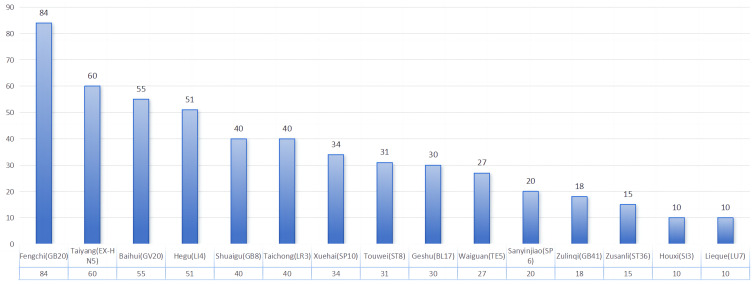
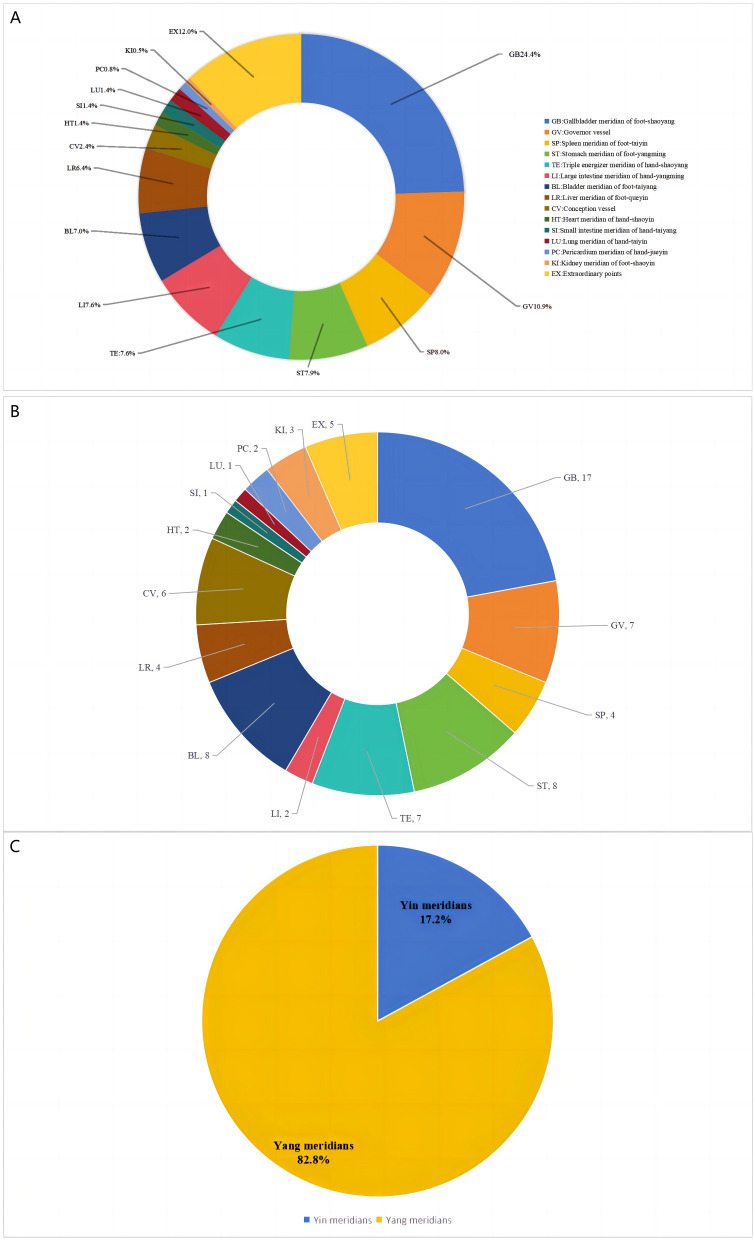
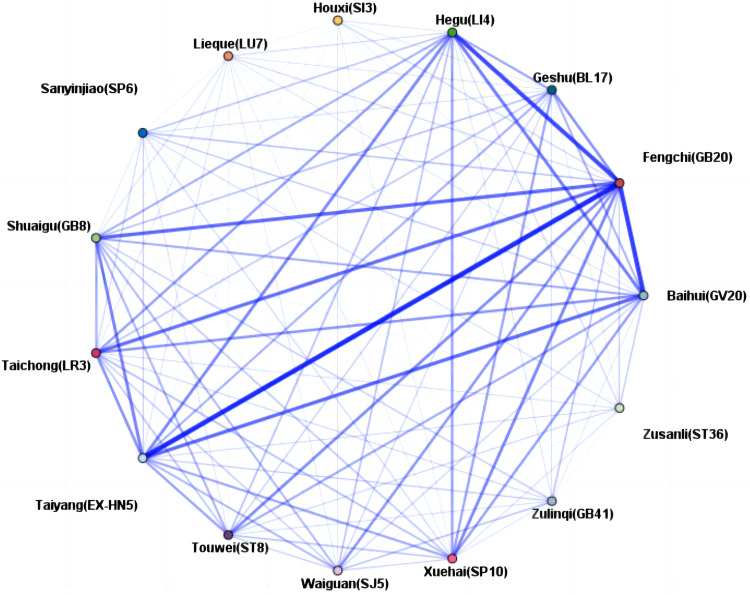
A total of 112 papers with 102 complete prescriptions were analyzed. Of the 77 acupoints examined, 72 were meridian points, and 5 were extraordinary points, used 699 times in total. The top ten acupoints by frequency were Fengchi (GB20), Taiyang (EX-HN5), Baihui (GV20), Hegu (LI4), Shuaigu (GB8), Taichong (LR3), Xuehai (SP10), Touwei (ST8), Geshu (BL17), and Waiguan (TE5). Yang meridian points were used more frequently than Yin meridian points (82.8% vs 17.2%), with the Gallbladder Meridian of Foot Shaoyang being the most common. Nearly half of the acupoints (49.9%) were on the head and neck, and 23.1% on the lower limbs. Specific acupoints accounted for 53.5% of the total frequency. Fengchi (GB20) and Taiyang (EX-HN5) showed the highest correlation. Association rule mining highlighted combinations like Fengchi (GB20) with Taiyang (EX-HN5) and Baihui (GV20). Cluster analysis yielded five clusters.
The study provides insights into selecting effective acupoints and combinations for clinical acupuncture practice and experimental studies in treating blood stasis headaches. Acupoints like Fengchi (GB20), Taiyang (EX-HN5), and Baihui (GV20) may be effective for clinical treatment, but further studies are needed to validate their efficacy.
本研究旨在探讨针刺治疗瘀血头痛所选用穴位的特点及潜在规律。
检索2000年1月1日至2024年1月1日期间三个中文数据库和一个英文数据库中关于针灸治疗瘀血头痛的文献。提取相关数据,包括标题、期刊、作者、关键词、干预措施、主要穴位及结局等,进行进一步分析。
共分析112篇论文,其中有102个完整处方。在所考察的77个穴位中,经穴72个,奇穴5个,共使用699次。使用频率排名前十的穴位依次为风池(GB20)、太阳(EX-HN5)、百会(GV20)、合谷(LI4)、率谷(GB8)、太冲(LR3)、血海(SP10)、头维(ST8)、膈俞(BL17)、外关(TE5)。阳经穴位的使用频率高于阴经穴位(82.8%对17.2%),其中足少阳胆经最为常用。近半数穴位(49.9%)分布于头颈部,23.1%分布于下肢。特定穴占总频次的53.5%。风池(GB20)与太阳(EX-HN5)的相关性最高。关联规则挖掘突出了风池(GB20)与太阳(EX-HN5)、百会(GV20)等组合。聚类分析产生了五个聚类。
本研究为临床针刺实践及瘀血头痛实验研究中有效穴位及组合的选择提供了思路。风池(GB20)、太阳(EX-HN5)、百会(GV20)等穴位可能对临床治疗有效,但仍需进一步研究验证其疗效。