Wong Joey, Hung Lillian, Bayabay Cates, Wong Karen Lok Yi, Berndt Annette, Mann Jim, Wong Lily, Jackson Lynn, Gregorio Mario
School of Nursing, University of British Columbia, Vancouver, BC, Canada.
UBC IDEA Lab, School of Nursing, University of British Columbia, Vancouver, BC, Canada.
Front Dement. 2024 Jun 24;3:1422820. doi: 10.3389/frdem.2024.1422820. eCollection 2024.
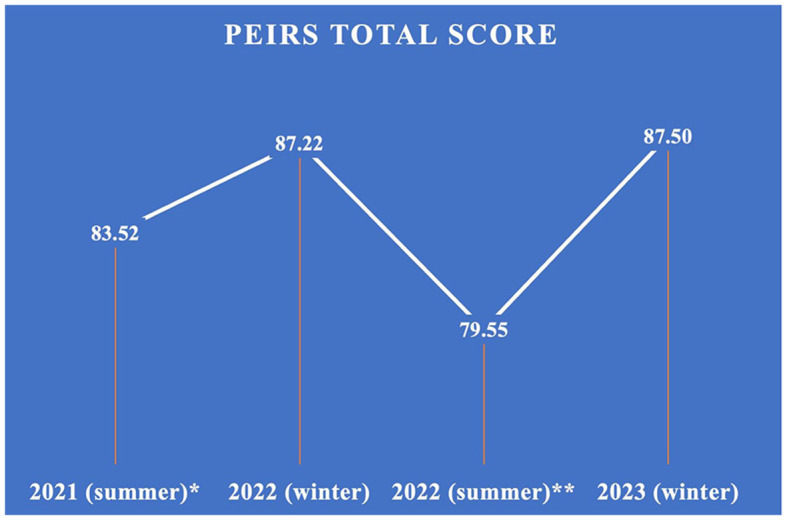
Research involvement of people with lived experiences is increasing. Few tools are designed to evaluate their engagement in research. The Patient Engagement In Research Scale (PEIRS) is one of the few validated tools. Our team employed the PEIRS with patient and family partners with lived experiences of dementia every 6 months in a two-year telepresence robot project. This reflection paper reports our self-study on key learnings and proposes practical tips on using the PEIRS to evaluate patient and family partners' engagement in dementia research. It is the first to document a case using the PEIRS multiple times in a dementia research project.
Guided by Rolfe et al.'s reflective model, we conducted three team reflective sessions to examine the team's experiences using the PEIRS to improve and evaluate patient and family partners' engagement in the research. We also reviewed our meeting notes and fieldnotes documented in the research journal. A reflexive thematic analysis was performed.
The team identified three key learnings: the values of using the PEIRS survey, the adaptations, and the factors influencing its implementation as an evaluation tool. Using the PEIRS provided significant benefits to the project, although some patient and family partners felt it was burdensome. The evaluation tool was enhanced with emojis and comment boxes based on suggestions from patient partners. The emojis introduced an element of fun, while the comment boxes allowed for personalized responses. Several factors influenced the PEIRS tool's effectiveness: the interviewer's identity, the confidentiality of responses and follow-ups, the timing and frequency of using the tool, and the presentation of the evaluations. These learnings led to the development of six practical tips,-"ENGAGE": Enjoyable and fun process, Never impose, Get prepared early, Adapt to the team's needs, Give people options, and Engage and reflect.
With the emerging trend of including people with lived experiences in dementia research, there is a need for ongoing assessment of engagement from both patient and family partners and the research team strategies. Future research can further explore survey logistics, co-development of evaluation tools, and the use of tools with people living with dementia.
有实际生活经历的人群参与研究的情况日益增多。但用于评估他们参与研究程度的工具却很少。患者研究参与度量表(PEIRS)是少数经过验证的工具之一。在一个为期两年的远程呈现机器人项目中,我们的团队每6个月就会让有痴呆症实际生活经历的患者和家属伙伴使用一次PEIRS。这篇反思性论文报告了我们关于关键经验教训的自我研究,并提出了使用PEIRS评估患者和家属伙伴参与痴呆症研究情况的实用建议。这是首次记录在痴呆症研究项目中多次使用PEIRS的案例。
在罗尔夫等人的反思模型指导下,我们进行了三次团队反思会议,以审视团队使用PEIRS来改善和评估患者及家属伙伴参与研究情况的经验。我们还查阅了研究日志中记录的会议笔记和实地记录。进行了反思性主题分析。
团队确定了三个关键经验教训:使用PEIRS调查的价值、调整内容以及影响其作为评估工具实施的因素。使用PEIRS给项目带来了显著益处,尽管一些患者和家属伙伴觉得它很繁琐。根据患者伙伴的建议,通过表情符号和评论框对评估工具进行了改进。表情符号增添了趣味性,而评论框则允许进行个性化回复。有几个因素影响了PEIRS工具的有效性:访谈者的身份、回复和后续跟进的保密性、使用该工具的时间和频率以及评估的呈现方式。这些经验教训促成了六个实用建议的形成,即“参与”:愉快有趣的过程、绝不强迫、尽早准备、适应团队需求、给人们选择以及参与并反思。
随着痴呆症研究中纳入有实际生活经历人群这一趋势的出现,需要持续评估患者和家属伙伴以及研究团队策略的参与度。未来的研究可以进一步探索调查后勤工作、评估工具的共同开发以及该工具在痴呆症患者中的使用情况。