Department of Surgical Science, Functional Pharmacology and Neuroscience, University of Uppsala, Uppsala, Sweden.
Advanced Molecular Technologies, Limited Liability Company (LLC), Moscow, Russia.
Transl Psychiatry. 2024 Jul 31;14(1):315. doi: 10.1038/s41398-024-03031-6.
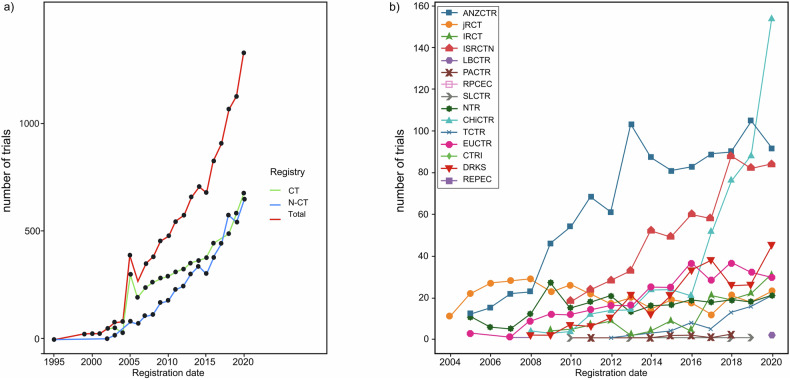
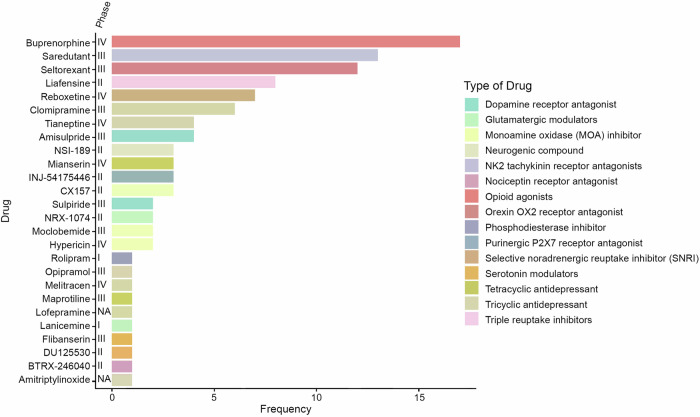
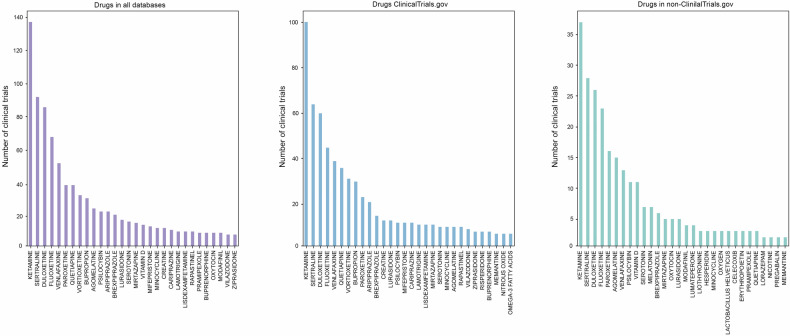
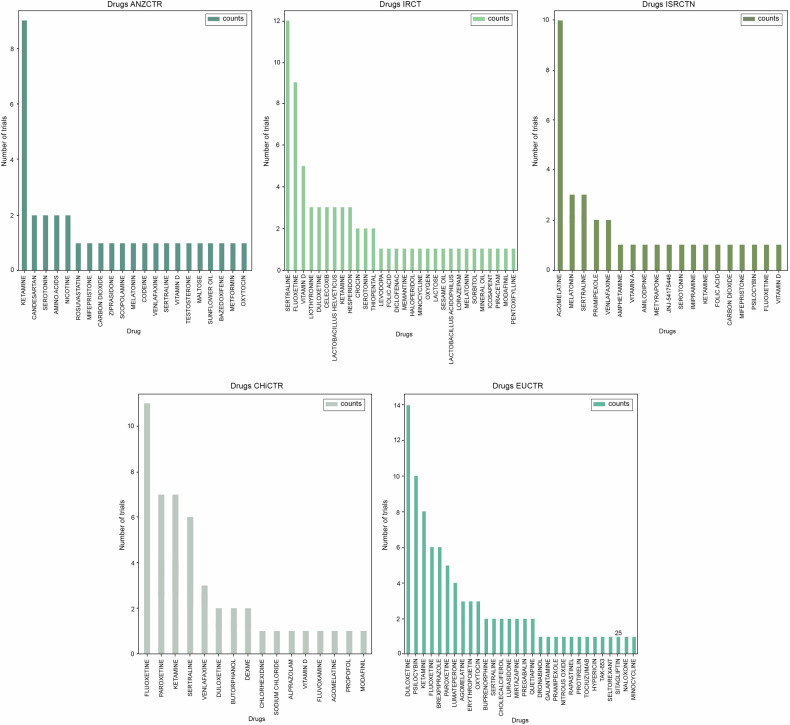
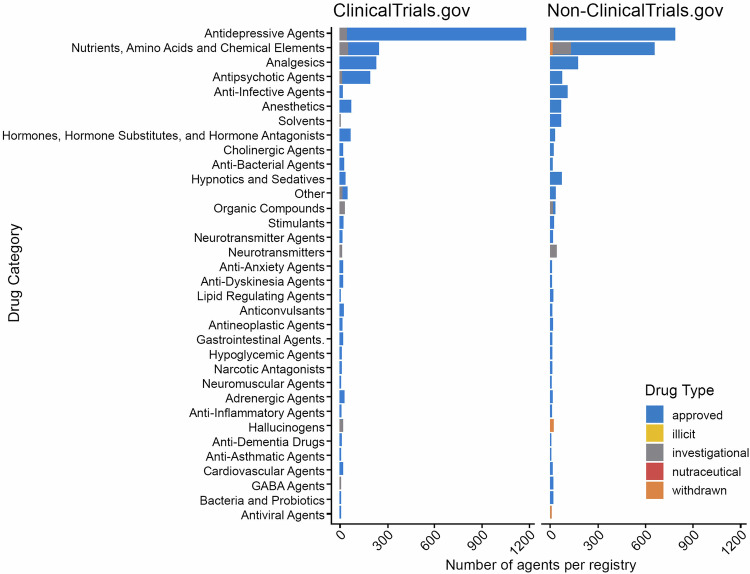
Major depressive disorder (MDD), commonly known as depression, affects over 300 million people worldwide as of 2018 and presents a wide range of clinical symptoms. The international clinical trials registry platform (ICTRP) introduced by WHO includes aggregated data from ClinicalTrials.gov and 17 other national registers, making it the largest clinical trial platform. Here we analysed data in ICTRP with the aim of providing comprehensive insights into clinical trials on depression. Applying a novel hidden duplicate identification method, 10,606 depression trials were identified in ICTRP, with ANZCTR being the largest non- ClinicalTrials.gov database at 1031 trials, followed by IRCT with 576 trials, ISRCTN with 501 trials, CHiCTR with 489 trials, and EUCTR with 351 trials. The top four most studied drugs, ketamine, sertraline, duloxetine, and fluoxetine, were consistent in both groups, but ClinicalTrials.gov had more trials for each drug compared to the non-ClinicalTrials.gov group. Out of 9229 interventional trials, 663 unique agents were identified, including approved drugs (74.5%), investigational drugs (23.2%), withdrawn drugs (1.8%), nutraceuticals (0.3%), and illicit substances (0.2%). Both ClinicalTrials.gov and non-ClinicalTrials.gov databases revealed that the largest categories were antidepressive agents (1172 in ClinicalTrials.gov and 659 in non-ClinicalTrials.gov) and nutrients, amino acids, and chemical elements (250 in ClinicalTrials.gov and 659 in non-ClinicalTrials.gov), indicating a focus on alternative treatments involving dietary supplements and nutrients. Additionally, 26 investigational antidepressive agents targeting 16 different drug targets were identified, with buprenorphine (opioid agonist), saredutant (NK2 antagonist), and seltorexant (OX2 antagonist) being the most frequently studied. This analysis addresses 40 approved drugs for depression treatment including new drug classes like GABA modulators and NMDA antagonists that are offering new prospects for treating MDD, including drug-resistant depression and postpartum depression subtypes.
重度抑郁症(MDD),通常被称为抑郁症,据 2018 年统计,全球有超过 3 亿人受其影响,表现出广泛的临床症状。世界卫生组织(WHO)推出的国际临床试验注册平台(ICTRP)包括来自 ClinicalTrials.gov 和 17 个其他国家登记处的汇总数据,是最大的临床试验平台。在这里,我们分析了 ICTRP 中的数据,旨在提供关于抑郁症临床试验的全面见解。应用一种新颖的隐藏重复识别方法,在 ICTRP 中确定了 10606 项抑郁症试验,其中 ANZCTR 是最大的非 ClinicalTrials.gov 数据库,有 1031 项试验,其次是 IRCT,有 576 项试验,ISRCTN 有 501 项试验,CHiCTR 有 489 项试验,EUCTR 有 351 项试验。研究最多的四种药物,氯胺酮、舍曲林、度洛西汀和氟西汀,在两组中都是一致的,但 ClinicalTrials.gov 对每种药物的试验数量都比非 ClinicalTrials.gov 组多。在 9229 项干预试验中,确定了 663 种独特的药物,包括已批准的药物(74.5%)、研究中的药物(23.2%)、已撤回的药物(1.8%)、营养保健品(0.3%)和非法物质(0.2%)。ClinicalTrials.gov 和非 ClinicalTrials.gov 数据库都显示,最大的类别是抗抑郁药(ClinicalTrials.gov 中有 1172 种,非 ClinicalTrials.gov 中有 659 种)和营养物、氨基酸和化学元素(ClinicalTrials.gov 中有 250 种,非 ClinicalTrials.gov 中有 659 种),表明人们关注涉及膳食补充剂和营养物的替代治疗方法。此外,确定了 26 种针对 16 种不同药物靶点的研究性抗抑郁药,其中丁丙诺啡(阿片类激动剂)、沙雷肽(NK2 拮抗剂)和塞尔托雷克斯(OX2 拮抗剂)是研究最多的药物。该分析涉及 40 种治疗抑郁症的批准药物,包括 GABA 调节剂和 NMDA 拮抗剂等新的药物类别,为治疗 MDD(包括耐药性抑郁症和产后抑郁症亚型)提供了新的前景。