Department of Urology, Toho University School of Medicine, 6-11-1, Omori-Nishi, Ota-Ku, Tokyo, 143-8541, Japan.
Sci Rep. 2024 Jul 31;14(1):17079. doi: 10.1038/s41598-024-67910-0.
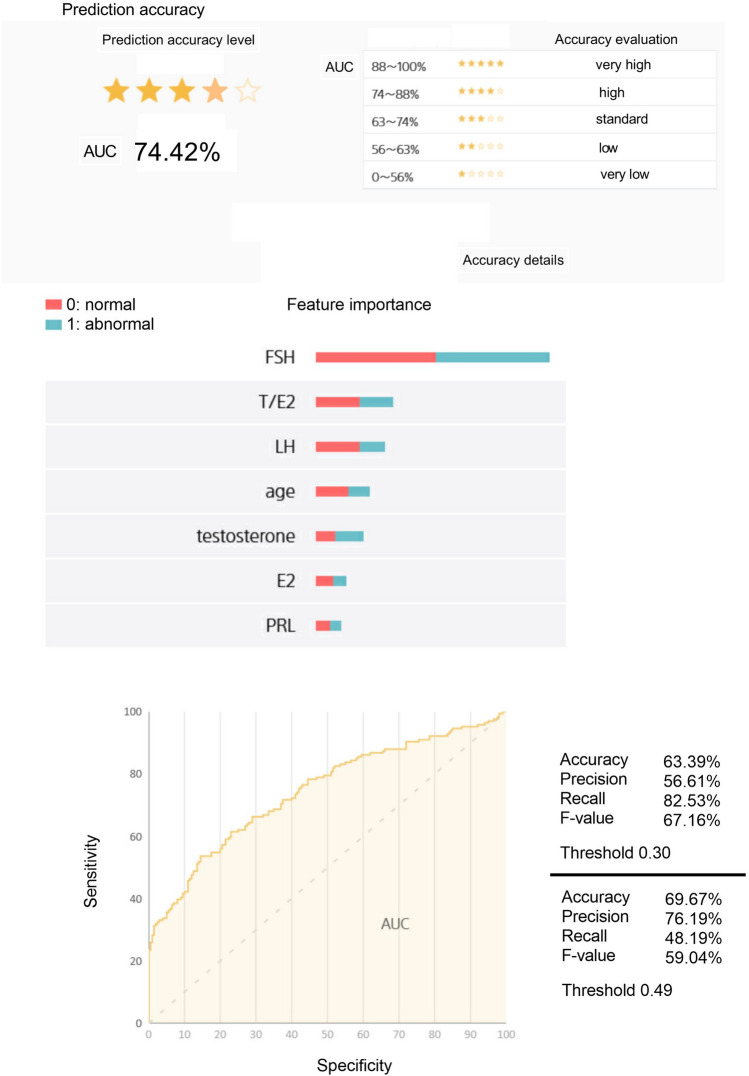
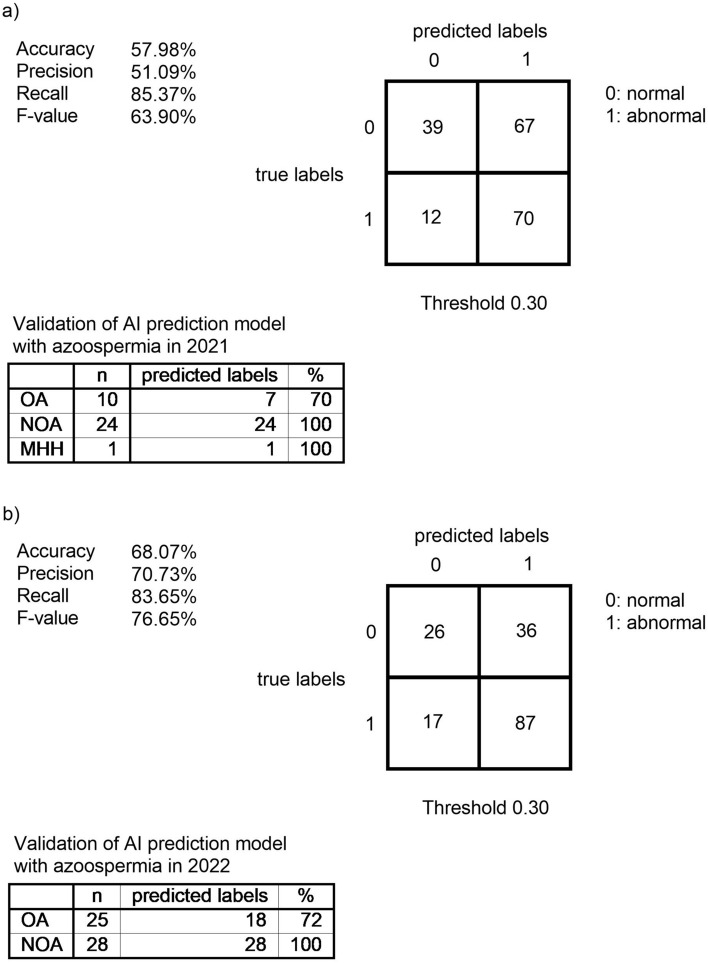
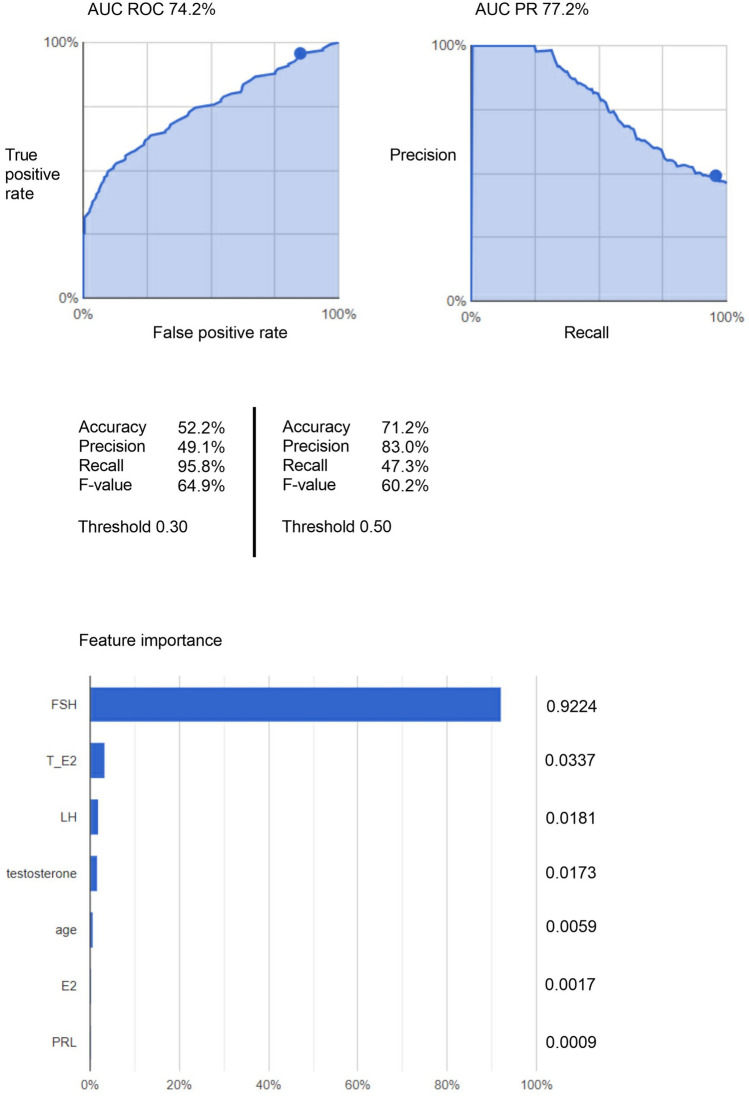
We investigated a screening method using only serum hormone levels and AI (artificial intelligence) predictive analysis. Among 3662 patients, numbers for NOA (non-obstructive azoospermia), OA (obstructive azoospermia), cryptozoospermia, oligozoospermia and/or asthenozoospermia, normal, and ejaculation disorder were 448, 210, 46, 1619, 1333, and 6, respectively. "Normal" was defined as semen findings normal according to the WHO (World Health Organization) Manual for Human Semen Testing of 2021. We extracted age, LH (luteinizing hormone), FSH (follicle stimulating hormone), PRL (prolactin), testosterone, E2 (estradiol), and T (testosterone)/E2 from medical records. A total motility sperm count of 9.408 × 10 (1.4 ml × 16 × 10/ml × 42%) was defined as the lower limit of normal. The Prediction One-based AI model had an AUC (area under the curve) of 74.42%. For the AutoML Tables-based model, AUC ROC (receiver operating characteristic) was 74.2% and AUC PR (precision-recall) 77.2%. In a ranking of feature importance from 1st to 3rd, FSH came a clear 1st. T/E2 and LH ranked 2nd and 3rd for both Prediction One and AutoML Tables. Using data from 2021 and 2022 to verify the Prediction One-based AI model, the predicted and actual results for NOA were 100% matched in both years.
我们研究了一种仅使用血清激素水平和 AI(人工智能)预测分析的筛查方法。在 3662 名患者中,NOA(非梗阻性无精子症)、OA(梗阻性无精子症)、隐匿精子症、少精子症和/或弱精子症、正常和射精障碍的数量分别为 448、210、46、1619、1333 和 6。“正常”是指根据 2021 年世界卫生组织(WHO)人类精液测试手册,精液检查正常。我们从病历中提取了年龄、LH(促黄体生成素)、FSH(卵泡刺激素)、PRL(催乳素)、睾酮、E2(雌二醇)和 T(睾酮)/E2。总活力精子数为 9.408×10(1.4ml×16×10/ml×42%)被定义为正常下限。基于 Prediction One 的 AI 模型的 AUC(曲线下面积)为 74.42%。对于基于 AutoML Tables 的模型,AUC ROC(接受者操作特征)为 74.2%,AUC PR(精度-召回率)为 77.2%。在从第 1 位到第 3 位的特征重要性排名中,FSH 明显排名第 1。对于 Prediction One 和 AutoML Tables,T/E2 和 LH 均排名第 2 和第 3。使用 2021 年和 2022 年的数据验证基于 Prediction One 的 AI 模型,这两年的预测和实际结果对 NOA 的匹配率均为 100%。