Na Han Gil, Kim Sangwoo, Jin Changhyun
UDerive, GJ Gajwa Tower Knowledge Industry Center, 16, Baekbeom-ro 630 beon-gil, Seo-gu, Incheon, 22824, Republic of Korea.
Materials Supply Chain R&D Department, Korea Institute of Industrial Technology, Incheon, 21999, Republic of Korea.
Sci Rep. 2024 Jul 31;14(1):17705. doi: 10.1038/s41598-024-68673-4.
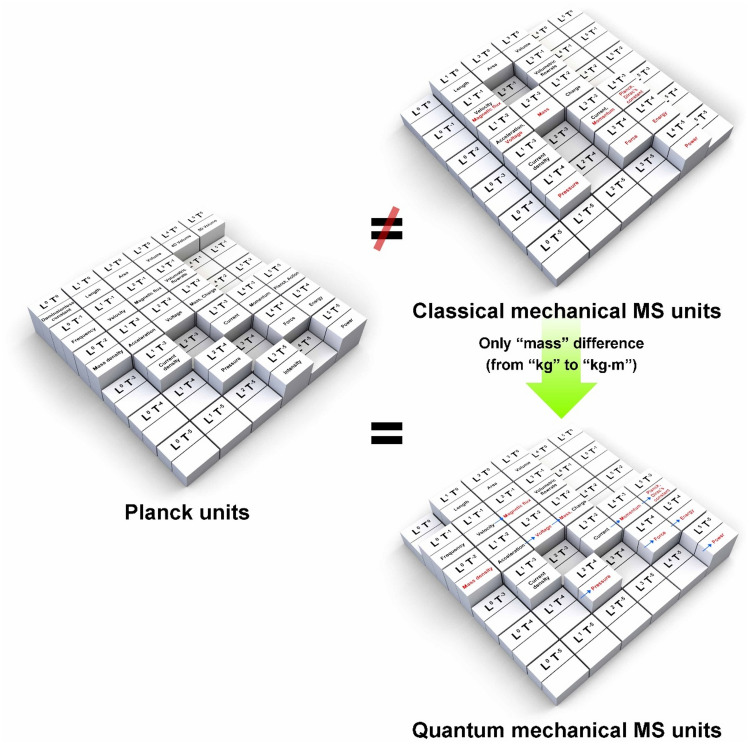
Through the previously reported the quantum-identity, the light-model, and the T S energy, the implied meaning of temperature and entropy, respectively, which it was difficult to intuitively recognize, was clearly defined. In order to minimize possible errors at this time, the interrelationship of the SI base unit, which is the smallest unit, and the T S unit integration was used. In the process of converting to Planck units, each unit (criterion) for entropy and temperature was calculated, and their physical and chemical meanings were compared and reinterpreted. Thus, the unit of entropy is related to the Boltzmann constant, and the temperature is the oscillation of pure mass units. Therefore, the intuitive recognition of physical and chemical factors based on the unit of meter(m)-time(s) is considered sufficient as an initiator to move closer to new science beyond the current limited application.
通过先前报道的量子恒等式、光模型和T - S能量,分别清晰地定义了难以直观认识的温度和熵的隐含意义。为了此时将可能的误差降至最低,使用了作为最小单位的国际单位制基本单位与T - S单位积分的相互关系。在转换为普朗克单位的过程中,计算了熵和温度的每个单位(标准),并对它们的物理和化学意义进行了比较和重新解释。因此,熵的单位与玻尔兹曼常数相关,而温度是纯质量单位的振荡。所以,基于米(m)-秒(s)单位对物理和化学因素的直观认识,被认为足以作为迈向超越当前有限应用的新科学的开端。