Song Wei, Shang Wen, Li Chunying, Bian Xinyu, Lu Hong, Ma Jun, Yu Dahai
Department of Radiation Oncology, Jiangsu Province Hospital of Chinese Medicine, Affiliated Hospital of Nanjing University of Chinese Medicine, Nanjing, 210029, China.
Radiat Oncol. 2024 Jul 31;19(1):98. doi: 10.1186/s13014-024-02496-5.
The purpose of this study was to improve the deep learning (DL) model performance in predicting and classifying IMRT gamma passing rate (GPR) by using input features related to machine parameters and a class balancing technique.
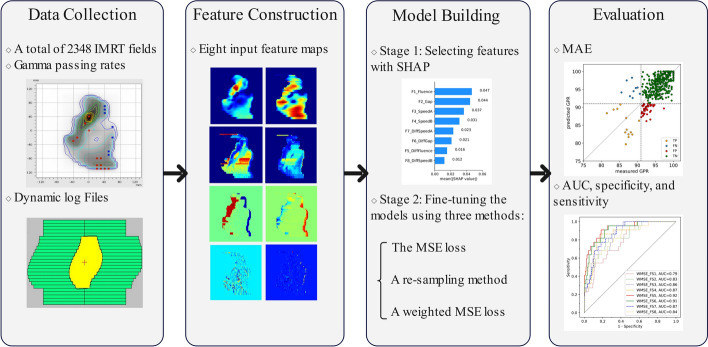
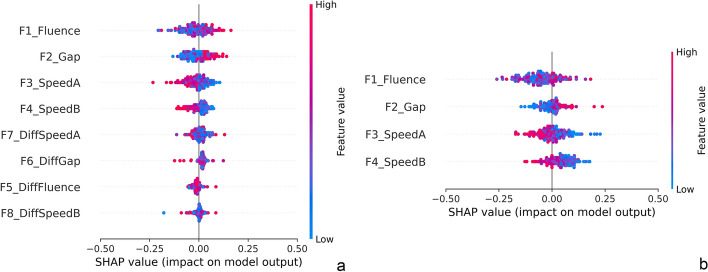
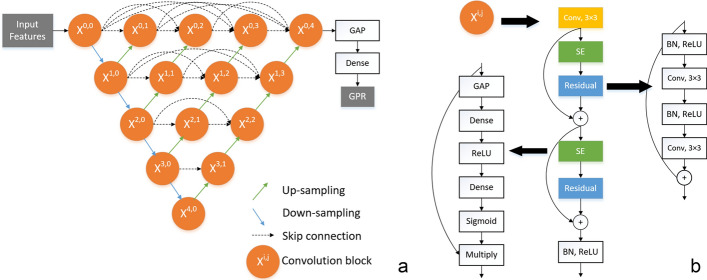
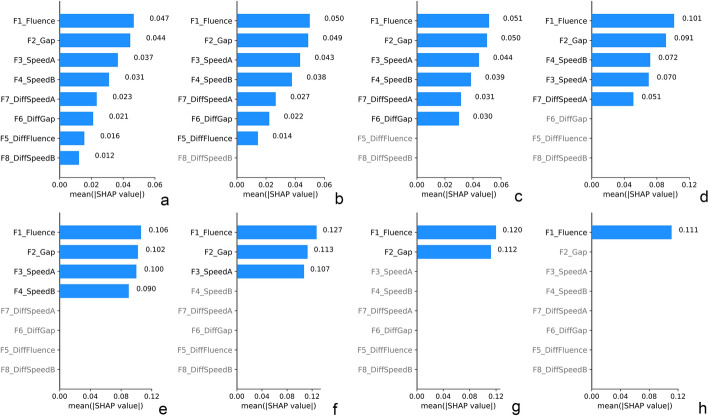
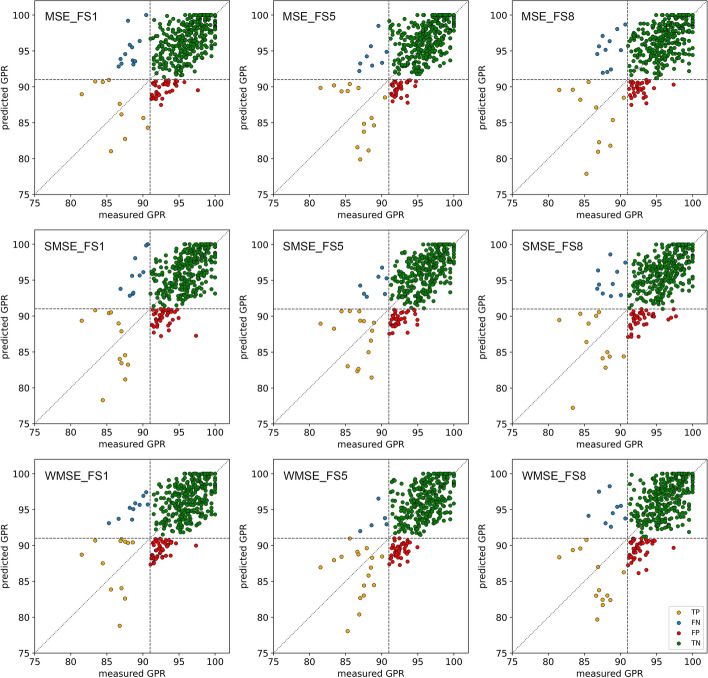
A total of 2348 fields from 204 IMRT plans for patients with nasopharyngeal carcinoma were retrospectively collected to form a dataset. Input feature maps, including fluence, leaf gap, leaf speed of both banks, and corresponding errors, were constructed from the dynamic log files. The SHAP framework was employed to compute the impact of each feature on the model output for recursive feature elimination. A series of UNet++ based models were trained on the obtained eight feature sets with three fine-tuning methods including the standard mean squared error (MSE) loss, a re-sampling technique, and a proposed weighted MSE loss (WMSE). Differences in mean absolute error, area under the receiver operating characteristic curve (AUC), sensitivity, and specificity were compared between the different models.
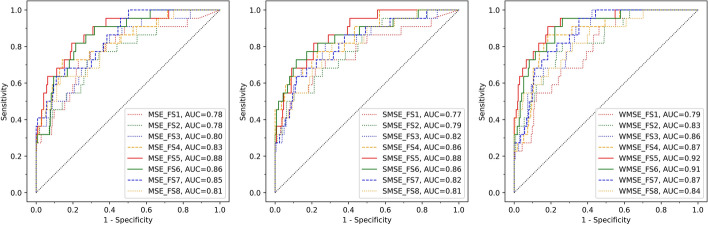
The models trained with feature sets including leaf speed and leaf gap features predicted GPR for failed fields more accurately than the other models (F(7, 147) = 5.378, p < 0.001). The WMSE loss had the highest accuracy in predicting GPR for failed fields among the three fine-tuning methods (F(2, 42) = 14.149, p < 0.001), while an opposite trend was observed in predicting GPR for passed fields (F(2, 730) = 9.907, p < 0.001). The WMSE_FS5 model achieved a superior AUC (0.92) and more balanced sensitivity (0.77) and specificity (0.89) compared to the other models.
Machine parameters can provide discriminative input features for GPR prediction in DL. The novel weighted loss function demonstrates the ability to balance the prediction and classification accuracy between the passed and failed fields. The proposed approach is able to improve the DL model performance in predicting and classifying GPR, and can potentially be integrated into the plan optimization process to generate higher deliverability plans.
This clinical trial was registered in the Chinese Clinical Trial Registry on March 26th, 2020 (registration number: ChiCTR2000031276). https://clinicaltrials.gov/ct2/show/ChiCTR2000031276.
本研究的目的是通过使用与机器参数相关的输入特征和类平衡技术,提高深度学习(DL)模型在预测和分类调强放疗伽马通过率(GPR)方面的性能。
回顾性收集了204例鼻咽癌患者调强放疗计划中的2348个射野,以形成一个数据集。根据动态日志文件构建输入特征图,包括注量、叶间距、双侧叶片速度及其相应误差。采用SHAP框架计算每个特征对模型输出的影响,以进行递归特征消除。基于一系列UNet++的模型在获得的八个特征集上进行训练,采用三种微调方法,包括标准均方误差(MSE)损失、重采样技术和提出的加权MSE损失(WMSE)。比较不同模型在平均绝对误差、受试者工作特征曲线下面积(AUC)、灵敏度和特异性方面的差异。
使用包括叶片速度和叶间距特征的特征集训练的模型,在预测失败射野的GPR方面比其他模型更准确(F(7, 147) = 5.378,p < 0.001)。在三种微调方法中,WMSE损失在预测失败射野的GPR方面具有最高的准确率(F(2, 42) = 14.149,p < 0.001),而在预测通过射野的GPR方面观察到相反的趋势(F(2, 730) = 9.907,p < 0.001)。与其他模型相比,WMSE_FS5模型实现了更高的AUC(0.92)以及更平衡的灵敏度(0.77)和特异性(0.89)。
机器参数可为DL中GPR的预测提供有区分性的输入特征。新型加权损失函数显示出能够平衡通过和失败射野之间的预测和分类准确率。所提出的方法能够提高DL模型在预测和分类GPR方面的性能,并有可能集成到计划优化过程中以生成更高可交付性的计划。
本临床试验于2020年3月26日在中国临床试验注册中心注册(注册号:ChiCTR2000031276)。https://clinicaltrials.gov/ct2/show/ChiCTR2000031276。