School of Biomedical Engineering, Southern Medical University, Guangzhou, 510515, China.
Department of Radiation Oncology, Sun Yat-sen University Cancer Center, State Key Laboratory of Oncology in South China, Collaborative Innovation Center for Cancer Medicine, Guangdong Key Laboratory of Nasopharyngeal Carcinoma Diagnosis and Therapy, Guangzhou, 510060, China.
Radiat Oncol. 2024 Mar 20;19(1):39. doi: 10.1186/s13014-024-02401-0.
At present, the implementation of intensity-modulated radiation therapy (IMRT) treatment planning for geometrically complex nasopharyngeal carcinoma (NPC) through manual trial-and-error fashion presents challenges to the improvement of planning efficiency and the obtaining of high-consistency plan quality. This paper aims to propose an automatic IMRT plan generation method through fluence prediction and further plan fine-tuning for patients with NPC and evaluates the planning efficiency and plan quality.
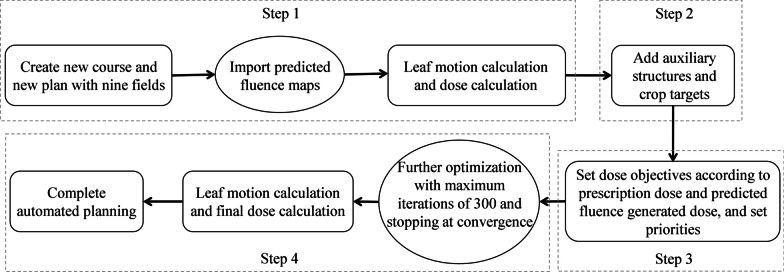
A total of 38 patients with NPC treated with nine-beam IMRT were enrolled in this study and automatically re-planned with the proposed method. A trained deep learning model was employed to generate static field fluence maps for each patient with 3D computed tomography images and structure contours as input. Automatic IMRT treatment planning was achieved by using its generated dose with slight tightening for further plan fine-tuning. Lastly, the plan quality was compared between automatic plans and clinical plans.
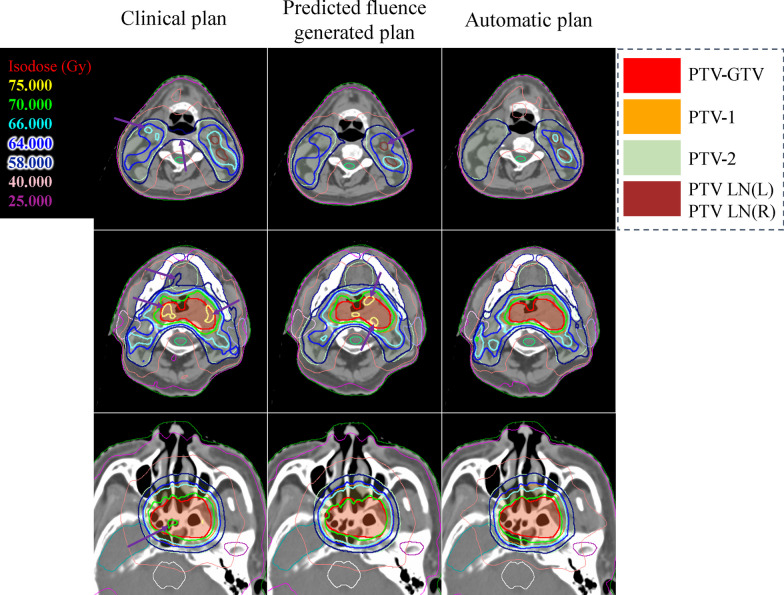
The average time for automatic plan generation was less than 4 min, including fluence maps prediction with a python script and automated plan tuning with a C# script. Compared with clinical plans, automatic plans showed better conformity and homogeneity for planning target volumes (PTVs) except for the conformity of PTV-1. Meanwhile, the dosimetric metrics for most organs at risk (OARs) were ameliorated in the automatic plan, especially D of the brainstem and spinal cord, and D of the left and right parotid glands significantly decreased (P < 0.05).
We have successfully implemented an automatic IMRT plan generation method for patients with NPC. This method shows high planning efficiency and comparable or superior plan quality than clinical plans. The qualitative results before and after the plan fine-tuning indicates that further optimization using dose objectives generated by predicted fluence maps is crucial to obtain high-quality automatic plans.
目前,通过手动反复试验的方式来执行几何形状复杂的鼻咽癌(NPC)的调强放射治疗(IMRT)治疗计划,这给提高计划效率和获得高一致性计划质量带来了挑战。本文旨在提出一种通过剂量预测和进一步的计划微调来为 NPC 患者生成自动 IMRT 计划的方法,并评估该方法的计划效率和计划质量。
本研究共纳入 38 例接受九野 IMRT 治疗的 NPC 患者,并使用所提出的方法对其进行自动重新计划。使用经过训练的深度学习模型,将每个患者的 3D 计算机断层扫描图像和结构轮廓作为输入,生成静态射束剂量图。通过使用其生成的剂量进行自动调强放射治疗计划,并对其进行轻微收紧,以进一步进行计划微调,从而实现自动 IMRT 治疗计划。最后,比较自动计划和临床计划的计划质量。
自动计划生成的平均时间不到 4 分钟,包括使用 Python 脚本预测剂量图和使用 C#脚本自动调整计划。与临床计划相比,自动计划在除 PTV-1 外的所有靶区(PTV)的适形性和均匀性方面表现更好。同时,大多数危及器官(OARs)的剂量学指标在自动计划中得到了改善,特别是脑干和脊髓的 D 值以及左右腮腺的 D 值明显降低(P<0.05)。
我们已经成功地为 NPC 患者实施了一种自动 IMRT 计划生成方法。该方法具有较高的计划效率,并且在计划质量方面与临床计划相当或更优。计划微调前后的定性结果表明,使用预测剂量图生成的剂量目标进行进一步优化对于获得高质量的自动计划至关重要。