Beaurenaut Morgan, Kovarski Klara, Destais Constance, Mennella Rocco, Grèzes Julie
Laboratoire sur les Interactions Cognition, Action, Émotion (LICAÉ), Université Paris Nanterre, 200 avenue de La République, Nanterre Cedex, 92001, France.
Sorbonne Université, INSPE, Paris, France.
Mol Autism. 2024 Jul 31;15(1):33. doi: 10.1186/s13229-024-00610-8.
Individuals with Autism Spectrum Condition (ASC) are characterized by atypicalities in social interactions, compared to Typically Developing individuals (TD). The social motivation theory posits that these difficulties stem from diminished anticipation, reception, and/or learning from social rewards. Although learning from socioemotional outcomes is core to the theory, studies to date have been sparse and inconsistent. This possibly arises from a combination of theoretical, methodological and sample-related issues. Here, we assessed participants' ability to develop a spontaneous preference for actions that lead to desirable socioemotional outcomes (approaching/avoiding of happy/angry individuals, respectively), in an ecologically valid social scenario. We expected that learning abilities would be impaired in ASC individuals, particularly in response to affiliative social feedback.
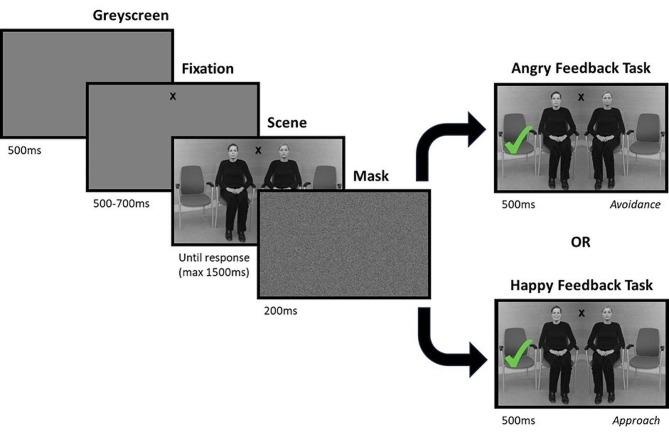
We ran an online social reinforcement learning task, on two large online cohorts with (n = 274) and without (n = 290) ASC, matched for gender, age and education. Participants had to indicate where they would sit in a waiting room. Each seat was associated with different probabilities of approaching/avoiding emotional individuals. Importantly, the task was implicit, as participants were not instructed to learn, and emotional expressions were never mentioned. We applied both categorical analyses contrasting the ASC and TD groups and dimensional factor analysis on affective questionnaires.
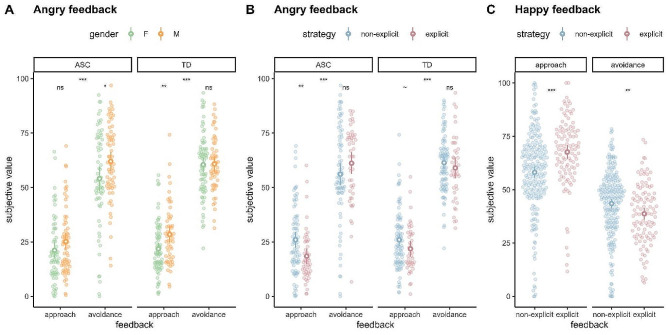
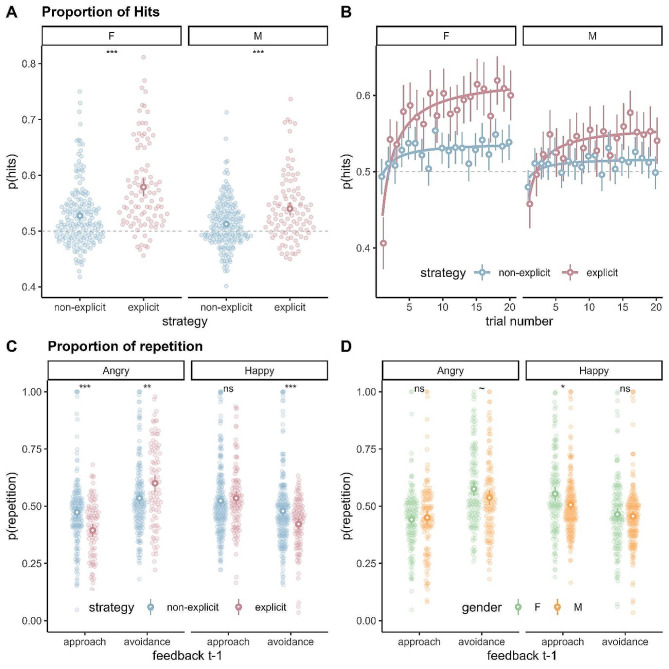
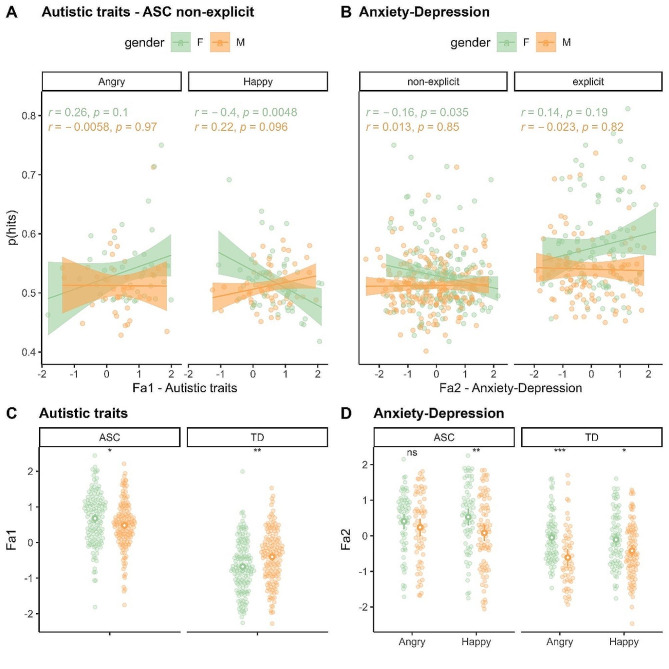
Contrary to our hypothesis, participants showed spontaneous learning from socioemotional outcomes, regardless of their diagnostic group. Yet, when accounting for dimensional variations in autistic traits, as well as depression and anxiety, two main findings emerged among females who failed to develop explicit learning strategies: (1) autism severity in ASC correlated with reduced learning to approach happy individuals; (2) anxiety-depression severity across both ASC and TD participants correlated with reduced learning to approach/avoid happy/angry individuals, respectively.
Implicit spontaneous learning from socioemotional outcomes is not generally impaired in autism but may be specifically associated with autism severity in females with ASC, when they do not have an explicit strategy for adapting to their social environment. Clinical diagnosis and intervention ought to take into account individual differences in their full complexity, including the presence of co-morbid anxiety and depression, when dealing with social atypicalities in autism.
与发育正常的个体(TD)相比,自闭症谱系障碍(ASC)个体的特点是社交互动存在异常。社会动机理论认为,这些困难源于对社会奖励的预期、接受和/或学习能力下降。尽管从社会情感结果中学习是该理论的核心,但迄今为止的研究稀少且不一致。这可能是由理论、方法和样本相关问题共同导致的。在此,我们在一个生态有效的社交场景中评估了参与者对导致理想社会情感结果的行为(分别是接近/回避快乐/愤怒的个体)形成自发偏好的能力。我们预计ASC个体的学习能力会受损,尤其是对亲和性社会反馈的反应。
我们在两个大型在线队列中进行了一项在线社会强化学习任务,一个队列有ASC个体(n = 274),另一个队列没有ASC个体(n = 290),两个队列在性别、年龄和教育程度上相匹配。参与者必须指出他们会在候诊室坐在哪里。每个座位与接近/回避情绪激动个体的不同概率相关联。重要的是,该任务是隐性的,因为没有指示参与者去学习,并且从未提及情绪表达。我们既应用了对比ASC组和TD组的分类分析,也对情感问卷进行了维度因素分析。
与我们的假设相反,无论诊断组如何,参与者都表现出从社会情感结果中进行自发学习。然而,在考虑自闭症特征以及抑郁和焦虑的维度变化时,在未能制定明确学习策略的女性中出现了两个主要发现:(1)ASC中的自闭症严重程度与接近快乐个体的学习减少相关;(2)ASC和TD参与者中的焦虑 - 抑郁严重程度分别与接近/回避快乐/愤怒个体的学习减少相关。
在自闭症中,从社会情感结果中进行隐性自发学习一般不会受损,但当患有ASC的女性没有适应其社会环境的明确策略时,可能与自闭症严重程度特别相关。在处理自闭症中的社会异常时,临床诊断和干预应该充分考虑个体差异的复杂性,包括共病焦虑和抑郁的存在。